Is That Picture AI? Google’s SynthID Detector Launches to Identify AI-Generated Media
Google has made its SynthID Detector publicly available, allowing users to upload images, audio, and video to check for signs of AI manipulation. The tool currently identifies content generated or edited by Google, OpenAI, Nvidia, and Kakao, with Apple support expected soon. While the detector successfully identifies tagged media from various platforms, it is not foolproof and relies on specific metadata tags rather than analyzing visual artifacts alone.
- ▪Google's SynthID Detector is now accessible to anyone with a Google, Apple, or ChatGPT account for verifying media authenticity.
- ▪The tool currently detects SynthID tags in media generated by Google, OpenAI, Nvidia, and Kakao, but Apple support is not yet officially listed.
- ▪Testing showed that the detector can identify AI edits on iPhone 18 Pro images using Apple's Reframe tool, but failed to flag images generated by Apple's Playground app.
- ▪Google uses a two-pronged approach on Pixel devices involving C2PA metadata for original captures and SynthID tags for AI edits, whereas Apple uses its own Reference Image technology.
- ▪Google emphasizes that cross-company collaboration is necessary to effectively identify AI-generated content, as no single entity can solve the problem independently.
CNET — News files mainly under tech. We currently carry 243 of its stories.
Story provenance
Source · retrieval · rights · ranking — open for full record
inspect →
Story provenance
Attribution is not the same as permission. This drawer separates discovery metadata, excerpts, WeSearch-generated summaries, reuse status, and whether the publisher receives the visit. Nothing here claims a legal grant the publisher has not made.
Record
| Original publisher | CNET — News |
| Canonical URL | https://www.cnet.com/tech/services-and-software/google-synthid-detector-launches/ |
| Publication time | 2026-10-08T09:33:53Z |
| Retrieval time | 2026-10-08T09:35:48.626Z |
| Last seen | 2026-10-08T09:35:48.626Z |
| Headline source | Publisher (no WeSearch rewrite) |
| Excerpt source | publisher body |
| Excerpt method | First ~120 words (~800 chars) of extracted publisher body, fair-use limited. |
| Summary | WeSearch · cerebras-chat (WeSearch summarizer) |
| Summary source text | contentText |
| Citation coverage | Summary is a WeSearch-generated derivative; primary citation is the original publisher URL. |
| Cluster | -UQq-5PhZWi2 · 1 stories |
| Cluster logic | Grouped by semantic title/content similarity across sources within a rolling window. Same-publisher template collisions are excluded from coverage comparison. |
| Ranking reason | Story pages are not engagement-ranked. Hub feeds use recency, with optional source-diversified chronological ordering (cap consecutive stories per source). No personalized ranking. |
| Publisher visit | Yes — open original |
| Substitutes article? | No — link-out required for full text |
Rights status (four layers)
WeSearch handling by dimension
| Indexing | May the item be indexed (stored, ranked, made findable)? | Allowed |
| Snippet | May a short excerpt of the publisher's text be shown? | Allowed |
| AI summary | May WeSearch generate its own short summary of the article? | Limited |
| Retrieval / RAG | May the content be exposed for third-party retrieval-augmented generation? | Not asserted |
| Model training | May the content be used to train AI models? | Not asserted |
| Commercial reuse | May the content be reused commercially? | Not permitted |
Basis: Derived from the published RSS/Atom feed. Contact: [email protected]. Reviewed: 2026-07-24.
Opening excerpt (first ~120 words) tap to expand
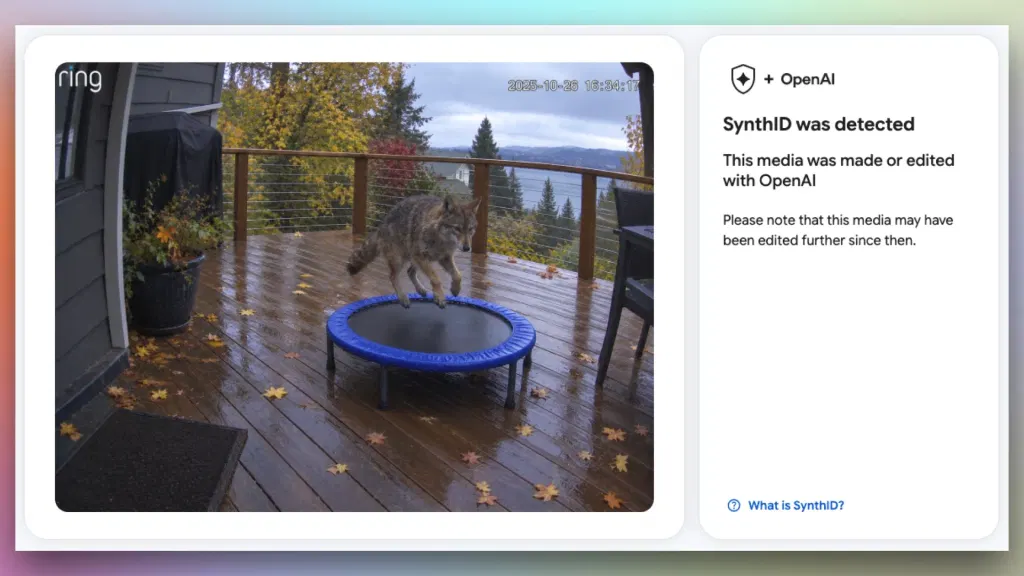
Tech > Services & Software > AI Is That Picture AI? Google’s SynthID Detector Launches to Identify AI-Generated Media Anyone can now upload a suspicious image to Google’s online tool, but it’s not a foolproof way to check for authenticity. Jeff Carlson Senior Writer Jeff Carlson writes about mobile technology at CNET, from cellular phone plans to devices and emerging technology. Jeff Carlson Senior Writer Read full bio Edited by Gael Cooper October 8, 2026, 5:33 am ET 3 min read Google's SynthID Detector determined that this image of a coyote jumping on a trampoline is, in fact, not genuine. Screenshot by Jeff Carlson/CNET AI slop is getting so good that it’s not always easy to distinguish a photorealistic forgery from a real photo.
…
Excerpt limited to ~120 words for fair-use compliance. The full article is at CNET — News.
Discussion
0 commentsMore from CNET — News