Keep That Old Radio Alive With An ESP32
A hobbyist has created a small AM transmitter using an ESP32-S3 microcontroller to keep vintage tube radios functional as legacy broadcast bands disappear. The device takes an online radio stream and transmits it via RF signals generated from a GPIO pin, utilizing a 3D-printed enclosure with a wire coil for radiation. While the project may have legal implications, the low power output is considered unlikely to cause significant interference.
- ▪The project uses an ESP32-S3 to convert online radio streams into AM broadcast signals.
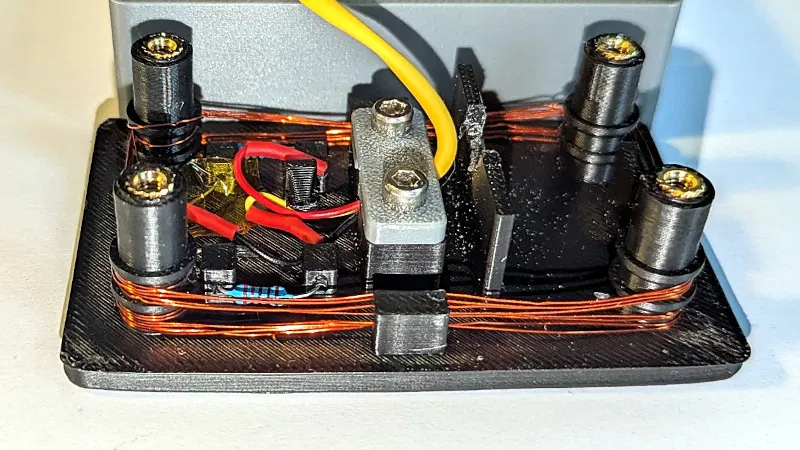
- ▪A 3D-printed box with a widely spaced wire coil is used to radiate the signal effectively.
- ▪The transmitter currently outputs on the 200kHz European long wave band.
- ▪The creator acknowledges potential legality issues but notes the low power makes detection unlikely.
Hackaday files mainly under tech. We currently carry 551 of its stories.
Story provenance
Source · retrieval · rights · ranking — open for full record
inspect →
Story provenance
Attribution is not the same as permission. This drawer separates discovery metadata, excerpts, WeSearch-generated summaries, reuse status, and whether the publisher receives the visit. Nothing here claims a legal grant the publisher has not made.
Record
| Original publisher | Hackaday |
| Canonical URL | https://hackaday.com/2026/10/07/keep-that-old-radio-alive-with-an-esp32/ |
| Publication time | Thu, 08 Oct 2026 02:00:32 +0000 |
| Retrieval time | 2026-10-08T02:03:19.924Z |
| Last seen | 2026-10-08T02:03:19.924Z |
| Headline source | Publisher (no WeSearch rewrite) |
| Excerpt source | publisher body |
| Excerpt method | First ~120 words (~800 chars) of extracted publisher body, fair-use limited. |
| Summary | WeSearch · cerebras-chat (WeSearch summarizer) |
| Summary source text | contentText |
| Citation coverage | Summary is a WeSearch-generated derivative; primary citation is the original publisher URL. |
| Cluster | SGFbL4-Fw5n9 · 1 stories |
| Cluster logic | Grouped by semantic title/content similarity across sources within a rolling window. Same-publisher template collisions are excluded from coverage comparison. |
| Ranking reason | Story pages are not engagement-ranked. Hub feeds use recency, with optional source-diversified chronological ordering (cap consecutive stories per source). No personalized ranking. |
| Publisher visit | Yes — open original |
| Substitutes article? | No — link-out required for full text |
Rights status (four layers)
WeSearch handling by dimension
| Indexing | May the item be indexed (stored, ranked, made findable)? | Allowed |
| Snippet | May a short excerpt of the publisher's text be shown? | Allowed |
| AI summary | May WeSearch generate its own short summary of the article? | Limited |
| Retrieval / RAG | May the content be exposed for third-party retrieval-augmented generation? | Not asserted |
| Model training | May the content be used to train AI models? | Not asserted |
| Commercial reuse | May the content be reused commercially? | Not permitted |
Basis: Derived from the published RSS/Atom feed. Contact: [email protected]. Reviewed: 2026-07-24.
Opening excerpt (first ~120 words) tap to expand
Keep That Old Radio Alive With An ESP32 No comments by: Jenny List October 7, 2026 Title: Copy Short Link: Copy As the legacy AM broadcast bands fade away, what happens to the millions of devices built to receive them? Many of them will go into e-waste, but with a century of radios to choose from, some of them are collector’s items. Vintage tube radios like the ones [GarethDaviesLondon] has would go silent, so he’s made a small AM transmitter to keep them alive. At its heart is an ESP32-S3, which takes an online radio stream and transmits it through RF generated with a pulse chain on a GPIO. Generating analogue signals from radio to video with a microcontroller is nothing new, but perhaps the more interesting part of this one comes in how he radiates enough from that pin.
…
Excerpt limited to ~120 words for fair-use compliance. The full article is at Hackaday.
Discussion
0 commentsMore from Hackaday