LensVLM-9B by Apple
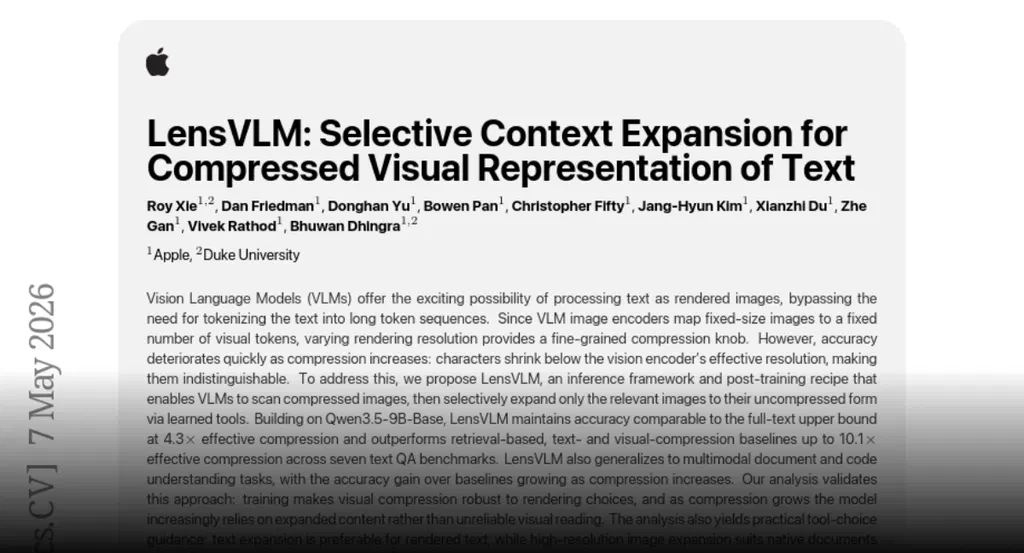
Generated by Qwen/Qwen2.5-Coder-32B-Instruct Vision Language Models (VLMs) offer the exciting possibility of processing text as rendered images, bypassing the need for tokenizing the text into long token sequences. Since VLM image encoders map fixed-size images to a fixed number of visual tokens, varying rendering resolution provides a fine-grained compression knob. However, accuracy deteriorates quickly as compression increases: characters shrink below the vision encoder's effective resolution, making them indistinguishable.
- ▪Generated by Qwen/Qwen2.5-Coder-32B-Instruct Vision Language Models (VLMs) offer the exciting possibility of processing text as rendered images, bypassing the need for tokenizing the text into long token sequences.
- ▪Since VLM image encoders map fixed-size images to a fixed number of visual tokens, varying rendering resolution provides a fine-grained compression knob.
- ▪However, accuracy deteriorates quickly as compression increases: characters shrink below the vision encoder's effective resolution, making them indistinguishable.
Hacker News (Front Page) files mainly under programming. We currently carry 2,065 of its stories. Top-voted stories on Hacker News.
Story provenance
Source · retrieval · rights · ranking — open for full record
inspect →
Story provenance
Attribution is not the same as permission. This drawer separates discovery metadata, excerpts, WeSearch-generated summaries, reuse status, and whether the publisher receives the visit. Nothing here claims a legal grant the publisher has not made.
Record
| Original publisher | Huggingface |
| Canonical URL | https://huggingface.co/papers/2605.07019 |
| Publication time | Wed, 23 Sep 2026 20:35:20 +0000 |
| Retrieval time | 2026-09-23T21:09:35.143Z |
| Last seen | 2026-09-23T21:09:35.143Z |
| Headline source | Publisher (no WeSearch rewrite) |
| Excerpt source | publisher body |
| Excerpt method | First ~120 words (~800 chars) of extracted publisher body, fair-use limited. |
| Summary | WeSearch · cerebras-chat (WeSearch summarizer) |
| Summary source text | contentText |
| Citation coverage | Summary is a WeSearch-generated derivative; primary citation is the original publisher URL. |
| Cluster | None |
| Cluster logic | Not yet clustered, or no peer story found in the clustering window. |
| Ranking reason | Story pages are not engagement-ranked. Hub feeds use recency, with optional source-diversified chronological ordering (cap consecutive stories per source). No personalized ranking. |
| Publisher visit | Yes — open original |
| Substitutes article? | No — link-out required for full text |
Rights status (four layers)
WeSearch handling by dimension
| Indexing | May the item be indexed (stored, ranked, made findable)? | Allowed |
| Snippet | May a short excerpt of the publisher's text be shown? | Allowed |
| AI summary | May WeSearch generate its own short summary of the article? | Limited |
| Retrieval / RAG | May the content be exposed for third-party retrieval-augmented generation? | Not asserted |
| Model training | May the content be used to train AI models? | Not asserted |
| Commercial reuse | May the content be reused commercially? | Not permitted |
Basis: Derived from the published RSS/Atom feed. Contact: [email protected]. Reviewed: 2026-07-24.
Opening excerpt (first ~120 words) tap to expand
Papers arxiv:2605.07019 Copy markdown LensVLM: Selective Context Expansion for Compressed Visual Representation of Text Published on May 7 Upvote 3 Authors: Roy Xie ,Dan Friedman ,Donghan Yu ,Bowen Pan ,Christopher Fifty ,Jang-Hyun Kim ,Xianzhi Du ,Zhe Gan ,Vivek Rathod ,Bhuwan Dhingra Abstract Vision-Language Models can process text as rendered images, but accuracy degrades with compression; LensVLM addresses this by scanning compressed images and selectively expanding relevant parts through learned tools, maintaining high accuracy even at high compression ratios. Generated by Qwen/Qwen2.5-Coder-32B-Instruct Vision Language Models (VLMs) offer the exciting possibility of processing text as rendered images, bypassing the need for tokenizing the text into long token sequences.
…
Excerpt limited to ~120 words for fair-use compliance. The full article is at Huggingface.
Discussion
0 commentsMore from Huggingface