Lessons from Reducing My Coding Agent's LLM API Costs
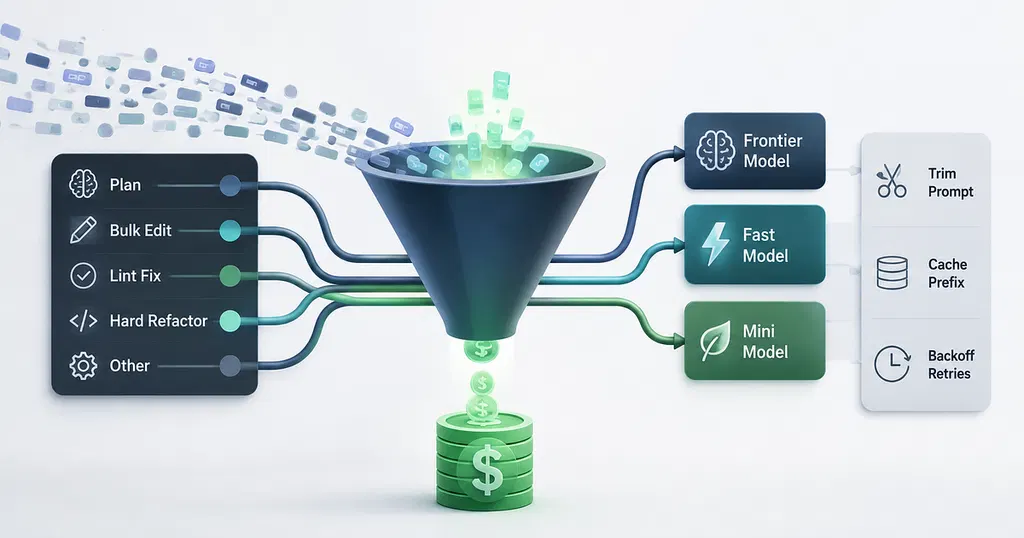
The article discusses how the author reduced their LLM API costs by optimizing their architecture. They started by instrumenting their spending to understand where the costs were coming from, and then made changes such as attributing every token to a workflow step and routing each step to the right model tier. By making these changes, the author was able to significantly reduce their costs.
- ▪The author's LLM bill was high due to inefficient architecture, not just expensive models.
- ▪Instrumenting spending and attributing every token to a workflow step was crucial for optimization.
- ▪Routing each workflow step to the right model tier, rather than defaulting to a frontier model, led to significant cost savings.
Hacker News (AI / LLM) files mainly under ai. We currently carry 4,141 of its stories.
Story provenance
Source · retrieval · rights · ranking — open for full record
inspect →
Story provenance
Attribution is not the same as permission. This drawer separates discovery metadata, excerpts, WeSearch-generated summaries, reuse status, and whether the publisher receives the visit. Nothing here claims a legal grant the publisher has not made.
Record
| Original publisher | Medium |
| Canonical URL | https://medium.com/@chuanweipeng5/where-my-llm-api-bill-actually-went-and-how-i-cut-it-f10158329c5c |
| Publication time | Sun, 09 Aug 2026 07:20:41 +0000 |
| Retrieval time | 2026-08-09T07:35:42.031Z |
| Last seen | 2026-08-09T07:35:42.031Z |
| Headline source | Publisher (no WeSearch rewrite) |
| Excerpt source | publisher body |
| Excerpt method | First ~120 words (~800 chars) of extracted publisher body, fair-use limited. |
| Summary | WeSearch · cerebras-chat (WeSearch summarizer) |
| Summary source text | contentText |
| Citation coverage | Summary is a WeSearch-generated derivative; primary citation is the original publisher URL. |
| Cluster | yDkvErF6b9ev · 1 stories |
| Cluster logic | Grouped by semantic title/content similarity across sources within a rolling window. Same-publisher template collisions are excluded from coverage comparison. |
| Ranking reason | Story pages are not engagement-ranked. Hub feeds use recency, with optional source-diversified chronological ordering (cap consecutive stories per source). No personalized ranking. |
| Publisher visit | Yes — open original |
| Substitutes article? | No — link-out required for full text |
Rights status (four layers)
WeSearch handling by dimension
| Indexing | May the item be indexed (stored, ranked, made findable)? | Allowed |
| Snippet | May a short excerpt of the publisher's text be shown? | Allowed |
| AI summary | May WeSearch generate its own short summary of the article? | Limited |
| Retrieval / RAG | May the content be exposed for third-party retrieval-augmented generation? | Not asserted |
| Model training | May the content be used to train AI models? | Not asserted |
| Commercial reuse | May the content be reused commercially? | Not permitted |
Basis: Derived from the published RSS/Atom feed. Contact: [email protected]. Reviewed: 2026-07-24.
Opening excerpt (first ~120 words) tap to expand
Artificial IntelligenceLarge Language ModelsSoftware EngineeringLlmopsWhere My LLM API Bill Actually Went — and How I Cut ItA practical breakdown of the architecture changes that reduced my coding-agent costs.Colin Peng8 min read·1 day ago--1ListenSharePress enter or click to view image in full sizeMy LLM bill was not high simply because the models were expensive. It was high because I was:Sending the same 1,800-token system prompt on every callRetrying failures immediately, without backoffDefaulting every workflow step to a frontier model, whether it needed one or notIn my workload, I estimated that headline price per token explained roughly 20% of the problem. My own architecture explained the other 80%.That split is specific to my system, not a universal benchmark.
…
Excerpt limited to ~120 words for fair-use compliance. The full article is at Medium.
Discussion
0 commentsMore from Medium