Local AI Models: The Catalyst for the Great Reset
The article argues that the current AI industry is facing a severe compute crisis due to GPU scarcity and the limitations of cloud-based infrastructure. It proposes that transitioning to decentralized, local AI models is the necessary solution to overcome these physical resource constraints and end the current technology cycle. The author highlights that recent advances in efficient model architectures, particularly from Chinese developers, have made local inference viable for the majority of common AI tasks.
- ▪GPU contracts now require 3-5 year commitments, making them unaffordable for most startups and exacerbating the compute crisis.
- ▪Local AI models can already handle 89% of general chat and reasoning queries as of early 2026.
- ▪Mixture of Experts (MoE) models are more suitable for consumer hardware because they activate fewer parameters per token, reducing memory bandwidth requirements.
- ▪Chinese open-weight models have recently made significant architectural advances that allow them to compete with proprietary models in coding and agentic workflows.
Hacker News (AI / LLM) files mainly under ai. We currently carry 6,982 of its stories.
Story provenance
Source · retrieval · rights · ranking — open for full record
inspect →
Story provenance
Attribution is not the same as permission. This drawer separates discovery metadata, excerpts, WeSearch-generated summaries, reuse status, and whether the publisher receives the visit. Nothing here claims a legal grant the publisher has not made.
Record
| Original publisher | Medium |
| Canonical URL | https://breadcrumb.vc/local-ai-models-the-catalyst-for-the-great-reset-2b93ece0687e |
| Publication time | Wed, 30 Sep 2026 11:19:10 +0000 |
| Retrieval time | 2026-09-30T11:22:01.560Z |
| Last seen | 2026-09-30T11:22:01.560Z |
| Headline source | Publisher (no WeSearch rewrite) |
| Excerpt source | publisher body |
| Excerpt method | First ~120 words (~800 chars) of extracted publisher body, fair-use limited. |
| Summary | WeSearch · cerebras-chat (WeSearch summarizer) |
| Summary source text | contentText |
| Citation coverage | Summary is a WeSearch-generated derivative; primary citation is the original publisher URL. |
| Cluster | SvqR7HJnQsMW · 1 stories |
| Cluster logic | Grouped by semantic title/content similarity across sources within a rolling window. Same-publisher template collisions are excluded from coverage comparison. |
| Ranking reason | Story pages are not engagement-ranked. Hub feeds use recency, with optional source-diversified chronological ordering (cap consecutive stories per source). No personalized ranking. |
| Publisher visit | Yes — open original |
| Substitutes article? | No — link-out required for full text |
Rights status (four layers)
WeSearch handling by dimension
| Indexing | May the item be indexed (stored, ranked, made findable)? | Allowed |
| Snippet | May a short excerpt of the publisher's text be shown? | Allowed |
| AI summary | May WeSearch generate its own short summary of the article? | Limited |
| Retrieval / RAG | May the content be exposed for third-party retrieval-augmented generation? | Not asserted |
| Model training | May the content be used to train AI models? | Not asserted |
| Commercial reuse | May the content be reused commercially? | Not permitted |
Basis: Derived from the published RSS/Atom feed. Contact: [email protected]. Reviewed: 2026-07-24.
Opening excerpt (first ~120 words) tap to expand
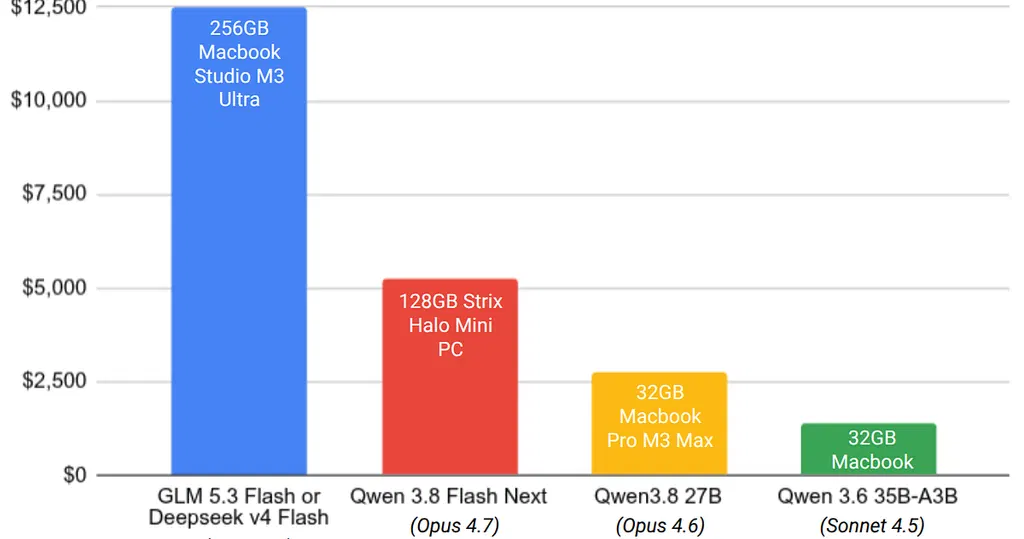
AITechnologyStartupBusinessRoboticsLocal AI Models: The Catalyst for the Great ResetLocal inference is the only solution to the compute crisis — transitioning to a decentralized architecture will end the focus on the “application layer" and spark the next technology cycleSameer Singh11 min read·1 day ago--ListenSharePress enter or click to view image in full sizeRough hardware cost to run leading open-weight models locally, as of September 2026We are in a compute crisis. What began as a memory crunch has snowballed into a full-blown scarcity of (plugged in) GPUs. GPU contracts now require 3–5 year committments, which most startups cannot afford. I have been tracking this all year, both on my blog and my newsletter.
…
Excerpt limited to ~120 words for fair-use compliance. The full article is at Medium.
Discussion
0 commentsMore from Medium