Lost in Translation: How AI Exposes the Rift Between Law and Logic
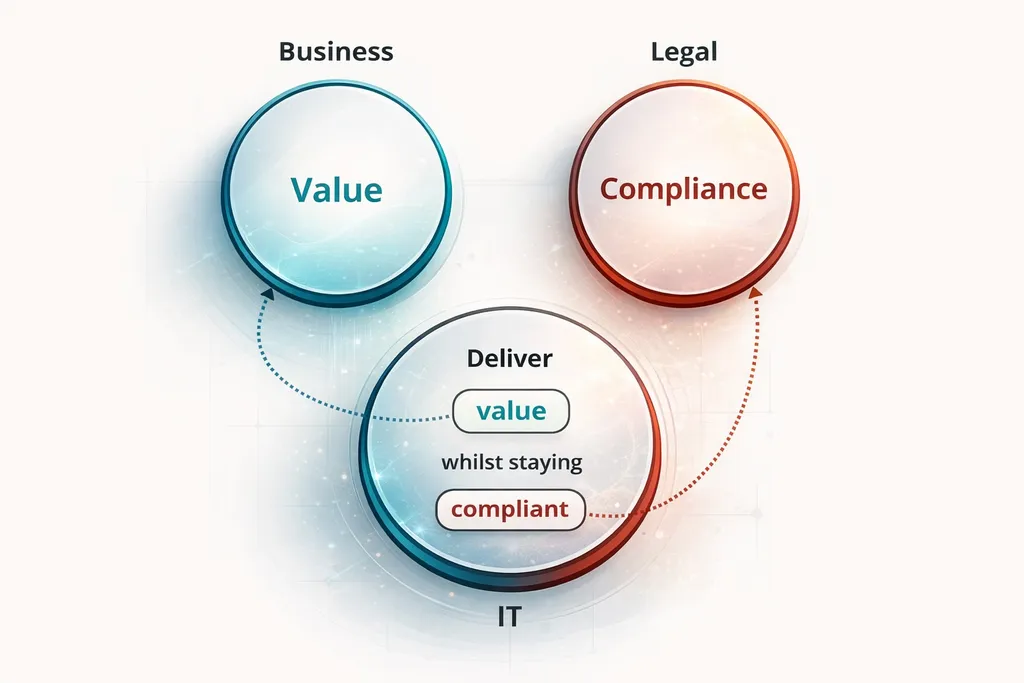
The article discusses the growing disconnect between legal and IT teams as AI technology advances. It highlights the challenges of aligning legal intent with IT requirements, especially in the context of compliance and data usage. The piece proposes a framework for translating legal principles into machine-readable formats to bridge this gap.
- ▪The tension between legal and IT teams has been exacerbated by the rise of AI and the introduction of GDPR rules.
- ▪Legal professionals operate with a focus on risk mitigation and defensibility, while IT requires specificity and deterministic controls.
- ▪The increasing volume and velocity of AI-driven data usage threaten traditional compliance models, making manual oversight impractical.
Towards Data Science files mainly under ai. We currently carry 96 of its stories.
Story provenance
Source · retrieval · rights · ranking — open for full record
inspect →
Story provenance
Attribution is not the same as permission. This drawer separates discovery metadata, excerpts, WeSearch-generated summaries, reuse status, and whether the publisher receives the visit. Nothing here claims a legal grant the publisher has not made.
Record
| Original publisher | Towards Data Science |
| Canonical URL | https://towardsdatascience.com/lost-in-translation-how-ai-exposes-the-rift-between-lw-and-logic/ |
| Publication time | Fri, 22 May 2026 12:00:00 +0000 |
| Retrieval time | 2026-05-22T12:07:01.630Z |
| Last seen | 2026-05-22T12:07:01.630Z |
| Headline source | Publisher (no WeSearch rewrite) |
| Excerpt source | publisher body |
| Excerpt method | First ~120 words (~800 chars) of extracted publisher body, fair-use limited. |
| Summary | WeSearch · cerebras-chat (WeSearch summarizer) |
| Summary source text | contentText |
| Citation coverage | Summary is a WeSearch-generated derivative; primary citation is the original publisher URL. |
| Cluster | 9m9Ksj0HVjRw |
| Cluster logic | Grouped by semantic title/content similarity across sources within a rolling window. Same-publisher template collisions are excluded from coverage comparison. |
| Ranking reason | Story pages are not engagement-ranked. Hub feeds use recency, with optional source-diversified chronological ordering (cap consecutive stories per source). No personalized ranking. |
| Publisher visit | Yes — open original |
| Substitutes article? | No — link-out required for full text |
Rights status (four layers)
WeSearch handling by dimension
| Indexing | May the item be indexed (stored, ranked, made findable)? | Allowed |
| Snippet | May a short excerpt of the publisher's text be shown? | Allowed |
| AI summary | May WeSearch generate its own short summary of the article? | Limited |
| Retrieval / RAG | May the content be exposed for third-party retrieval-augmented generation? | Not asserted |
| Model training | May the content be used to train AI models? | Not asserted |
| Commercial reuse | May the content be reused commercially? | Not permitted |
Basis: Derived from the published RSS/Atom feed. Contact: [email protected]. Reviewed: 2026-07-24.
Opening excerpt (first ~120 words) tap to expand
Artificial Intelligence Lost in Translation: How AI Exposes the Rift Between Law and Logic The tension between Legal and IT has always been frustrating but AI is about to make it worse, at scale. The answer is observable compliance: encoding legal intent directly into architecture. Corné POTGIETER May 22, 2026 20 min read Share Image generated with ChatGPT Over the last few years, I have sat in multiple meetings with IT and legal teams where the intent and motivation is visibly misaligned. It often feels like two completely different worlds trying to reach agreement under pressure. As one colleague once described it to me: “Legal writes for humans, IT builds for machines.” Law allows interpretation, context, and mitigation, while IT depends on logic and deterministic workflows.
…
Excerpt limited to ~120 words for fair-use compliance. The full article is at Towards Data Science.
Discussion
0 commentsMore from Towards Data Science