
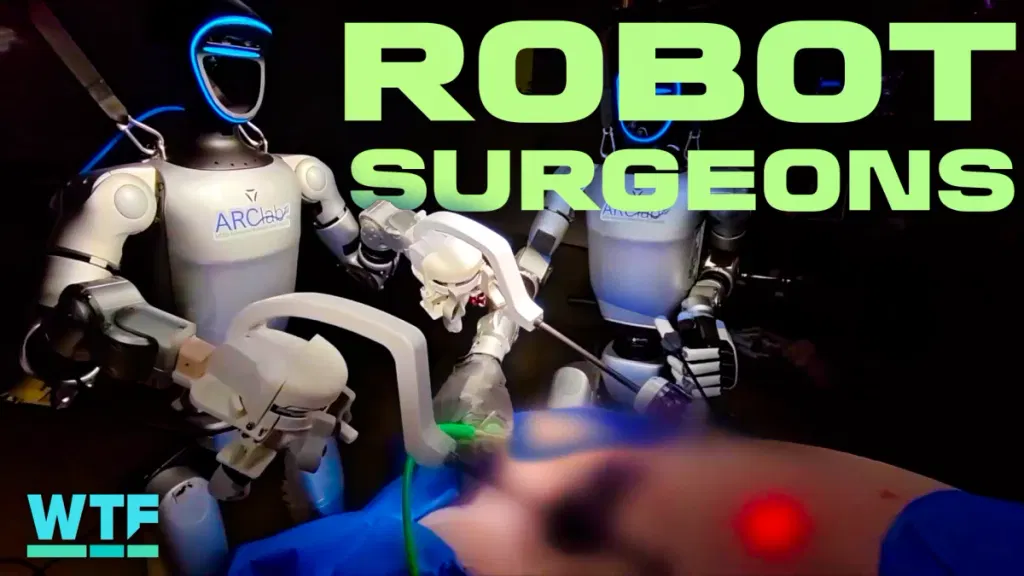
Meet the first ever humanoid robot surgeon
Researchers at UCSD's Center for the Future of Surgery have conducted the first live surgery using humanoid robots. The procedure involved a teleoperation setup to address the need for remote surgical capabilities. The team highlighted challenges such as thermal management and the potential for future AI autonomy in medical procedures.
- ▪The first live surgery using humanoid robots was performed at UCSD's Center for the Future of Surgery.
- ▪The surgery utilized a teleoperation setup to allow for remote control of the robotic systems.
- ▪Live animal surgeries are considered necessary for testing the performance and safety of these robotic systems.
- ▪Key technical challenges identified include thermal management issues and the adaptation of humanoid robots for surgical precision.
- ▪The research aims to explore the potential for AI autonomy in future surgical applications.
Mashable files mainly under tech. We currently carry 2,787 of its stories.
Story provenance
Source · retrieval · rights · ranking — open for full record
inspect →
Story provenance
Attribution is not the same as permission. This drawer separates discovery metadata, excerpts, WeSearch-generated summaries, reuse status, and whether the publisher receives the visit. Nothing here claims a legal grant the publisher has not made.
Record
| Original publisher | Mashable |
| Canonical URL | https://mashable.com/science/first-humanoid-robot-surgeon-live-surgery |
| Publication time | Mon, 05 Oct 2026 18:58:12 +0000 |
| Retrieval time | 2026-10-05T19:56:28.833Z |
| Last seen | 2026-10-05T19:56:43.170Z |
| Headline source | Publisher (no WeSearch rewrite) |
| Excerpt source | publisher body |
| Excerpt method | First ~120 words (~800 chars) of extracted publisher body, fair-use limited. |
| Summary | WeSearch · cerebras-chat (WeSearch summarizer) |
| Summary source text | contentText |
| Citation coverage | Summary is a WeSearch-generated derivative; primary citation is the original publisher URL. |
| Cluster | ItSzPpwIoyT6 · 1 stories |
| Cluster logic | Grouped by semantic title/content similarity across sources within a rolling window. Same-publisher template collisions are excluded from coverage comparison. |
| Ranking reason | Story pages are not engagement-ranked. Hub feeds use recency, with optional source-diversified chronological ordering (cap consecutive stories per source). No personalized ranking. |
| Publisher visit | Yes — open original |
| Substitutes article? | No — link-out required for full text |
Rights status (four layers)
WeSearch handling by dimension
| Indexing | May the item be indexed (stored, ranked, made findable)? | Allowed |
| Snippet | May a short excerpt of the publisher's text be shown? | Allowed |
| AI summary | May WeSearch generate its own short summary of the article? | Limited |
| Retrieval / RAG | May the content be exposed for third-party retrieval-augmented generation? | Not asserted |
| Model training | May the content be used to train AI models? | Not asserted |
| Commercial reuse | May the content be reused commercially? | Not permitted |
Basis: Derived from the published RSS/Atom feed. Contact: [email protected]. Reviewed: 2026-07-24.
Opening excerpt (first ~120 words) tap to expand
We visited UCSD's Center for the Future of Surgery to learn about the first ever live surgery using humanoid robots.Read more about AI in health care: ChatGPT Health is now available to all usersAI is changing health: Here's what you should knowTimecode chapters0:00 Introduction: Humanoid robots in surgery0:35 The need for remote and robotic surgery0:59 Challenges of adapting humanoid robots1:21 Testing the teleoperation setup2:18 Why live animal surgeries are necessary3:00 Performance and thermal management issues3:32 Potential for AI autonomy in surgery3:59 Key challenges and future outlook Related Stories Humanoid robots just removed a gallbladder in a live surgery Hyundai's Atlas robot debuts on the biggest stage of all: The World Cup Watch these defunct humanoid robots go full…
Excerpt limited to ~120 words for fair-use compliance. The full article is at Mashable.
Discussion
0 commentsMore from Mashable


