NASA Backs Wild Plan for a Laser-Powered Drone to Explore Giant Caves Below the Moon’s Surface
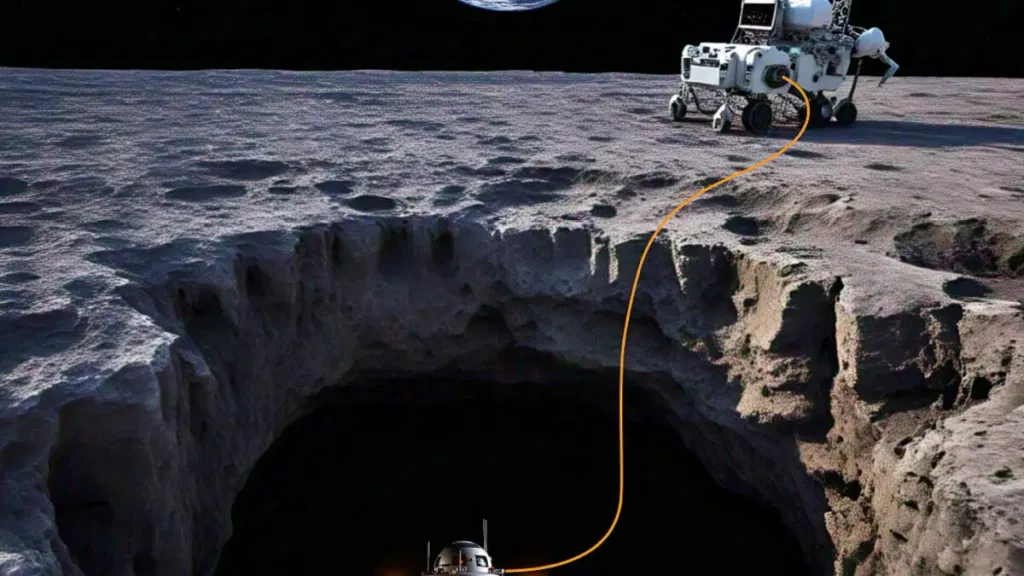
Just under the surface of the Moon, subterranean caverns stretch out thousands of feet (hundreds of meters) in diameter—some as much as 1,000 times more vast than similar lava tubes carved out by volcanic activity here on Earth. The U.S. space agency announced that it will fund research by Austin-based Stone Aerospace, Inc. to develop a tethered lunar-spelunking drone—powered via laser light that will be beamed through a system of fiber optic cables conjoining it to a lunar rover on the Moon’s surface. As part of the proposed Lunar Underground eXplorer (LUX) mission, Stone Aerospace’s hovering robotic explorer will descend into the Mare Tranquillitatis lunar skylight, a yawning chasm about the size of two football fields roughly 250 miles (400 kilometers) away from where Apollo 11 landed.
- ▪Just under the surface of the Moon, subterranean caverns stretch out thousands of feet (hundreds of meters) in diameter—some as much as 1,000 times more vast than similar lava tubes carved out by volcanic activity here on Earth.
- ▪The U.S. space agency announced that it will fund research by Austin-based Stone Aerospace, Inc. to develop a tethered lunar-spelunking drone—powered via laser light that will be beamed through a system of fiber optic cables conjoining it t
- ▪As part of the proposed Lunar Underground eXplorer (LUX) mission, Stone Aerospace’s hovering robotic explorer will descend into the Mare Tranquillitatis lunar skylight, a yawning chasm about the size of two football fields roughly 250 miles
Gizmodo files mainly under tech. We currently carry 749 of its stories.
Story provenance
Source · retrieval · rights · ranking — open for full record
inspect →
Story provenance
Attribution is not the same as permission. This drawer separates discovery metadata, excerpts, WeSearch-generated summaries, reuse status, and whether the publisher receives the visit. Nothing here claims a legal grant the publisher has not made.
Record
| Original publisher | Gizmodo |
| Canonical URL | https://gizmodo.com/nasa-backs-wild-plan-for-a-laser-powered-drone-to-explore-giant-caves-below-the-moons-surface-2000793949 |
| Publication time | Tue, 04 Aug 2026 13:45:52 +0000 |
| Retrieval time | 2026-08-04T13:50:41.429Z |
| Last seen | 2026-08-04T13:50:41.429Z |
| Headline source | Publisher (no WeSearch rewrite) |
| Excerpt source | publisher body |
| Excerpt method | First ~120 words (~800 chars) of extracted publisher body, fair-use limited. |
| Summary | WeSearch · cerebras-chat (WeSearch summarizer) |
| Summary source text | contentText |
| Citation coverage | Summary is a WeSearch-generated derivative; primary citation is the original publisher URL. |
| Cluster | uPKOzg6Qf5GJ · 1 stories |
| Cluster logic | Grouped by semantic title/content similarity across sources within a rolling window. Same-publisher template collisions are excluded from coverage comparison. |
| Ranking reason | Story pages are not engagement-ranked. Hub feeds use recency, with optional source-diversified chronological ordering (cap consecutive stories per source). No personalized ranking. |
| Publisher visit | Yes — open original |
| Substitutes article? | No — link-out required for full text |
Rights status (four layers)
WeSearch handling by dimension
| Indexing | May the item be indexed (stored, ranked, made findable)? | Allowed |
| Snippet | May a short excerpt of the publisher's text be shown? | Allowed |
| AI summary | May WeSearch generate its own short summary of the article? | Limited |
| Retrieval / RAG | May the content be exposed for third-party retrieval-augmented generation? | Not asserted |
| Model training | May the content be used to train AI models? | Not asserted |
| Commercial reuse | May the content be reused commercially? | Not permitted |
Basis: Derived from the published RSS/Atom feed. Contact: [email protected]. Reviewed: 2026-07-24.
Opening excerpt (first ~120 words) tap to expand
Just under the surface of the Moon, subterranean caverns stretch out thousands of feet (hundreds of meters) in diameter—some as much as 1,000 times more vast than similar lava tubes carved out by volcanic activity here on Earth. Scientists have long schemed about refurbishing these lunar caves into sites for exploratory bases on the Moon, given the caves’ natural protection from cosmic radiation beneath thick layers of regolith and cooled…
Excerpt limited to ~120 words for fair-use compliance. The full article is at Gizmodo.
Discussion
0 commentsMore from Gizmodo