NASA Glenn’s Legacy Forged Through Decades of Flight Research
Credit: NASA Many of NASA’s most important aerospace breakthroughs that began in the laboratory were ultimately proven in the sky. For decades, experts at NASA’s Glenn Research Center in Cleveland conducted flight tests — piloting aircraft into targeted environments such as icing clouds and carefully defined atmospheric routes. This approach allowed them to collect measurements directly in flight, providing critical data that linked laboratory theories to practical performance.
- ▪Credit: NASA Many of NASA’s most important aerospace breakthroughs that began in the laboratory were ultimately proven in the sky.
- ▪For decades, experts at NASA’s Glenn Research Center in Cleveland conducted flight tests — piloting aircraft into targeted environments such as icing clouds and carefully defined atmospheric routes.
- ▪This approach allowed them to collect measurements directly in flight, providing critical data that linked laboratory theories to practical performance.
NASA — Breaking News files mainly under science. We currently carry 102 of its stories.
Story provenance
Source · retrieval · rights · ranking — open for full record
inspect →
Story provenance
Attribution is not the same as permission. This drawer separates discovery metadata, excerpts, WeSearch-generated summaries, reuse status, and whether the publisher receives the visit. Nothing here claims a legal grant the publisher has not made.
Record
| Original publisher | NASA |
| Canonical URL | https://www.nasa.gov/general/nasa-glenn-inflight-research/ |
| Publication time | Tue, 18 Aug 2026 14:00:00 +0000 |
| Retrieval time | 2026-08-18T14:21:01.237Z |
| Last seen | 2026-08-18T14:21:01.237Z |
| Headline source | Publisher (no WeSearch rewrite) |
| Excerpt source | publisher body |
| Excerpt method | First ~120 words (~800 chars) of extracted publisher body, fair-use limited. |
| Summary | WeSearch · cerebras-chat (WeSearch summarizer) |
| Summary source text | contentText |
| Citation coverage | Summary is a WeSearch-generated derivative; primary citation is the original publisher URL. |
| Cluster | None |
| Cluster logic | Not yet clustered, or no peer story found in the clustering window. |
| Ranking reason | Story pages are not engagement-ranked. Hub feeds use recency, with optional source-diversified chronological ordering (cap consecutive stories per source). No personalized ranking. |
| Publisher visit | Yes — open original |
| Substitutes article? | No — link-out required for full text |
Rights status (four layers)
WeSearch handling by dimension
| Indexing | May the item be indexed (stored, ranked, made findable)? | Allowed |
| Snippet | May a short excerpt of the publisher's text be shown? | Allowed |
| AI summary | May WeSearch generate its own short summary of the article? | Limited |
| Retrieval / RAG | May the content be exposed for third-party retrieval-augmented generation? | Not asserted |
| Model training | May the content be used to train AI models? | Not asserted |
| Commercial reuse | May the content be reused commercially? | Not permitted |
Basis: Derived from the published RSS/Atom feed. Contact: [email protected]. Reviewed: 2026-07-24.
Opening excerpt (first ~120 words) tap to expand
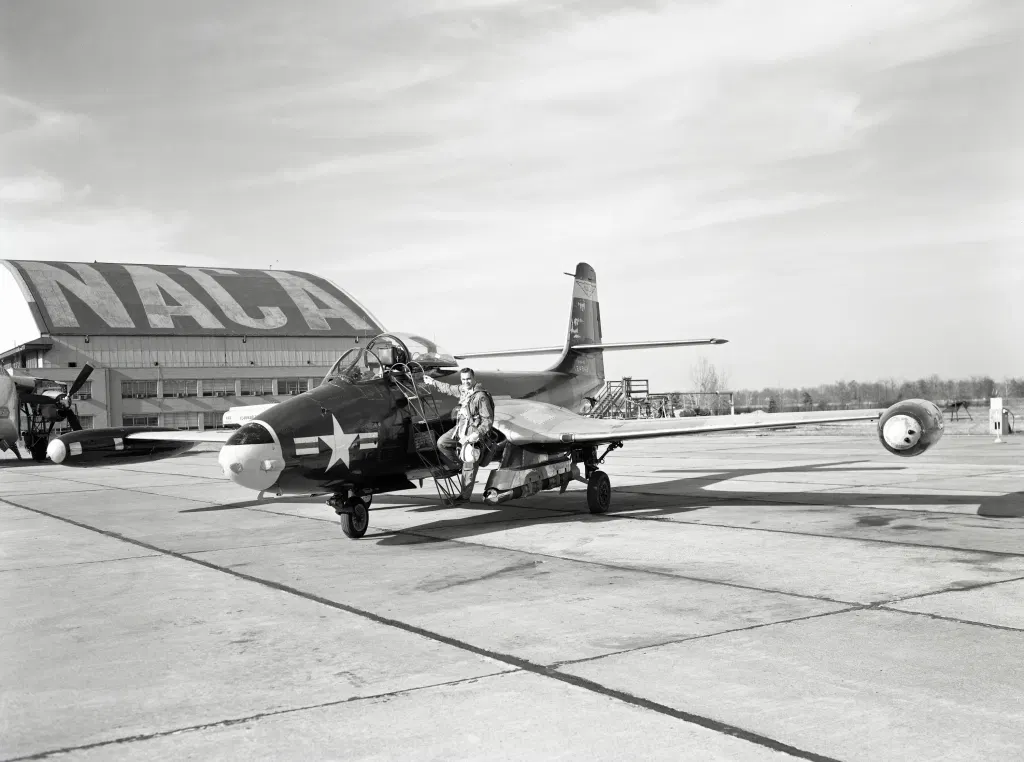
6 min readNASA Glenn’s Legacy Forged Through Decades of Flight ResearchDoreen ZudellEditorAug 18, 2026 Article William “Bill” Swann, one of the first-generation pilots at the National Advisory Committee for Aeronautics’ Flight Propulsion Research Laboratory (predecessor to NASA’s Glenn Research Center in Cleveland), prepares to board a McDonnell F2H-2B airplane on Nov. 6, 1956. Credit: NASA Many of NASA’s most important aerospace breakthroughs that began in the laboratory were ultimately proven in the sky. For decades, experts at NASA’s Glenn Research Center in Cleveland conducted flight tests — piloting aircraft into targeted environments such as icing clouds and carefully defined atmospheric routes.
…
Excerpt limited to ~120 words for fair-use compliance. The full article is at NASA.
Discussion
0 commentsMore from NASA