NASA Laser Terminal Enhances Views During Artemis II Mission
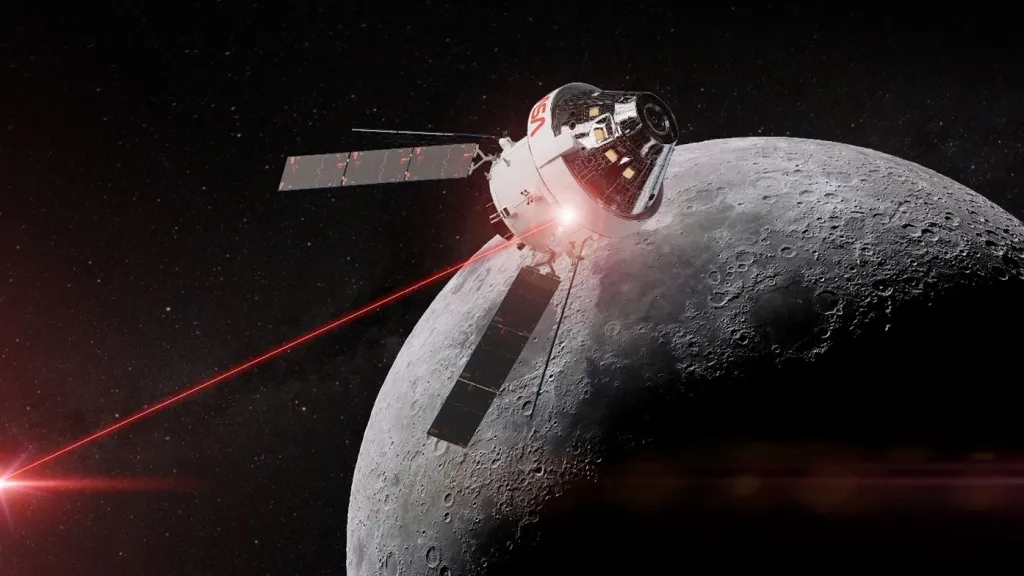
NASA's Artemis II mission showcased the use of a laser communications terminal, enhancing the public's viewing experience of the lunar journey. This optical system allowed for the transmission of high-definition data, surpassing traditional radio frequency capabilities. The mission successfully exchanged 484 gigabytes of data, significantly improving communication and data transfer rates.
- ▪The Artemis II mission featured a laser communications system that transmitted data using invisible infrared light.
- ▪During the mission, the optical terminal exchanged 484 gigabytes of data, equivalent to about 100 high-definition movies.
- ▪The system established multiple downlinks at 260 megabits per second, significantly exceeding traditional radio frequency data rates.
Story provenance
Source · retrieval · rights · ranking — open for full record
inspect →
Attribution is not the same as permission. This drawer separates discovery metadata, excerpts, WeSearch-generated summaries, reuse status, and whether the publisher receives the visit. Nothing here claims a legal grant the publisher has not made.
Record
| Original publisher | NASA |
| Canonical URL | https://www.nasa.gov/missions/artemis/artemis-2/nasa-laser-terminal-enhances-views-during-artemis-ii-mission/ |
| Publication time | Tue, 28 Apr 2026 16:10:25 +0000 |
| Retrieval time | 2026-04-28T16:37:43.353Z |
| Last seen | 2026-04-28T16:37:43.353Z |
| Headline source | Publisher (no WeSearch rewrite) |
| Excerpt source | publisher body |
| Excerpt method | First ~120 words (~800 chars) of extracted publisher body, fair-use limited. |
| Summary | WeSearch · cerebras-chat (WeSearch summarizer) |
| Summary source text | contentText |
| Citation coverage | Summary is a WeSearch-generated derivative; primary citation is the original publisher URL. |
| Cluster | eAPz3-n4hbfh |
| Cluster logic | Grouped by semantic title/content similarity across sources within a rolling window. Same-publisher template collisions are excluded from coverage comparison. |
| Ranking reason | Story pages are not engagement-ranked. Hub feeds use recency, with optional source-diversified chronological ordering (cap consecutive stories per source). No personalized ranking. |
| Publisher visit | Yes — open original |
| Substitutes article? | No — link-out required for full text |
Rights status (four layers)
WeSearch handling by dimension
| Indexing | May the item be indexed (stored, ranked, made findable)? | Allowed |
| Snippet | May a short excerpt of the publisher's text be shown? | Allowed |
| AI summary | May WeSearch generate its own short summary of the article? | Limited |
| Retrieval / RAG | May the content be exposed for third-party retrieval-augmented generation? | Not asserted |
| Model training | May the content be used to train AI models? | Not asserted |
| Commercial reuse | May the content be reused commercially? | Not permitted |
Basis: Derived from the published RSS/Atom feed. Contact: [email protected]. Reviewed: 2026-07-24.
Opening excerpt (first ~120 words) tap to expand
4 min readNASA Laser Terminal Enhances Views During Artemis II MissionKendall MurphyCommunications SpecialistApr 28, 2026 Article Millions of people watched the historic launch of Artemis II and were captivated by the mission’s 10-day journey around the Moon as NASA astronauts Reid Wiseman, Victor Glover, and Christina Koch, and CSA (Canadian Space Agency) astronaut Jeremy Hansen ventured farther into space than any human before. Part of the public’s ability to experience the mission in high-definition was due to laser communications. To view this video please enable JavaScript, and consider upgrading to a web browser that supports HTML5 video An animation depicting the Orion capsule using infrared light. Although infrared light is shown here, it is actually invisible to the human eye.
…
Excerpt limited to ~120 words for fair-use compliance. The full article is at NASA.
Discussion
0 commentsMore from NASA