NASA’s Exoplanet Hunter Reveals its Most Complete Look at the Night Sky
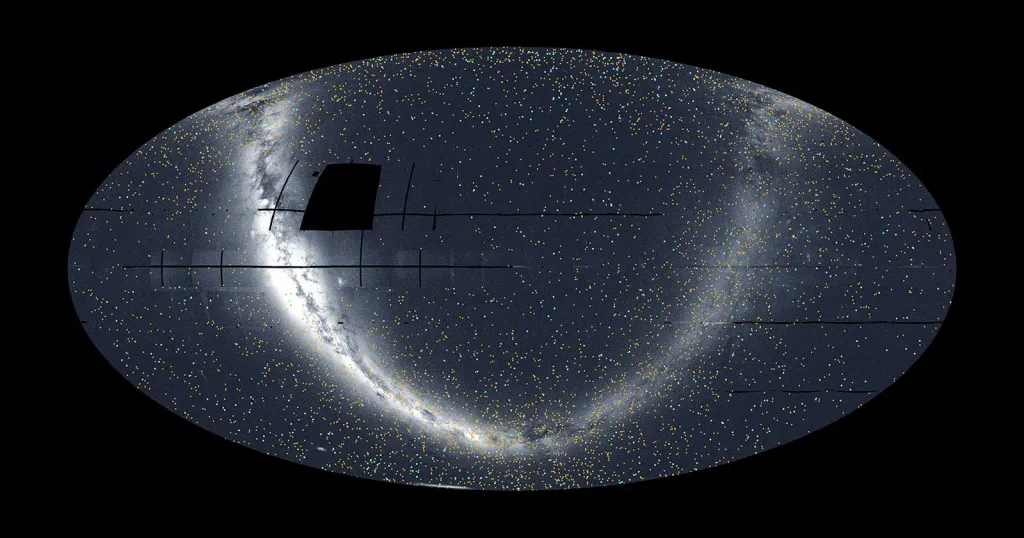
NASA's Transiting Exoplanet Survey Satellite (TESS) has released its most comprehensive view of the night sky to date. The mosaic includes 679 confirmed exoplanets and over 5,000 candidate exoplanets, showcasing a wide variety of celestial bodies. TESS has significantly advanced our understanding of exoplanets and their potential for hosting life.
- ▪The all-sky mosaic was constructed from 96 TESS sectors captured over eight years.
- ▪TESS has discovered 679 confirmed exoplanets and nearly 5,200 candidate exoplanets.
- ▪The satellite's cameras monitor a strip of the sky for 27 days and nights with a two-second cadence.
PetaPixel files mainly under photography. We currently carry 92 of its stories.
Story provenance
Source · retrieval · rights · ranking — open for full record
inspect →
Story provenance
Attribution is not the same as permission. This drawer separates discovery metadata, excerpts, WeSearch-generated summaries, reuse status, and whether the publisher receives the visit. Nothing here claims a legal grant the publisher has not made.
Record
| Original publisher | PetaPixel |
| Canonical URL | https://petapixel.com/2026/05/21/nasas-exoplanet-hunter-reveals-its-most-complete-look-at-the-night-sky/ |
| Publication time | Thu, 21 May 2026 16:29:35 +0000 |
| Retrieval time | 2026-05-21T16:31:31.346Z |
| Last seen | 2026-05-21T16:31:31.346Z |
| Headline source | Publisher (no WeSearch rewrite) |
| Excerpt source | publisher body |
| Excerpt method | First ~120 words (~800 chars) of extracted publisher body, fair-use limited. |
| Summary | WeSearch · cerebras-chat (WeSearch summarizer) |
| Summary source text | contentText |
| Citation coverage | Summary is a WeSearch-generated derivative; primary citation is the original publisher URL. |
| Cluster | NE2I2ennHn4z |
| Cluster logic | Grouped by semantic title/content similarity across sources within a rolling window. Same-publisher template collisions are excluded from coverage comparison. |
| Ranking reason | Story pages are not engagement-ranked. Hub feeds use recency, with optional source-diversified chronological ordering (cap consecutive stories per source). No personalized ranking. |
| Publisher visit | Yes — open original |
| Substitutes article? | No — link-out required for full text |
Rights status (four layers)
WeSearch handling by dimension
| Indexing | May the item be indexed (stored, ranked, made findable)? | Allowed |
| Snippet | May a short excerpt of the publisher's text be shown? | Allowed |
| AI summary | May WeSearch generate its own short summary of the article? | Limited |
| Retrieval / RAG | May the content be exposed for third-party retrieval-augmented generation? | Not asserted |
| Model training | May the content be used to train AI models? | Not asserted |
| Commercial reuse | May the content be reused commercially? | Not permitted |
Basis: Derived from the published RSS/Atom feed. Contact: [email protected]. Reviewed: 2026-07-24.
Opening excerpt (first ~120 words) tap to expand
NASA’s Exoplanet Hunter Reveals its Most Complete Look at the Night Sky May 21, 2026 Jeremy Gray ‘This view of the whole sky was constructed from 96 TESS sectors. By the end of September 2025, when the last image of this mosaic was captured, TESS had discovered 679 exoplanets (blue dots) and 5,165 candidates (orange dots). The glowing arc running through the center is the plane of the Milky Way. The Large Magellanic Cloud can be seen along the bottom edge just left of center. Black areas within the oval indicate regions TESS has not yet imaged.’ | Credit: NASA/MIT/TESS and Veselin Kostov (University of Maryland College Park) NASA’s Transiting Exoplanet Survey Satellite (TESS) has released a new mosaic that offers its most complete view of the night sky yet.
…
Excerpt limited to ~120 words for fair-use compliance. The full article is at PetaPixel.
Discussion
0 commentsMore from PetaPixel