‘Negotiations’ Aren’t the Answer in Iran or Ukraine
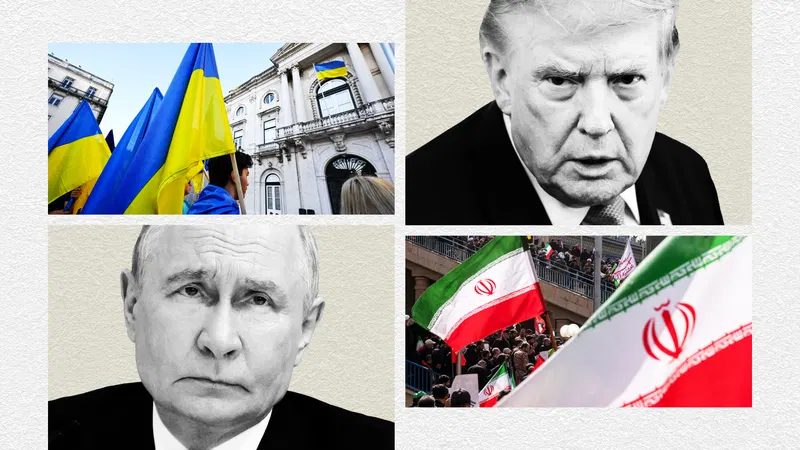
The article argues that negotiations are unlikely to resolve the conflicts in Iran and Ukraine because both wars are being fought as choices rather than matters of survival. It explains that as long as the parties believe they can achieve victory, they will resist compromising, and the outcome will be determined by battlefield conditions. The piece contrasts how democracies and autocracies approach war, noting that leaders like Donald Trump and Vladimir Putin are entrenched in conflicts they cannot easily exit.
- ▪Wars typically end when one side can no longer resist, achieves its objectives, or loses the will to fight.
- ▪Both the United States and Russia have entered wars of choice that have become protracted and difficult to resolve.
- ▪In autocratic regimes, leaders may continue fighting even when popular support wanes, as seen with Putin’s considerations of further mobilization.
- ▪Democratic leaders face pressure from public opinion and political constraints, exemplified by Trump’s potential loss of congressional control.
The Bulwark files mainly under politics. We currently carry 323 of its stories.
Story provenance
Source · retrieval · rights · ranking — open for full record
inspect →
Story provenance
Attribution is not the same as permission. This drawer separates discovery metadata, excerpts, WeSearch-generated summaries, reuse status, and whether the publisher receives the visit. Nothing here claims a legal grant the publisher has not made.
Record
| Original publisher | The Bulwark |
| Canonical URL | https://www.thebulwark.com/p/negotiations-arent-the-answer-in-iran-ukraine-putin-trump-hormuz-europe-war |
| Publication time | Mon, 17 Aug 2026 07:32:23 GMT |
| Retrieval time | 2026-08-17T07:55:18.012Z |
| Last seen | 2026-08-17T07:55:18.012Z |
| Headline source | Publisher (no WeSearch rewrite) |
| Excerpt source | publisher body |
| Excerpt method | First ~120 words (~800 chars) of extracted publisher body, fair-use limited. |
| Summary | WeSearch · cerebras-chat (WeSearch summarizer) |
| Summary source text | contentText |
| Citation coverage | Summary is a WeSearch-generated derivative; primary citation is the original publisher URL. |
| Cluster | None |
| Cluster logic | Not yet clustered, or no peer story found in the clustering window. |
| Ranking reason | Story pages are not engagement-ranked. Hub feeds use recency, with optional source-diversified chronological ordering (cap consecutive stories per source). No personalized ranking. |
| Publisher visit | Yes — open original |
| Substitutes article? | No — link-out required for full text |
Rights status (four layers)
WeSearch handling by dimension
| Indexing | May the item be indexed (stored, ranked, made findable)? | Allowed |
| Snippet | May a short excerpt of the publisher's text be shown? | Allowed |
| AI summary | May WeSearch generate its own short summary of the article? | Limited |
| Retrieval / RAG | May the content be exposed for third-party retrieval-augmented generation? | Not asserted |
| Model training | May the content be used to train AI models? | Not asserted |
| Commercial reuse | May the content be reused commercially? | Not permitted |
Basis: Derived from the published RSS/Atom feed. Contact: [email protected]. Reviewed: 2026-07-24.
Opening excerpt (first ~120 words) tap to expand
‘Negotiations’ Aren’t the Answer in Iran or Ukraine“Gentlemen may cry, ‘Peace, peace!’ But there is no peace.”Brynn TannehillAugust 17Upgrade to listen10 minutes(Photo illustration by Bill Kuchman/The Bulwark | Photos: Getty, Shutterstock)IT’S EASY TO START WARS, and far harder to end them. This is a lesson that both Donald Trump and Vladimir Putin are discovering, for a lot of the same reasons. Both began wars of choice on the assumption that they could conduct decapitation strikes, achieve favorable leadership changes, and end up in control of a puppet state. Trump clearly had Venezuela in mind; Putin probably had a situation more like Chechnya or Belarus.
…
Excerpt limited to ~120 words for fair-use compliance. The full article is at The Bulwark.
Discussion
0 commentsMore from The Bulwark