New Method Accelerates Color 3D Printing
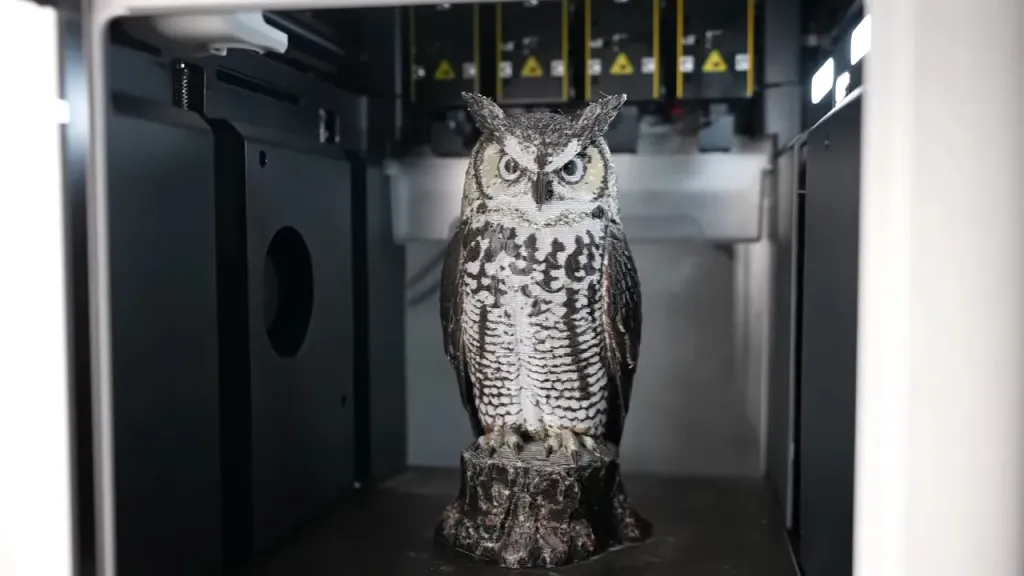
A new slicer method for multi-color FDM 3D printing reduces the number of tool changes required. It works by rotating through a palette of colors each layer and adjusting filament flow or edge displacement to control color prominence, resulting in smoother gradients and faster prints. However, increasing the number of base colors can thicken apparent layer lines and steep walls may degrade the color blending effect.
- ▪The method rotates through a color palette each layer, adjusting filament amount or edge displacement to modulate color prominence.
- ▪It achieves smoother gradients and faster printing by requiring fewer tool changes than traditional multi-color approaches.
- ▪Adding more base colors increases the apparent layer height, e.g., a 3‑color print at 0.2 mm layer height appears as 0.6 mm.
- ▪Steep wall geometries can cause the color blending illusion to break down.
Hackaday files mainly under tech. We currently carry 319 of its stories.
Story provenance
Source · retrieval · rights · ranking — open for full record
inspect →
Story provenance
Attribution is not the same as permission. This drawer separates discovery metadata, excerpts, WeSearch-generated summaries, reuse status, and whether the publisher receives the visit. Nothing here claims a legal grant the publisher has not made.
Record
| Original publisher | Hackaday |
| Canonical URL | https://hackaday.com/2026/07/23/new-method-accelerates-color-3d-printing/ |
| Publication time | Fri, 24 Jul 2026 05:00:13 +0000 |
| Retrieval time | 2026-07-24T05:00:46.349Z |
| Last seen | 2026-07-24T05:00:46.349Z |
| Headline source | Publisher (no WeSearch rewrite) |
| Excerpt source | publisher body |
| Excerpt method | First ~120 words (~800 chars) of extracted publisher body, fair-use limited. |
| Summary | WeSearch · cerebras-chat (WeSearch summarizer) |
| Summary source text | contentText |
| Citation coverage | Summary is a WeSearch-generated derivative; primary citation is the original publisher URL. |
| Cluster | PAOU7QTUa5Ob |
| Cluster logic | Grouped by semantic title/content similarity across sources within a rolling window. Same-publisher template collisions are excluded from coverage comparison. |
| Ranking reason | Story pages are not engagement-ranked. Hub feeds use recency, with optional source-diversified chronological ordering (cap consecutive stories per source). No personalized ranking. |
| Publisher visit | Yes — open original |
| Substitutes article? | No — link-out required for full text |
Rights status (four layers)
WeSearch handling by dimension
| Indexing | May the item be indexed (stored, ranked, made findable)? | Allowed |
| Snippet | May a short excerpt of the publisher's text be shown? | Allowed |
| AI summary | May WeSearch generate its own short summary of the article? | Limited |
| Retrieval / RAG | May the content be exposed for third-party retrieval-augmented generation? | Not asserted |
| Model training | May the content be used to train AI models? | Not asserted |
| Commercial reuse | May the content be reused commercially? | Not permitted |
Basis: Derived from the published RSS/Atom feed. Contact: [email protected]. Reviewed: 2026-07-24.
Opening excerpt (first ~120 words) tap to expand
New Method Accelerates Color 3D Printing No comments by: Julian Scheffers July 23, 2026 Title: Copy Short Link: Copy Multi-color 3D printing is notorious for being difficult to get right. Even with modern printers, you often end up much using more filament (and tool changes) than you would for a single-color print. [YKG3D] shows us a new method of color printing that needs far fewer tool changes. Based on 2018 research, the new slicer rotates through its palette of colors each layer. Then, either by adjusting the amount of filament dispensed or by displacing the edges, the prominence of each color is adjusted.
…
Excerpt limited to ~120 words for fair-use compliance. The full article is at Hackaday.
Discussion
0 commentsMore from Hackaday