Objective metrics that change the most as we age
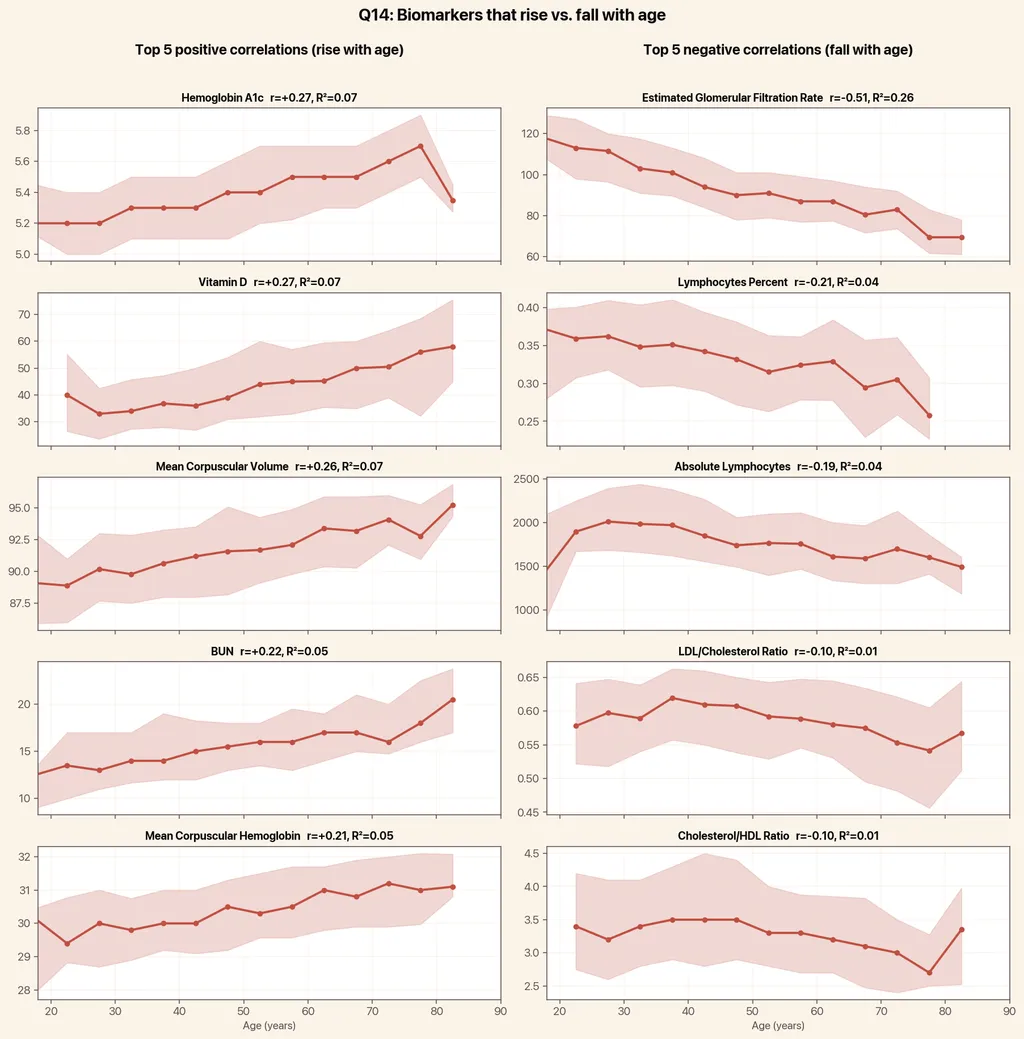
As people age, various objective metrics indicate gradual changes in bodily functions. Key biomarkers such as kidney function and blood sugar levels show measurable declines over time. Understanding these changes can help identify ways to slow or reverse aging effects.
- ▪eGFR, a measure of kidney function, declines approximately 6 to 7 points per decade after age 20.
- ▪HbA1c, which measures average blood sugar, increases about 0.1 percent per decade, indicating rising glucose intolerance.
- ▪Mean corpuscular volume (MCV) and mean corpuscular hemoglobin (MCH) also increase with age, reflecting changes in red blood cell size.
Hacker News (Newest) files mainly under programming. We currently carry 5,306 of its stories.
Story provenance
Source · retrieval · rights · ranking — open for full record
inspect →
Story provenance
Attribution is not the same as permission. This drawer separates discovery metadata, excerpts, WeSearch-generated summaries, reuse status, and whether the publisher receives the visit. Nothing here claims a legal grant the publisher has not made.
Record
| Original publisher | Empirical Health |
| Canonical URL | https://www.empirical.health/blog/biomarkers-that-change-with-age/ |
| Publication time | Wed, 27 May 2026 17:30:41 +0000 |
| Retrieval time | 2026-05-27T17:38:02.410Z |
| Last seen | 2026-05-27T17:38:02.410Z |
| Headline source | Publisher (no WeSearch rewrite) |
| Excerpt source | publisher body |
| Excerpt method | First ~120 words (~800 chars) of extracted publisher body, fair-use limited. |
| Summary | WeSearch · cerebras-chat (WeSearch summarizer) |
| Summary source text | contentText |
| Citation coverage | Summary is a WeSearch-generated derivative; primary citation is the original publisher URL. |
| Cluster | iHPMyrHqV10C |
| Cluster logic | Grouped by semantic title/content similarity across sources within a rolling window. Same-publisher template collisions are excluded from coverage comparison. |
| Ranking reason | Story pages are not engagement-ranked. Hub feeds use recency, with optional source-diversified chronological ordering (cap consecutive stories per source). No personalized ranking. |
| Publisher visit | Yes — open original |
| Substitutes article? | No — link-out required for full text |
Rights status (four layers)
WeSearch handling by dimension
| Indexing | May the item be indexed (stored, ranked, made findable)? | Allowed |
| Snippet | May a short excerpt of the publisher's text be shown? | Allowed |
| AI summary | May WeSearch generate its own short summary of the article? | Limited |
| Retrieval / RAG | May the content be exposed for third-party retrieval-augmented generation? | Not asserted |
| Model training | May the content be used to train AI models? | Not asserted |
| Commercial reuse | May the content be reused commercially? | Not permitted |
Basis: Derived from the published RSS/Atom feed. Contact: [email protected]. Reviewed: 2026-07-24.
Opening excerpt (first ~120 words) tap to expand
Objective metrics that change the most as we age Brandon Ballinger May 23, 2026 Yeats wrote of an aged man as “a tattered coat upon a stick.” But for most of us, aging comes as small diminishments: the morning that takes a little longer to shake off, the flight of stairs you notice, the cold that lingers a week instead of three days, the run that used to feel easy. We register these shifts as fatigue or a busy season before we register them as time. The body is keeping score long before we are. Each of these feelings has a number behind it. The morning that takes longer to shake off lines up with kidney and liver filtration slowing down. Two glasses of wine hit differently at forty than at twenty, and as eGFR drops a few points per decade, the cleanup takes longer.
…
Excerpt limited to ~120 words for fair-use compliance. The full article is at Empirical Health.
Discussion
0 commentsMore from Empirical Health