
One Flexible Tool Beats a Hundred Dedicated Ones
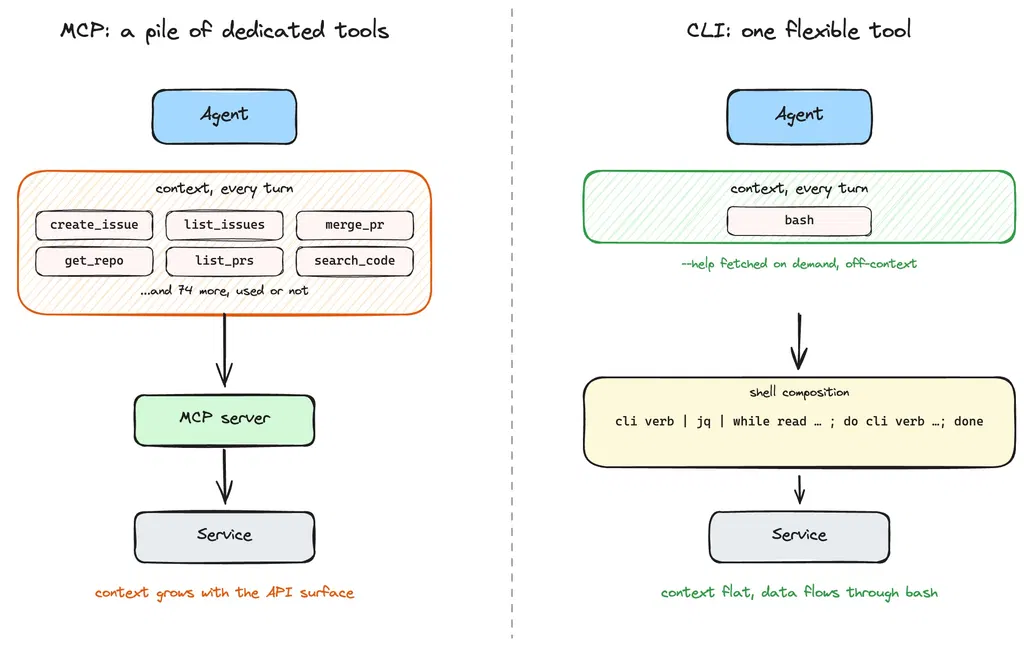
The article discusses the advantages of using command-line interfaces (CLIs) over managed control plane (MCP) servers for LLM agents. It argues that while MCP servers provide a structured onboarding experience with dedicated tools, CLIs offer greater flexibility and efficiency for modern models. However, this flexibility comes with increased risks that need to be managed carefully.
- ▪MCP servers typically wrap services as dedicated tools, while CLIs provide a single flexible tool.
- ▪Modern models can effectively utilize CLIs by composing commands without supervision, making them more efficient.
- ▪Using a CLI introduces a larger risk of prompt injection attacks, necessitating careful management of security.
Towards Data Science files mainly under ai. We currently carry 273 of its stories.
Story provenance
Source · retrieval · rights · ranking — open for full record
inspect →
Story provenance
Attribution is not the same as permission. This drawer separates discovery metadata, excerpts, WeSearch-generated summaries, reuse status, and whether the publisher receives the visit. Nothing here claims a legal grant the publisher has not made.
Record
| Original publisher | Towards Data Science |
| Canonical URL | https://towardsdatascience.com/one-flexible-tool-beats-a-hundred-dedicated-ones/ |
| Publication time | Mon, 18 May 2026 15:00:00 +0000 |
| Retrieval time | 2026-05-18T15:04:56.645Z |
| Last seen | 2026-05-18T15:04:56.645Z |
| Headline source | Publisher (no WeSearch rewrite) |
| Excerpt source | publisher body |
| Excerpt method | First ~120 words (~800 chars) of extracted publisher body, fair-use limited. |
| Summary | WeSearch · cerebras-chat (WeSearch summarizer) |
| Summary source text | contentText |
| Citation coverage | Summary is a WeSearch-generated derivative; primary citation is the original publisher URL. |
| Cluster | MRYx76Xz-I-9 |
| Cluster logic | Grouped by semantic title/content similarity across sources within a rolling window. Same-publisher template collisions are excluded from coverage comparison. |
| Ranking reason | Story pages are not engagement-ranked. Hub feeds use recency, with optional source-diversified chronological ordering (cap consecutive stories per source). No personalized ranking. |
| Publisher visit | Yes — open original |
| Substitutes article? | No — link-out required for full text |
Rights status (four layers)
WeSearch handling by dimension
| Indexing | May the item be indexed (stored, ranked, made findable)? | Allowed |
| Snippet | May a short excerpt of the publisher's text be shown? | Allowed |
| AI summary | May WeSearch generate its own short summary of the article? | Limited |
| Retrieval / RAG | May the content be exposed for third-party retrieval-augmented generation? | Not asserted |
| Model training | May the content be used to train AI models? | Not asserted |
| Commercial reuse | May the content be reused commercially? | Not permitted |
Basis: Derived from the published RSS/Atom feed. Contact: [email protected]. Reviewed: 2026-07-24.
Opening excerpt (first ~120 words) tap to expand
Agentic AI One Flexible Tool Beats a Hundred Dedicated Ones Why MCP servers keep losing to CLIs once the agent gets a terminal Tomaz Bratanic May 18, 2026 9 min read Share The default move when you wanted an LLM agent to talk to a system at the start of 2026 was to install an MCP server for it. GitHub. Jira. Slack. Linear. Postgres. Neo4j. Each one ships a server that exposes a tidy menu of tools, create_issue, list_pull_requests, merge_pull_request, get_repository, search_code, and so on, and you point your agent at it. It’s a great onboarding experience. It’s also, for a surprising number of real workloads, the wrong shape. The thesis is short: MCP design usually wraps each service as a pile of dedicated tools; a CLI hands the agent one really flexible tool.
…
Excerpt limited to ~120 words for fair-use compliance. The full article is at Towards Data Science.