Open Source Tricorder Is In It For The Science
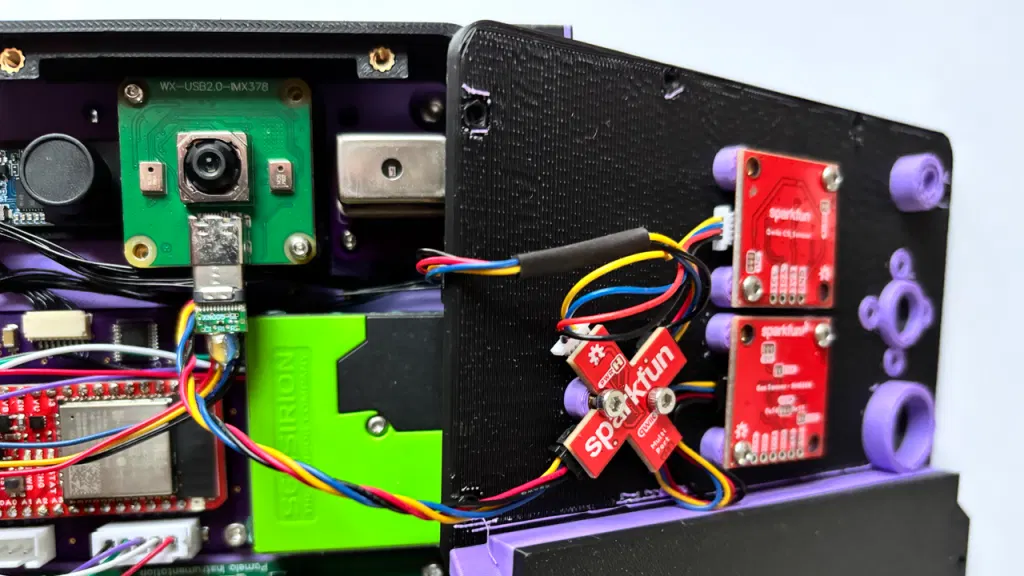
PeterAJansen has developed the Open Source Science Tricorder Cyberdeck, a handheld device designed for practical scientific analysis rather than mere aesthetic replication of Star Trek props. The device integrates a variety of sensors, including a scintillation crystal for radiation detection, a visible light spectrometer, and environmental monitors for temperature and air quality. Built around a Clockwork Pi uConsole, the project is fully open source, with assembly instructions and operational videos available on its GitHub repository.
- ▪The device features a scintillation crystal for spectroscopic analysis of beta- or gamma-ray sources.
- ▪It includes a visible light spectrometer, thermal camera, magnetic field camera, and standard environmental sensors.
- ▪The hardware is based on a Clockwork Pi uConsole equipped with a Compute Module 5 for data processing.
- ▪The project is open source, with all necessary details for construction available on a public GitHub repository.
- ▪This iteration prioritizes scientific utility over the screen-accurate design of previous tricorder projects.
Hackaday files mainly under tech. We currently carry 494 of its stories.
Story provenance
Source · retrieval · rights · ranking — open for full record
inspect →
Story provenance
Attribution is not the same as permission. This drawer separates discovery metadata, excerpts, WeSearch-generated summaries, reuse status, and whether the publisher receives the visit. Nothing here claims a legal grant the publisher has not made.
Record
| Original publisher | Hackaday |
| Canonical URL | https://hackaday.com/2026/09/30/open-source-tricorder-is-in-it-for-the-science/ |
| Publication time | Wed, 30 Sep 2026 20:00:23 +0000 |
| Retrieval time | 2026-09-30T20:02:01.724Z |
| Last seen | 2026-09-30T20:02:01.724Z |
| Headline source | Publisher (no WeSearch rewrite) |
| Excerpt source | publisher body |
| Excerpt method | First ~120 words (~800 chars) of extracted publisher body, fair-use limited. |
| Summary | WeSearch · cerebras-chat (WeSearch summarizer) |
| Summary source text | contentText |
| Citation coverage | Summary is a WeSearch-generated derivative; primary citation is the original publisher URL. |
| Cluster | 1hA5HaIbuoo2 · 1 stories |
| Cluster logic | Grouped by semantic title/content similarity across sources within a rolling window. Same-publisher template collisions are excluded from coverage comparison. |
| Ranking reason | Story pages are not engagement-ranked. Hub feeds use recency, with optional source-diversified chronological ordering (cap consecutive stories per source). No personalized ranking. |
| Publisher visit | Yes — open original |
| Substitutes article? | No — link-out required for full text |
Rights status (four layers)
WeSearch handling by dimension
| Indexing | May the item be indexed (stored, ranked, made findable)? | Allowed |
| Snippet | May a short excerpt of the publisher's text be shown? | Allowed |
| AI summary | May WeSearch generate its own short summary of the article? | Limited |
| Retrieval / RAG | May the content be exposed for third-party retrieval-augmented generation? | Not asserted |
| Model training | May the content be used to train AI models? | Not asserted |
| Commercial reuse | May the content be reused commercially? | Not permitted |
Basis: Derived from the published RSS/Atom feed. Contact: [email protected]. Reviewed: 2026-07-24.
Opening excerpt (first ~120 words) tap to expand
Open Source Tricorder Is In It For The Science No comments by: Tyler August September 30, 2026 Title: Copy Short Link: Copy If you’re reading Hackaday there’s pretty good odds you’re at least somewhat fond of Star Trek. We’d bet good money most of you would quit your jobs today if a Starfleet recruiter showed up. That’s something you’d have in common with [PeterAJansen], who has been working for over a decade now to create something worthy of being called a tricorder. If his latest iteration, the Open Source Science Tricorder Cyberdeck, isn’t there yet, it’s pretty darn close. Frankly, it looks more usable than Roddenberry’s version. The “tri” in tricorder means three, but this device has more than three instruments– so did the ones on the show, come to think of it.
…
Excerpt limited to ~120 words for fair-use compliance. The full article is at Hackaday.
Discussion
0 commentsMore from Hackaday