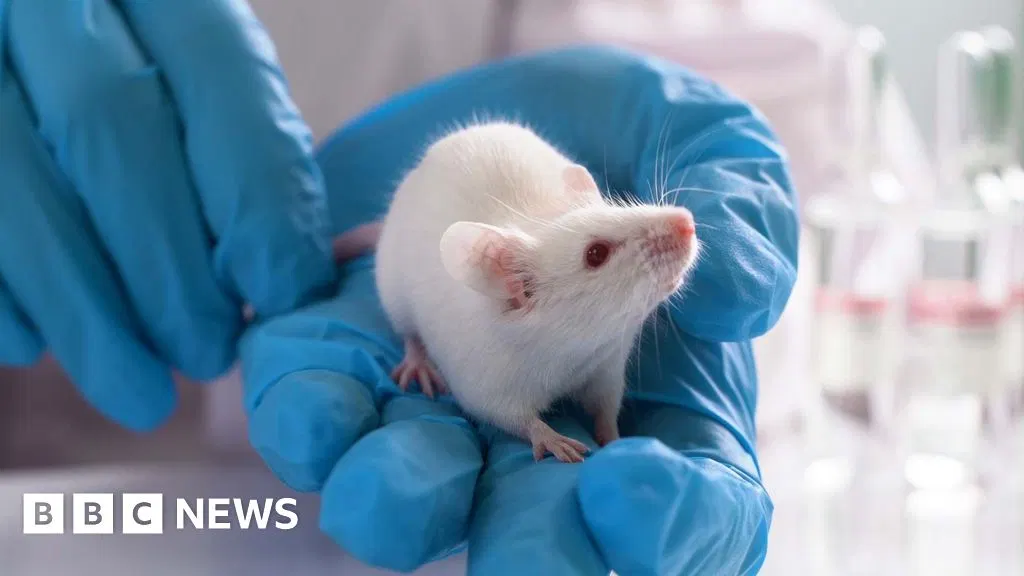
Part-human part-mouse brain developed in science breakthrough
Stanford researchers have successfully implanted human brain organoids into genetically modified mice that lack their own cerebral cortex. This breakthrough allows for the study of human-specific psychiatric and neurodevelopmental disorders that cannot be replicated in standard animal models. The study, published in Nature, was conducted under independent ethical scrutiny to ensure the animals did not develop human-like cognition.
- ▪Scientists at Stanford University implanted human-derived brain organoids into mice that were genetically engineered to have minimal cerebral cortex.
- ▪The human cells integrated into the mouse brain circuitry and began to function like the outer layer of the brain after several months.
- ▪Behavioral tests indicated that the modified mice performed largely like normal mice without any cognitive enhancements.
- ▪The research aims to improve the success rate of clinical trials for conditions such as epilepsy, autism, and cerebral palsy by better capturing human brain biology.
- ▪Bioethicists noted that while the mice do not think like humans, the study raises important questions about altering animal cognition and welfare.
5 outlets in our directory ran this story, first to last over 13 hours. Coverage spans 2 points on the political spectrum — 2 lean left, 2 centre.
- ▪ Researchers swap in human brain cells for a mouse's cortex — Ars Technica — Science
- ▪ Part-human part-mouse brain developed in science breakthrough — BBC News — Science
- ▪ Scientists create mice with part-human brains — The Guardian — Science
- ▪ Scientists Fuse Human Neurons Into the Brains of Mice — NYT — Science
Hacker News (Front Page) files mainly under programming. We currently carry 1,744 of its stories. Top-voted stories on Hacker News.
Story provenance
Source · retrieval · rights · ranking — open for full record
inspect →
Story provenance
Attribution is not the same as permission. This drawer separates discovery metadata, excerpts, WeSearch-generated summaries, reuse status, and whether the publisher receives the visit. Nothing here claims a legal grant the publisher has not made.
Record
| Original publisher | Bbc |
| Canonical URL | https://www.bbc.com/news/articles/c60m3k28j81mo |
| Publication time | Thu, 17 Sep 2026 01:33:10 +0000 |
| Retrieval time | 2026-09-17T04:08:41.823Z |
| Last seen | 2026-09-17T04:08:41.823Z |
| Headline source | Publisher (no WeSearch rewrite) |
| Excerpt source | publisher body |
| Excerpt method | First ~120 words (~800 chars) of extracted publisher body, fair-use limited. |
| Summary | WeSearch · cerebras-chat (WeSearch summarizer) |
| Summary source text | contentText |
| Citation coverage | Summary is a WeSearch-generated derivative; primary citation is the original publisher URL. |
| Cluster | y1SZl_uV1kwI · 5 stories |
| Cluster logic | Grouped by semantic title/content similarity across sources within a rolling window. Same-publisher template collisions are excluded from coverage comparison. |
| Ranking reason | Story pages are not engagement-ranked. Hub feeds use recency, with optional source-diversified chronological ordering (cap consecutive stories per source). No personalized ranking. |
| Publisher visit | Yes — open original |
| Substitutes article? | No — link-out required for full text |
Rights status (four layers)
WeSearch handling by dimension
| Indexing | May the item be indexed (stored, ranked, made findable)? | Allowed |
| Snippet | May a short excerpt of the publisher's text be shown? | Allowed |
| AI summary | May WeSearch generate its own short summary of the article? | Limited |
| Retrieval / RAG | May the content be exposed for third-party retrieval-augmented generation? | Not asserted |
| Model training | May the content be used to train AI models? | Not asserted |
| Commercial reuse | May the content be reused commercially? | Not permitted |
Basis: Derived from the published RSS/Atom feed. Contact: [email protected]. Reviewed: 2026-07-24.
Opening excerpt (first ~120 words) tap to expand
Part-human part-mouse brain developed in science breakthrough12 hours agoShareSaveAdd as preferred on GoogleVictoria Gill,Science correspondent andKate Stephens,Senior science journalistGetty ImagesThe research has raised questions about what it means to alter the way laboratory animals think and feel Neuroscientists in the US have successfully adapted mice to have functioning human cells inside their own brains.The researchers hope that potential treatments for psychiatric and neurodevelopmental diseases that only occur in humans could now be tested on the laboratory rodents.While mice with brains that are partly human might sound like a Kafkaesque experiment, the scientists said these are not "mice that think like humans".The animals are genetically engineered - and surgically altered -…
Excerpt limited to ~120 words for fair-use compliance. The full article is at Bbc.
Discussion
0 commentsMore from Bbc