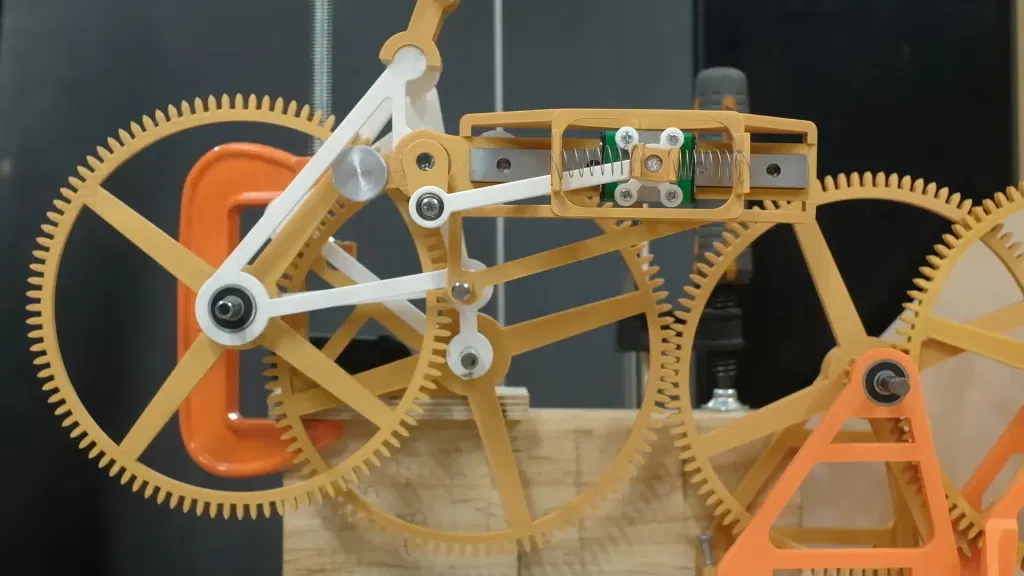
Printing a Clock Fit for a Pope
Watchmaker Carlo G. Croce recreated a 1656 silent clock mechanism originally commissioned by Pope Alexander VII using extruded plastic. The design utilizes an eccentric crank escapement to eliminate the traditional ticking sound, though it suffers from lower power efficiency compared to standard anchor escapements. This project highlights the evolution of 3D printing technology, which now allows for the complex fabrication of mechanical clockwork that was once considered a significant challenge.
- ▪Pope Alexander VII commissioned a silent timepiece from the Fratelli Campani workshop in 1656 to avoid the noise of traditional clocks.
- ▪Carlo G. Croce recreated the historical mechanism in extruded plastic, documenting the process through videos and a PDF file.
- ▪The clock uses an eccentric crank escapement that provides continuous movement but wastes more power than the traditional anchor escapement.
- ▪Despite its aesthetic appeal, the linear-rail-based spring pendulum modification does not offer the same runtime as conventional clockwork mechanisms.
Hackaday files mainly under tech. We currently carry 375 of its stories.
Story provenance
Source · retrieval · rights · ranking — open for full record
inspect →
Story provenance
Attribution is not the same as permission. This drawer separates discovery metadata, excerpts, WeSearch-generated summaries, reuse status, and whether the publisher receives the visit. Nothing here claims a legal grant the publisher has not made.
Record
| Original publisher | Hackaday |
| Canonical URL | https://hackaday.com/2026/09/17/printing-a-clock-fit-for-a-pope/ |
| Publication time | Thu, 17 Sep 2026 08:00:11 +0000 |
| Retrieval time | 2026-09-17T08:03:43.179Z |
| Last seen | 2026-09-17T08:03:43.179Z |
| Headline source | Publisher (no WeSearch rewrite) |
| Excerpt source | publisher body |
| Excerpt method | First ~120 words (~800 chars) of extracted publisher body, fair-use limited. |
| Summary | WeSearch · cerebras-chat (WeSearch summarizer) |
| Summary source text | contentText |
| Citation coverage | Summary is a WeSearch-generated derivative; primary citation is the original publisher URL. |
| Cluster | ov58mdVqDQ2e · 1 stories |
| Cluster logic | Grouped by semantic title/content similarity across sources within a rolling window. Same-publisher template collisions are excluded from coverage comparison. |
| Ranking reason | Story pages are not engagement-ranked. Hub feeds use recency, with optional source-diversified chronological ordering (cap consecutive stories per source). No personalized ranking. |
| Publisher visit | Yes — open original |
| Substitutes article? | No — link-out required for full text |
Rights status (four layers)
WeSearch handling by dimension
| Indexing | May the item be indexed (stored, ranked, made findable)? | Allowed |
| Snippet | May a short excerpt of the publisher's text be shown? | Allowed |
| AI summary | May WeSearch generate its own short summary of the article? | Limited |
| Retrieval / RAG | May the content be exposed for third-party retrieval-augmented generation? | Not asserted |
| Model training | May the content be used to train AI models? | Not asserted |
| Commercial reuse | May the content be reused commercially? | Not permitted |
Basis: Derived from the published RSS/Atom feed. Contact: [email protected]. Reviewed: 2026-07-24.
Opening excerpt (first ~120 words) tap to expand
Printing A Clock Fit For A Pope No comments by: Tyler August September 17, 2026 Title: Copy Short Link: Copy When it comes to clockwork, there is a spectrum — some people love the ticking, and some people hate it, while most fall into the broad middle of indifference. Once upon a time, Pope Alexander VII fell into the “hate it” category, and commissioned a silent timepiece from [Fratelli Campani] in 1656. Three hundred seventy years later, [Many Vices] sought out to re-create the mechanism in extruded plastic thanks to the efforts of watchmaker [Carlo G. Croce], who documented his brass recreation in this PDF file and his own videos. While the archaeology of recreating the mechanism from old photos is interesting, the mechanism itself is the real showpiece.
…
Excerpt limited to ~120 words for fair-use compliance. The full article is at Hackaday.
Discussion
0 commentsMore from Hackaday