Recursive Language Models: An All-in-One Deep Dive
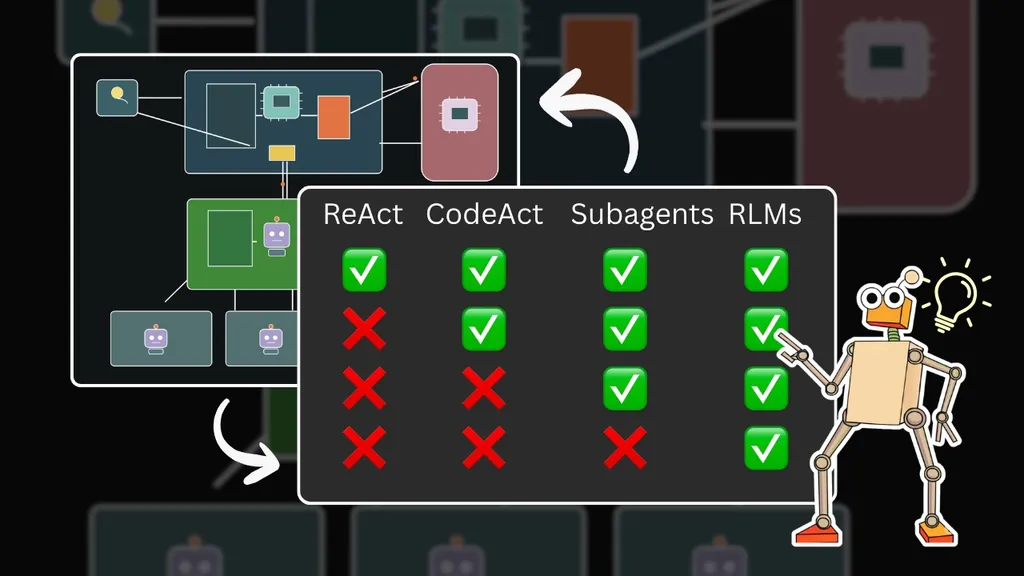
Recursive Language Models (RLMs) represent a new approach in agentic AI architectures that differ significantly from methods like ReAct and CodeAct by passing context by reference rather than replication. They excel in long-context benchmarks and handle complex, structured tasks more efficiently by avoiding redundant data processing. A simple fruit-naming and letter-counting task illustrates how RLMs manage context and computation more effectively than traditional models.
- ▪Recursive Language Models (RLMs) pass context by reference instead of replicating it, which improves efficiency in long-context tasks.
- ▪RLMs outperform models like ReAct and CodeAct in benchmarks that require handling extended or nested data structures.
- ▪Unlike ReAct, which relies on predefined tool functions for tasks like counting letters, RLMs can dynamically manage context and computation without external tool definitions.
- ▪The article uses a fruit, country, and animal naming task with letter counting to demonstrate how RLMs handle structured output generation more effectively.
- ▪Direct generation and ReAct methods struggle with accuracy and scalability in tasks requiring verification or nested outputs, whereas RLMs are designed to address these limitations.
2 outlets in our directory ran this story, first to last over 13 hours. All of the coverage we found sits in one bucket: centre. That one-sidedness is itself worth noticing.
Towards Data Science files mainly under ai. We currently carry 87 of its stories.
Story provenance
Source · retrieval · rights · ranking — open for full record
inspect →
Attribution is not the same as permission. This drawer separates discovery metadata, excerpts, WeSearch-generated summaries, reuse status, and whether the publisher receives the visit. Nothing here claims a legal grant the publisher has not made.
Record
| Original publisher | Towards Data Science |
| Canonical URL | https://towardsdatascience.com/recursive-language-models-one-example-deep-dive-that-explains-everything/ |
| Publication time | Sat, 16 May 2026 13:00:00 +0000 |
| Retrieval time | 2026-05-16T13:05:18.535Z |
| Last seen | 2026-05-16T13:05:18.535Z |
| Headline source | Publisher (no WeSearch rewrite) |
| Excerpt source | publisher body |
| Excerpt method | First ~120 words (~800 chars) of extracted publisher body, fair-use limited. |
| Summary | WeSearch · cerebras-chat (WeSearch summarizer) |
| Summary source text | contentText |
| Citation coverage | Summary is a WeSearch-generated derivative; primary citation is the original publisher URL. |
| Cluster | jpDCG217kdlF · 2 stories |
| Cluster logic | Grouped by semantic title/content similarity across sources within a rolling window. Same-publisher template collisions are excluded from coverage comparison. |
| Ranking reason | Story pages are not engagement-ranked. Hub feeds use recency, with optional source-diversified chronological ordering (cap consecutive stories per source). No personalized ranking. |
| Publisher visit | Yes — open original |
| Substitutes article? | No — link-out required for full text |
Rights status (four layers)
WeSearch handling by dimension
| Indexing | May the item be indexed (stored, ranked, made findable)? | Allowed |
| Snippet | May a short excerpt of the publisher's text be shown? | Allowed |
| AI summary | May WeSearch generate its own short summary of the article? | Limited |
| Retrieval / RAG | May the content be exposed for third-party retrieval-augmented generation? | Not asserted |
| Model training | May the content be used to train AI models? | Not asserted |
| Commercial reuse | May the content be reused commercially? | Not permitted |
Basis: Derived from the published RSS/Atom feed. Contact: [email protected]. Reviewed: 2026-07-24.
Opening excerpt (first ~120 words) tap to expand
Large Language Models Recursive Language Models: An All-in-One Deep Dive Exactly how does it differ from ReAct, CodeAct, Self-Loops, and Subagents? Avishek Biswas May 16, 2026 33 min read Share In this article, you will learn what Recursive Language Models (RLMs) are, why they are winning all the long-context benchmarks right now, and understand how they are different from existing agentic harness designs! And we are going to learn it by magnifying one simple case study. I have spent a decent chunk of last month implementing RLMs, running benchmarks, and producing a 50-minute tutorial video on it. Throughout the process, I responded to 100+ questions on YouTube and X about RLMs.
…
Excerpt limited to ~120 words for fair-use compliance. The full article is at Towards Data Science.
Discussion
0 commentsMore from Towards Data Science