Researchers devise a full-color night vision goggle
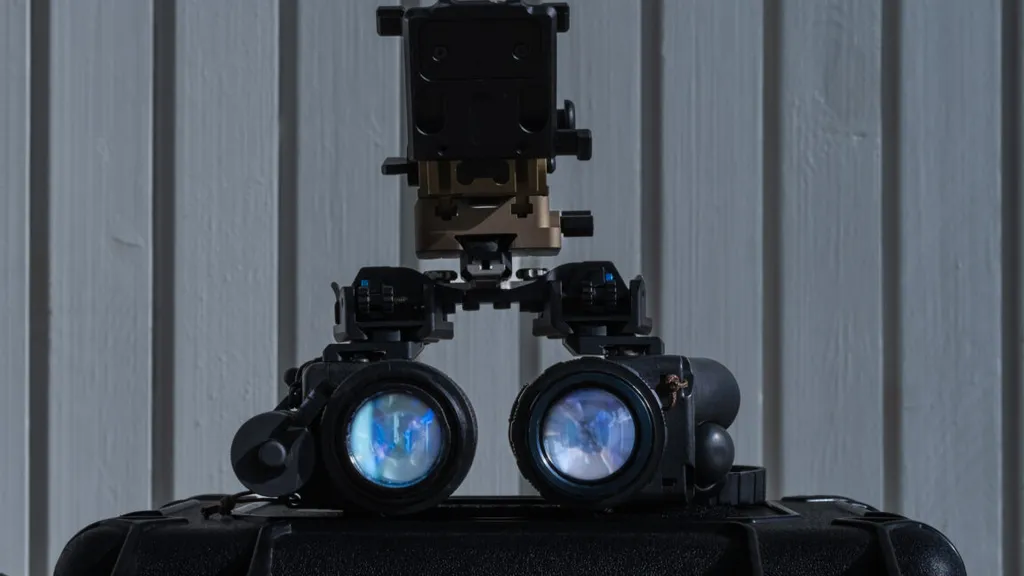
Researchers at the Beijing Institute of Technology have created a night‑vision goggle that renders infrared light as full‑color images. The device combines mercury telluride colloidal quantum dots with a dual‑layer OLED to convert infrared wavelengths into distinct visible hues. This approach aims to utilize human hue sensitivity, offering a more detailed perception than traditional brightness‑only infrared displays.
- ▪The new goggle translates infrared wavelengths into separate parts of the visible spectrum rather than representing them solely as brightness variations.
- ▪Mercury telluride quantum dots, about 4 nm in size, provide discrete energy levels that allow the device to differentiate infrared wavelengths.
- ▪A dual‑layer OLED converts the charge carriers generated by the quantum dots into ordinary‑looking, full‑color images.
- ▪Traditional infrared devices typically display a single greenish hue, limiting the eye’s ability to discern subtle differences.
- ▪The prototype was tested with infrared wavelengths up to approximately 2 micrometers, demonstrating the concept’s feasibility.
Ars Technica files mainly under tech. We currently carry 179 of its stories.
Story provenance
Source · retrieval · rights · ranking — open for full record
inspect →
Story provenance
Attribution is not the same as permission. This drawer separates discovery metadata, excerpts, WeSearch-generated summaries, reuse status, and whether the publisher receives the visit. Nothing here claims a legal grant the publisher has not made.
Record
| Original publisher | Ars Technica |
| Canonical URL | https://arstechnica.com/science/2026/07/see-the-heat-an-infrared-imaging-system-that-outputs-in-color/ |
| Publication time | Fri, 31 Jul 2026 17:58:38 +0000 |
| Retrieval time | 2026-07-31T18:54:04.395Z |
| Last seen | 2026-07-31T18:54:04.395Z |
| Headline source | Publisher (no WeSearch rewrite) |
| Excerpt source | publisher body |
| Excerpt method | First ~120 words (~800 chars) of extracted publisher body, fair-use limited. |
| Summary | WeSearch · cerebras-chat (WeSearch summarizer) |
| Summary source text | contentText |
| Citation coverage | Summary is a WeSearch-generated derivative; primary citation is the original publisher URL. |
| Cluster | yVwhA9bbdLO7 · 1 stories |
| Cluster logic | Grouped by semantic title/content similarity across sources within a rolling window. Same-publisher template collisions are excluded from coverage comparison. |
| Ranking reason | Story pages are not engagement-ranked. Hub feeds use recency, with optional source-diversified chronological ordering (cap consecutive stories per source). No personalized ranking. |
| Publisher visit | Yes — open original |
| Substitutes article? | No — link-out required for full text |
Rights status (four layers)
WeSearch handling by dimension
| Indexing | May the item be indexed (stored, ranked, made findable)? | Allowed |
| Snippet | May a short excerpt of the publisher's text be shown? | Allowed |
| AI summary | May WeSearch generate its own short summary of the article? | Limited |
| Retrieval / RAG | May the content be exposed for third-party retrieval-augmented generation? | Not asserted |
| Model training | May the content be used to train AI models? | Not asserted |
| Commercial reuse | May the content be reused commercially? | Not permitted |
Basis: Derived from the published RSS/Atom feed. Contact: [email protected]. Reviewed: 2026-07-24.
Opening excerpt (first ~120 words) tap to expand
Infravision Researchers devise a full-color night vision goggle Wavelength and intensity in the infrared are translated into colors in the visible. Jacek Krywko – Jul 31, 2026 1:58 pm | 17 Credit: Dmitri Toms Credit: Dmitri Toms Text settings Story text Size Small Standard Large Width * Standard Wide Links Standard Orange * Subscribers only Learn more Minimize to nav Human eyes don’t register the infrared portion of the light spectrum because infrared photons don’t carry enough energy to trigger the signaling pathway inside our light-sensing cells. But we’ve been able to make devices that give us a visual representation of what’s happening in the infrared.
…
Excerpt limited to ~120 words for fair-use compliance. The full article is at Ars Technica.
Discussion
0 commentsMore from Ars Technica