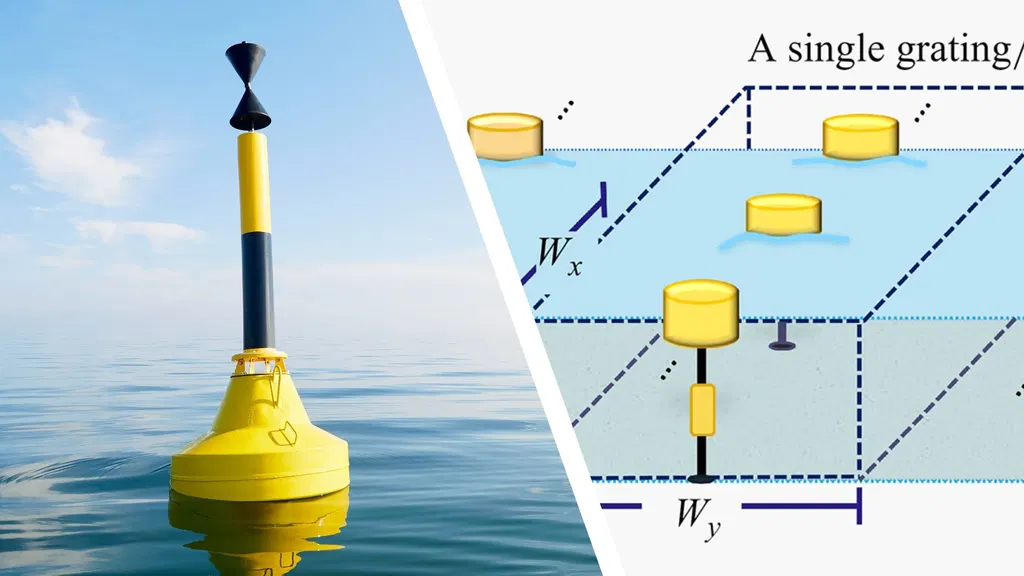
Researchers say fields of house-sized buoys capture 90% of wave energy
Tech Researchers say that fields of house-sized buoys could capture up to 90% of wave energy — and each buoy could provide the power for 'several hundred households' News By David Nield Published 22 September 2026 Less wave power lost When you purchase through links on our site, we may earn an affiliate commission. Now researchers from Germany and Australia have come up with a potential method for capturing way more of the energy produced by the undulating oceans.The solution (via Interesting Engineering) is big buoys, and lots of them. "Only if the support comes at the right moment will the child swing higher and higher over time.
- ▪Tech Researchers say that fields of house-sized buoys could capture up to 90% of wave energy — and each buoy could provide the power for 'several hundred households' News By David Nield Published 22 September 2026 Less wave power lost When
- ▪Now researchers from Germany and Australia have come up with a potential method for capturing way more of the energy produced by the undulating oceans.The solution (via Interesting Engineering) is big buoys, and lots of them.
- ▪"Only if the support comes at the right moment will the child swing higher and higher over time.
TechRadar publishes from United Kingdom and files mainly under tech. We currently carry 2,669 of its stories.
Story provenance
Source · retrieval · rights · ranking — open for full record
inspect →
Story provenance
Attribution is not the same as permission. This drawer separates discovery metadata, excerpts, WeSearch-generated summaries, reuse status, and whether the publisher receives the visit. Nothing here claims a legal grant the publisher has not made.
Record
| Original publisher | TechRadar |
| Canonical URL | https://www.techradar.com/tech/researchers-say-that-fields-of-house-sized-buoys-could-capture-up-to-90-percent-of-wave-energy-and-each-buoy-could-provide-the-power-for-several-hundred-households |
| Publication time | Tue, 22 Sep 2026 20:00:00 +0000 |
| Retrieval time | 2026-09-22T20:03:57.143Z |
| Last seen | 2026-09-22T20:03:57.143Z |
| Headline source | Publisher (no WeSearch rewrite) |
| Excerpt source | publisher body |
| Excerpt method | First ~120 words (~800 chars) of extracted publisher body, fair-use limited. |
| Summary | WeSearch · cerebras-chat (WeSearch summarizer) |
| Summary source text | contentText |
| Citation coverage | Summary is a WeSearch-generated derivative; primary citation is the original publisher URL. |
| Cluster | oiasNAnTo0cT · 1 stories |
| Cluster logic | Grouped by semantic title/content similarity across sources within a rolling window. Same-publisher template collisions are excluded from coverage comparison. |
| Ranking reason | Story pages are not engagement-ranked. Hub feeds use recency, with optional source-diversified chronological ordering (cap consecutive stories per source). No personalized ranking. |
| Publisher visit | Yes — open original |
| Substitutes article? | No — link-out required for full text |
Rights status (four layers)
WeSearch handling by dimension
| Indexing | May the item be indexed (stored, ranked, made findable)? | Allowed |
| Snippet | May a short excerpt of the publisher's text be shown? | Allowed |
| AI summary | May WeSearch generate its own short summary of the article? | Limited |
| Retrieval / RAG | May the content be exposed for third-party retrieval-augmented generation? | Not asserted |
| Model training | May the content be used to train AI models? | Not asserted |
| Commercial reuse | May the content be reused commercially? | Not permitted |
Basis: Derived from the published RSS/Atom feed. Contact: [email protected]. Reviewed: 2026-07-24.
Opening excerpt (first ~120 words) tap to expand
Tech Researchers say that fields of house-sized buoys could capture up to 90% of wave energy — and each buoy could provide the power for 'several hundred households' News By David Nield Published 22 September 2026 Less wave power lost When you purchase through links on our site, we may earn an affiliate commission. Here’s how it works. (Image credit: Getty Images / Westcott et al., Journal of Fluid Mechanics, 2026) Copy link Facebook X Whatsapp Reddit Pinterest Flipboard Threads Email Share this article 0 Join the conversation Follow us Add us as a preferred source on Google Newsletter Subscribe to our newsletter A new approach could catch 90% of potentially convertible wave energyIt's based on a array of dozens of connected buoys, designed to handle different types of wavesFurther…
Excerpt limited to ~120 words for fair-use compliance. The full article is at TechRadar.
Discussion
0 commentsMore from TechRadar