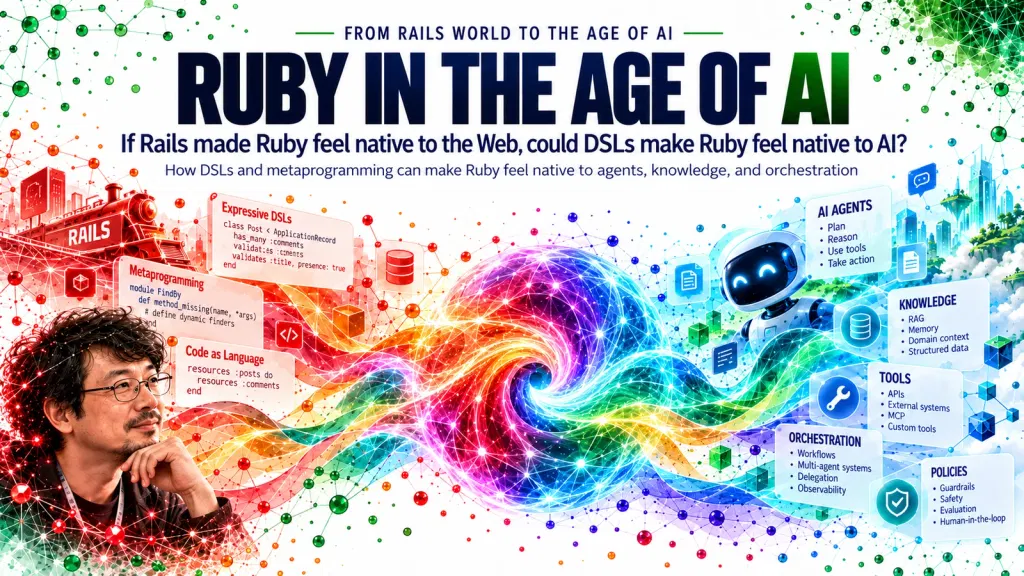
Ruby in the Age of AI
The article argues that Ruby's next major opportunity lies in creating domain-specific languages (DSLs) for AI rather than implementing AI models directly. By leveraging metaprogramming, Ruby can transform complex AI infrastructure into intuitive, domain-focused vocabulary similar to how Rails simplified web development. This approach allows developers to express semantic intentions clearly while the framework handles the underlying machinery of agents and workflows.
- ▪Ruby's historical strength in creating domain-specific languages through Rails provides a strong foundation for AI-native development.
- ▪Current AI development requires managing complex infrastructure primitives like prompts, tools, and memory, which can obscure the developer's domain intent.
- ▪Ruby DSLs allow for dynamic evolution of language concepts, enabling the same code to serve as configuration, policy, and executable program.
- ▪Metaprogramming features in Ruby enable simple declarations to expand into complex behaviors such as retrieval, access policies, and orchestration.
- ▪The proposed AI-native Ruby DSL aims to let developers define agents using natural domain vocabulary like 'knows' and 'hands_off_to' instead of low-level infrastructure calls.
Hacker News (AI / LLM) files mainly under ai. We currently carry 7,111 of its stories.
Story provenance
Source · retrieval · rights · ranking — open for full record
inspect →
Story provenance
Attribution is not the same as permission. This drawer separates discovery metadata, excerpts, WeSearch-generated summaries, reuse status, and whether the publisher receives the visit. Nothing here claims a legal grant the publisher has not made.
Record
| Original publisher | enogrob - Roberto Nogueira’s blog |
| Canonical URL | https://enogrob.github.io/ruby/artificial-intelligence/software-engineering/architecture/2026/10/01/ruby-in-the-age-of-ai.html |
| Publication time | Thu, 01 Oct 2026 01:48:40 +0000 |
| Retrieval time | 2026-10-01T01:57:06.382Z |
| Last seen | 2026-10-01T01:57:06.382Z |
| Headline source | Publisher (no WeSearch rewrite) |
| Excerpt source | publisher body |
| Excerpt method | First ~120 words (~800 chars) of extracted publisher body, fair-use limited. |
| Summary | WeSearch · cerebras-chat (WeSearch summarizer) |
| Summary source text | contentText |
| Citation coverage | Summary is a WeSearch-generated derivative; primary citation is the original publisher URL. |
| Cluster | None |
| Cluster logic | Not yet clustered, or no peer story found in the clustering window. |
| Ranking reason | Story pages are not engagement-ranked. Hub feeds use recency, with optional source-diversified chronological ordering (cap consecutive stories per source). No personalized ranking. |
| Publisher visit | Yes — open original |
| Substitutes article? | No — link-out required for full text |
Rights status (four layers)
WeSearch handling by dimension
| Indexing | May the item be indexed (stored, ranked, made findable)? | Allowed |
| Snippet | May a short excerpt of the publisher's text be shown? | Allowed |
| AI summary | May WeSearch generate its own short summary of the article? | Limited |
| Retrieval / RAG | May the content be exposed for third-party retrieval-augmented generation? | Not asserted |
| Model training | May the content be used to train AI models? | Not asserted |
| Commercial reuse | May the content be reused commercially? | Not permitted |
Basis: Derived from the published RSS/Atom feed. Contact: [email protected]. Reviewed: 2026-07-24.
Opening excerpt (first ~120 words) tap to expand
From Rails world to the age of AI. Ruby’s next opportunity may not be to become the language AI models are implemented in. It may be to become one of the best languages for creating the languages through which humans and AI describe, generate, and orchestrate software. Ruby has been here before. When Rails appeared, Ruby did not suddenly become closer to HTTP internals, SQL, sockets, or browser rendering. Something more interesting happened: Ruby made it possible to create a language closer to the Web domain. resources :orders class Customer < ApplicationRecord has_many :orders end has_many :orders is technically a Ruby method call. But that is not how a Rails developer experiences it. It reads like a statement about the domain.
…
Excerpt limited to ~120 words for fair-use compliance. The full article is at enogrob - Roberto Nogueira’s blog.
Discussion
0 commentsMore from enogrob - Roberto Nogueira’s blog