Russia’s military satellite moves signal new Ukraine war surge
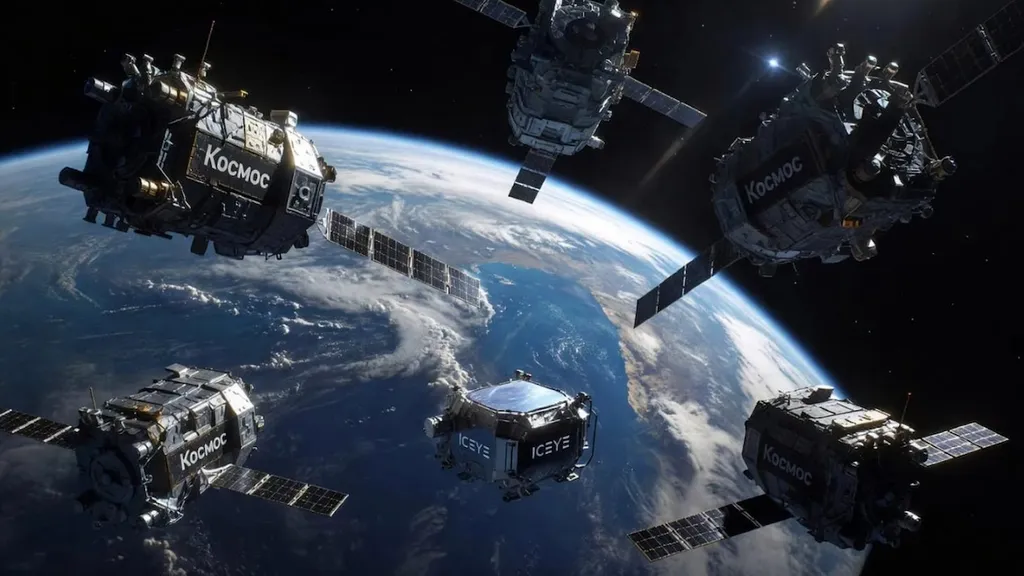
Russia has repositioned five of its Cosmos military satellites, aligning them with the ICEYE-X36 satellite, which is crucial for Ukraine's military operations. The ICEYE-X36 satellite has significantly enhanced Ukraine's battlefield intelligence capabilities, allowing for detailed tracking of enemy movements. There are concerns that Russia's satellite maneuvering may indicate preparations for a major offensive in Ukraine, although no concrete evidence has been presented yet.
- ▪Russia repositioned five Cosmos military satellites to align with ICEYE-X36.
- ▪ICEYE-X36 has revolutionized battlefield intelligence for Ukraine, producing thousands of images and identifying key military assets.
- ▪There are speculations about a potential Russian offensive in Ukraine, although no solid evidence supports this claim.
Asia Times files mainly under world. We currently carry 156 of its stories.
Story provenance
Source · retrieval · rights · ranking — open for full record
inspect →
Attribution is not the same as permission. This drawer separates discovery metadata, excerpts, WeSearch-generated summaries, reuse status, and whether the publisher receives the visit. Nothing here claims a legal grant the publisher has not made.
Record
| Original publisher | Asia Times |
| Canonical URL | https://asiatimes.com/2026/05/russias-military-satellite-moves-signal-new-ukraine-war-surge/ |
| Publication time | Mon, 25 May 2026 05:05:01 +0000 |
| Retrieval time | 2026-05-25T05:07:36.227Z |
| Last seen | 2026-05-25T05:07:36.227Z |
| Headline source | Publisher (no WeSearch rewrite) |
| Excerpt source | publisher body |
| Excerpt method | First ~120 words (~800 chars) of extracted publisher body, fair-use limited. |
| Summary | WeSearch · cerebras-chat (WeSearch summarizer) |
| Summary source text | contentText |
| Citation coverage | Summary is a WeSearch-generated derivative; primary citation is the original publisher URL. |
| Cluster | AFMFpROCJh1L |
| Cluster logic | Grouped by semantic title/content similarity across sources within a rolling window. Same-publisher template collisions are excluded from coverage comparison. |
| Ranking reason | Story pages are not engagement-ranked. Hub feeds use recency, with optional source-diversified chronological ordering (cap consecutive stories per source). No personalized ranking. |
| Publisher visit | Yes — open original |
| Substitutes article? | No — link-out required for full text |
Rights status (four layers)
WeSearch handling by dimension
| Indexing | May the item be indexed (stored, ranked, made findable)? | Allowed |
| Snippet | May a short excerpt of the publisher's text be shown? | Allowed |
| AI summary | May WeSearch generate its own short summary of the article? | Limited |
| Retrieval / RAG | May the content be exposed for third-party retrieval-augmented generation? | Not asserted |
| Model training | May the content be used to train AI models? | Not asserted |
| Commercial reuse | May the content be reused commercially? | Not permitted |
Basis: Derived from the published RSS/Atom feed. Contact: [email protected]. Reviewed: 2026-07-24.
Opening excerpt (first ~120 words) tap to expand
Between May 14 and 20, Russia repositioned five of six recently launched Cosmos military satellites from an orbital inclination of 97 degrees to 97.8 degrees, putting the Cosmos satellites on the same orbital plane as a satellite known as ICEYE-X36. ICEYE is a Finnish-American aerospace and data company that designs, builds and operates the world’s largest constellation of Synthetic Aperature Radar (SAR) satellites. Russia’s repositioning of five Cosmos satellites, specifically Cosmos 2610, 2611, 2612, 2613 and 2614, is an unprecedented move. According to Integrity ISR, ICEYE-X36 was launched March 4, 2024 from Vandenberg on a SpaceX Falcon 9. It’s registered under ICEYE US, has a mass of ~90 kilograms and is one node in a 44+ satellite constellation that Ukraine can task.
…
Excerpt limited to ~120 words for fair-use compliance. The full article is at Asia Times.
Discussion
0 commentsMore from Asia Times