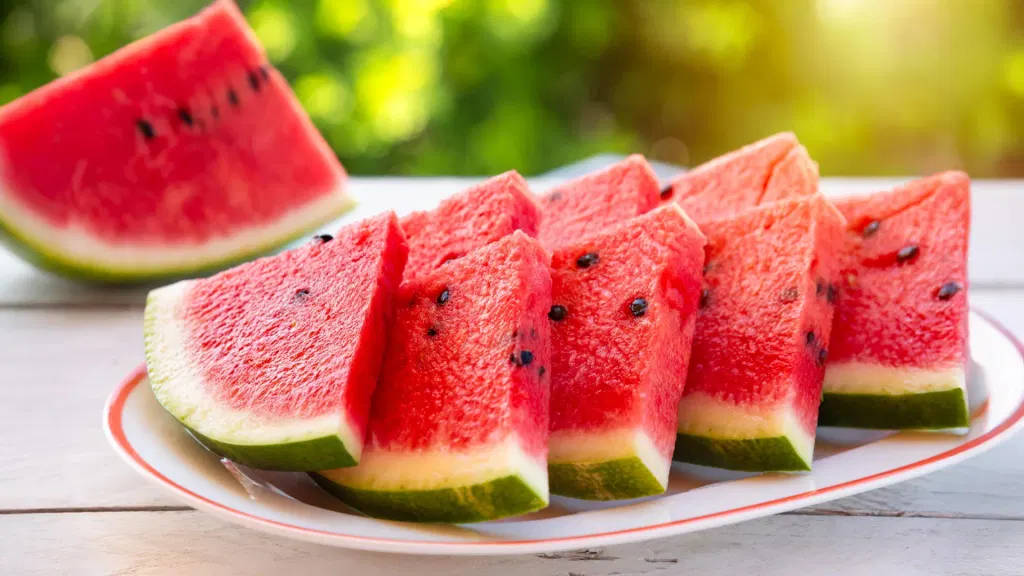
Scientists uncover surprising health benefits of watermelon
Research suggests watermelon consumption is linked to improved diet quality and heart health. People who eat watermelon tend to have higher intakes of key nutrients and lower intakes of added sugars and saturated fats. Compounds in watermelon, such as L-citrulline and lycopene, may support blood vessel function and cardiovascular health.
- ▪Watermelon consumers have higher diet quality, with more fiber, vitamins, and antioxidants, according to NHANES data.
- ▪Watermelon juice may help maintain blood vessel function during high blood sugar due to its L-citrulline and L-arginine content.
- ▪Studies show watermelon is a rich natural source of lycopene and other antioxidants that reduce oxidative stress.
- ▪A clinical trial found watermelon juice positively influenced vascular function and heart rate variability in healthy adults.
- ▪Researchers emphasize the need for larger, long-term studies to confirm watermelon's cardio-metabolic benefits.
ScienceDaily files mainly under science. We currently carry 88 of its stories.
Story provenance
Source · retrieval · rights · ranking — open for full record
inspect →
Story provenance
Attribution is not the same as permission. This drawer separates discovery metadata, excerpts, WeSearch-generated summaries, reuse status, and whether the publisher receives the visit. Nothing here claims a legal grant the publisher has not made.
Record
| Original publisher | ScienceDaily |
| Canonical URL | https://www.sciencedaily.com/releases/2026/05/260517030515.htm |
| Publication time | Sun, 17 May 2026 08:56:21 EDT |
| Retrieval time | 2026-05-17T13:02:13.089Z |
| Last seen | 2026-05-17T13:02:13.089Z |
| Headline source | Publisher (no WeSearch rewrite) |
| Excerpt source | publisher body |
| Excerpt method | First ~120 words (~800 chars) of extracted publisher body, fair-use limited. |
| Summary | WeSearch · cerebras-chat (WeSearch summarizer) |
| Summary source text | contentText |
| Citation coverage | Summary is a WeSearch-generated derivative; primary citation is the original publisher URL. |
| Cluster | dfwkg0byE4PZ |
| Cluster logic | Grouped by semantic title/content similarity across sources within a rolling window. Same-publisher template collisions are excluded from coverage comparison. |
| Ranking reason | Story pages are not engagement-ranked. Hub feeds use recency, with optional source-diversified chronological ordering (cap consecutive stories per source). No personalized ranking. |
| Publisher visit | Yes — open original |
| Substitutes article? | No — link-out required for full text |
Rights status (four layers)
WeSearch handling by dimension
| Indexing | May the item be indexed (stored, ranked, made findable)? | Allowed |
| Snippet | May a short excerpt of the publisher's text be shown? | Allowed |
| AI summary | May WeSearch generate its own short summary of the article? | Limited |
| Retrieval / RAG | May the content be exposed for third-party retrieval-augmented generation? | Not asserted |
| Model training | May the content be used to train AI models? | Not asserted |
| Commercial reuse | May the content be reused commercially? | Not permitted |
Basis: Derived from the published RSS/Atom feed. Contact: [email protected]. Reviewed: 2026-07-24.
Opening excerpt (first ~120 words) tap to expand
Science News from research organizations Scientists uncover surprising health benefits of watermelon Research suggests watermelon could be one of summer’s tastiest secrets for better heart health and nutrition. Date: May 17, 2026 Source: Wild Hive Summary: Studies suggest watermelon could be a hidden powerhouse for better health. Researchers found that people who eat watermelon tend to have higher-quality diets packed with more vitamins, fiber, and antioxidants — while consuming less added sugar and saturated fat. Another study showed watermelon juice may help protect blood vessel function and support heart health. Share: Facebook Twitter Pinterest LinkedIN Email FULL STORY Watermelon lovers may be getting a bigger health boost than they realize.
…
Excerpt limited to ~120 words for fair-use compliance. The full article is at ScienceDaily.
Discussion
0 commentsMore from ScienceDaily