Seeing Is Not Believing: Realistic AI Videos Disrupt Confidence in Real Videos
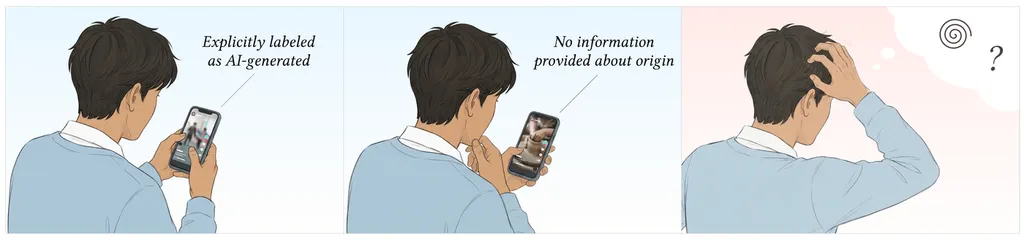
The rise of realistic AI-generated videos is disrupting people's confidence in real videos, even when the synthetic content is clearly disclosed. A recent study found that participants who were exposed to AI-generated videos were more likely to doubt the authenticity of subsequent human-generated videos. This suggests that the effects of AI-generated content on perception and psychology are more complex than previously thought.
- ▪Generative video models can produce synthetic footage that closely resembles real-world scenes.
- ▪Exposure to AI-generated videos can increase doubt about the authenticity of subsequent human-generated videos.
- ▪The effects of AI-generated content on perception and psychology can occur even when the content is clearly disclosed.
Hacker News (AI / LLM) files mainly under ai. We currently carry 2,092 of its stories.
Opening excerpt (first ~120 words) tap to expand
Abstract Visual media has long served as a reference for what feels real, but generative video models now produce synthetic footage closely resembling real-world scenes. Such media increasingly appears in short-form social feeds, where AI-generated and human-generated videos are consumed in rapid succession. While prior work has focused on detecting synthetic content, less is known about how exposure to such content shapes perception of subsequent human- generated media. We conducted a two-phase study (𝑁 = 100), comparing participants first exposed to AI-generated videos to a control group viewing human-generated videos, before both groups transitioned to human-generated content.
…
Excerpt limited to ~120 words for fair-use compliance. The full article is at MIT Media Lab.
Discussion
0 commentsMore from MIT Media Lab