Show HN: A Stateful LLM API that works across providers
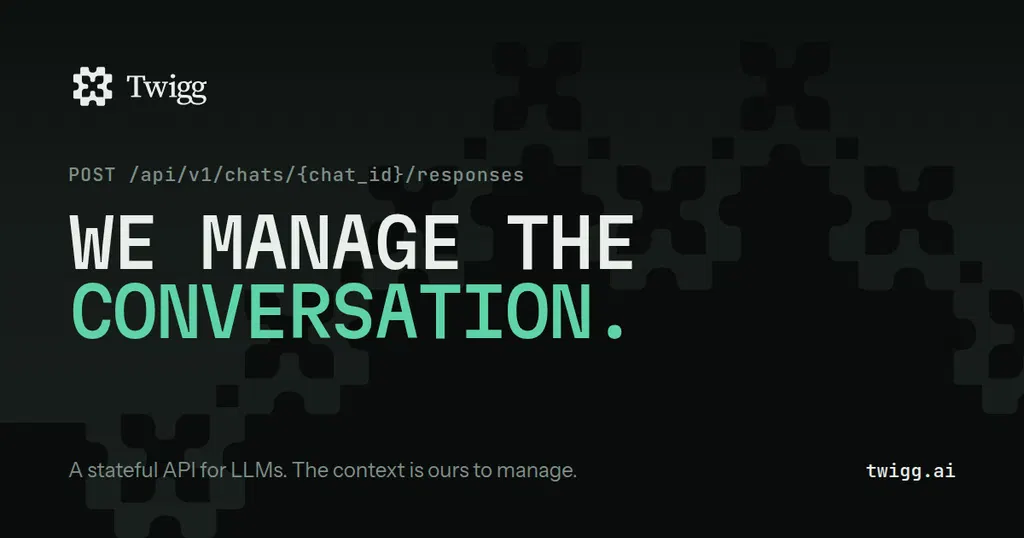
Twigg is a stateful API designed to simplify interactions with Large Language Models by managing conversation context internally. It allows developers to create chats, send events, and switch between different LLM providers without handling context storage or assembly manually. The service also provides cost reporting for each request and supports multiple major AI providers through a unified interface.
- ▪Twigg manages conversation context internally, allowing users to send only the next event without worrying about context storage.
- ▪The API routes requests to various providers including Anthropic, OpenAI, Google, xAI, Fireworks, and OpenRouter.
- ▪Users can switch models mid-conversation while the system fits the context to each model's specific window size.
- ▪The service reports the cost of every request made through the API.
- ▪Documentation is available in markdown format at specific URLs, and the API is authenticated using a bearer token.
Hacker News (AI / LLM) files mainly under ai. We currently carry 5,160 of its stories.
Story provenance
Source · retrieval · rights · ranking — open for full record
inspect →
Story provenance
Attribution is not the same as permission. This drawer separates discovery metadata, excerpts, WeSearch-generated summaries, reuse status, and whether the publisher receives the visit. Nothing here claims a legal grant the publisher has not made.
Record
| Original publisher | Twigg |
| Canonical URL | https://twigg.ai |
| Publication time | Wed, 16 Sep 2026 13:53:49 +0000 |
| Retrieval time | 2026-09-16T13:58:41.568Z |
| Last seen | 2026-09-16T13:58:41.568Z |
| Headline source | Publisher (no WeSearch rewrite) |
| Excerpt source | publisher body |
| Excerpt method | First ~120 words (~800 chars) of extracted publisher body, fair-use limited. |
| Summary | WeSearch · cerebras-chat (WeSearch summarizer) |
| Summary source text | contentText |
| Citation coverage | Summary is a WeSearch-generated derivative; primary citation is the original publisher URL. |
| Cluster | Hqvt-q3ST9ao · 1 stories |
| Cluster logic | Grouped by semantic title/content similarity across sources within a rolling window. Same-publisher template collisions are excluded from coverage comparison. |
| Ranking reason | Story pages are not engagement-ranked. Hub feeds use recency, with optional source-diversified chronological ordering (cap consecutive stories per source). No personalized ranking. |
| Publisher visit | Yes — open original |
| Substitutes article? | No — link-out required for full text |
Rights status (four layers)
WeSearch handling by dimension
| Indexing | May the item be indexed (stored, ranked, made findable)? | Allowed |
| Snippet | May a short excerpt of the publisher's text be shown? | Allowed |
| AI summary | May WeSearch generate its own short summary of the article? | Limited |
| Retrieval / RAG | May the content be exposed for third-party retrieval-augmented generation? | Not asserted |
| Model training | May the content be used to train AI models? | Not asserted |
| Commercial reuse | May the content be reused commercially? | Not permitted |
Basis: Derived from the published RSS/Atom feed. Contact: [email protected]. Reviewed: 2026-07-24.
Opening excerpt (first ~120 words) tap to expand
We manage the conversation. Twigg is a stateful API for interacting with LLMs. Simply create a chat, send events to it, and receive responses. The context is all managed and stored internally so you don't have to worry about it. A hosted context store, assembler and model router. Create a chat once, send only the next event, switch models mid-conversation. Conversations live outside the LLM providers. Get started or read the docs. Twigg is one API for LLM use. It stores the conversation, fits it to each model's context window, routes it to Anthropic, OpenAI, Google, xAI, Fireworks or OpenRouter, and reports what every request cost. This website is a JavaScript app, so a plain fetch of any page returns only this text.
…
Excerpt limited to ~120 words for fair-use compliance. The full article is at Twigg.
Discussion
0 commentsMore from Twigg