Show HN: iClaw is part OpenClaw, part Siri, powered by Apple Intelligence
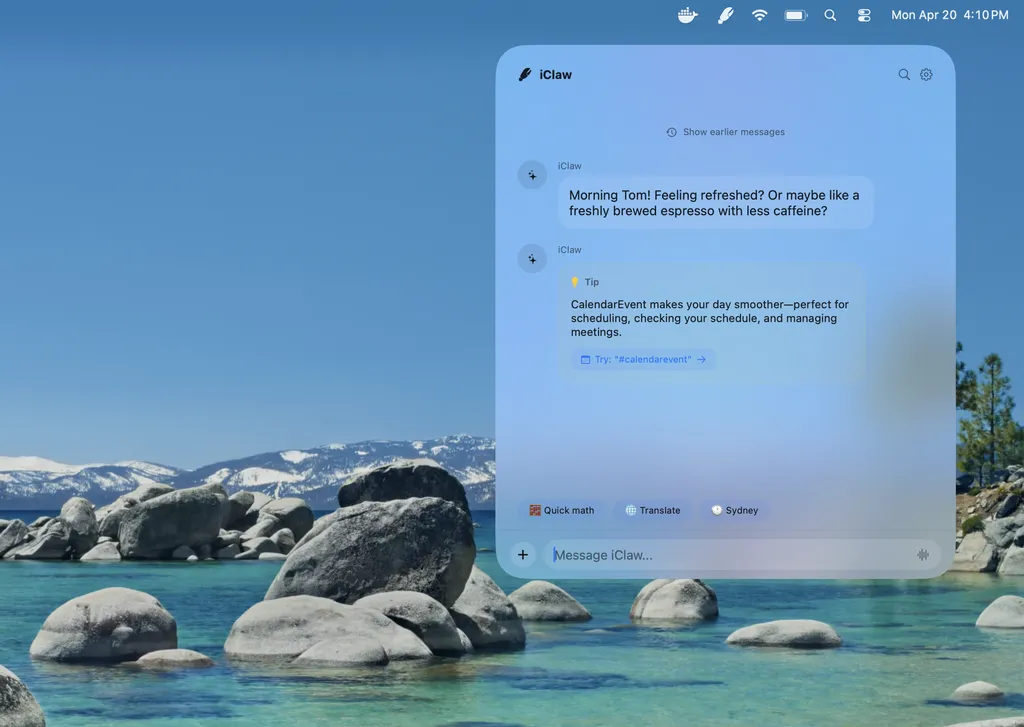
iClaw is an experimental local AI agent for macOS that prioritizes safety and privacy. It is designed to utilize existing Apple Intelligence without requiring additional subscriptions or credits. While currently limited in functionality, iClaw has potential for future enhancements and applications.
- ▪iClaw started as a SundAI hackathon project in March and aims to make AI more accessible to non-technical users.
- ▪It operates within Apple's App Sandbox, ensuring that it only accesses data with explicit user permission.
- ▪Current capabilities include basic tasks like checking the weather and reading calendar events, but it struggles with complex instructions.
Story provenance
Source · retrieval · rights · ranking — open for full record
inspect →
Story provenance
Attribution is not the same as permission. This drawer separates discovery metadata, excerpts, WeSearch-generated summaries, reuse status, and whether the publisher receives the visit. Nothing here claims a legal grant the publisher has not made.
Record
| Original publisher | Barrasso |
| Canonical URL | https://barrasso.me/posts/2026-04-27-iclaw-ai-agent-using-apple-intelligence/ |
| Publication time | Tue, 28 Apr 2026 12:42:07 +0000 |
| Retrieval time | 2026-04-28T12:54:31.957Z |
| Last seen | 2026-04-28T12:54:31.957Z |
| Headline source | Publisher (no WeSearch rewrite) |
| Excerpt source | publisher body |
| Excerpt method | First ~120 words (~800 chars) of extracted publisher body, fair-use limited. |
| Summary | WeSearch · cerebras-chat (WeSearch summarizer) |
| Summary source text | contentText |
| Citation coverage | Summary is a WeSearch-generated derivative; primary citation is the original publisher URL. |
| Cluster | aOr4N9gWq5Tp |
| Cluster logic | Grouped by semantic title/content similarity across sources within a rolling window. Same-publisher template collisions are excluded from coverage comparison. |
| Ranking reason | Story pages are not engagement-ranked. Hub feeds use recency, with optional source-diversified chronological ordering (cap consecutive stories per source). No personalized ranking. |
| Publisher visit | Yes — open original |
| Substitutes article? | No — link-out required for full text |
Rights status (four layers)
WeSearch handling by dimension
| Indexing | May the item be indexed (stored, ranked, made findable)? | Allowed |
| Snippet | May a short excerpt of the publisher's text be shown? | Allowed |
| AI summary | May WeSearch generate its own short summary of the article? | Limited |
| Retrieval / RAG | May the content be exposed for third-party retrieval-augmented generation? | Not asserted |
| Model training | May the content be used to train AI models? | Not asserted |
| Commercial reuse | May the content be reused commercially? | Not permitted |
Basis: Derived from the published RSS/Atom feed. Contact: [email protected]. Reviewed: 2026-07-24.
Opening excerpt (first ~120 words) tap to expand
I recently shared Junco, an on-device AI agent that uses Apple Intelligence to write and edit Swift code. Today I’m sharing iClaw, an experimental local AI agent for macOS designed around safety and privacy.Screen recording of iClaw local AI agent on macOSiClaw started as a SundAI hackathon project in March. Although our demo failed, we learned many lessons I’ll share. But first:Why Build iClaw? #Technologies like OpenClaw are transformative, and while it’s among the fastest-growing GitHub repositories, it hasn’t crossed the chasm into mainstream use. I suspect non-technical users lack the time, knowledge, patience, and risk appetite to purchase a Mac Mini and AI credits, configure agents, and give them access to their personal accounts.iClaw is fundamentally different.
…
Excerpt limited to ~120 words for fair-use compliance. The full article is at Barrasso.
Discussion
0 commentsMore from Barrasso