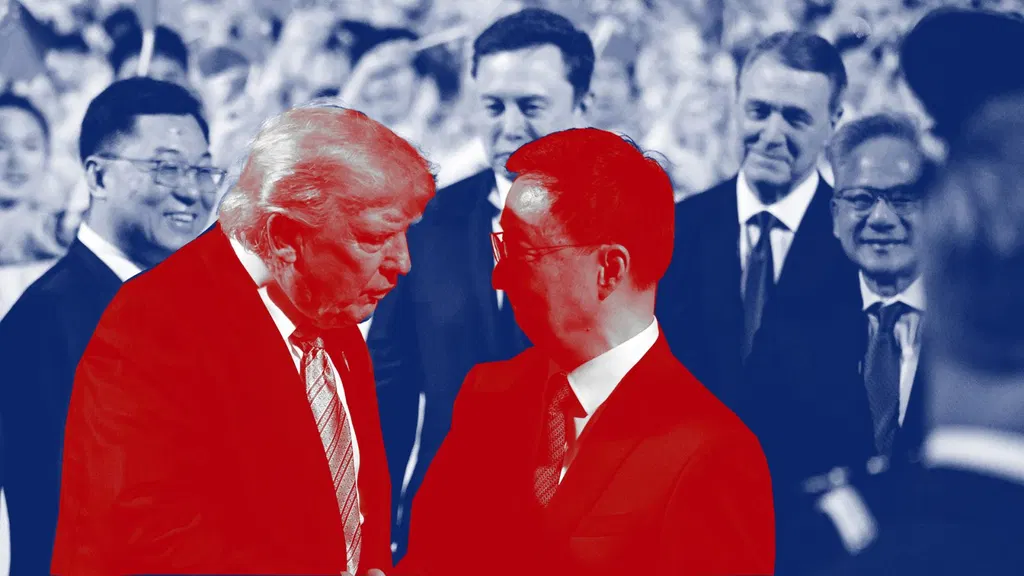
Silicon Valley keeps misreading China’s role in tech
Silicon Valley's perception of China's role in technology is often misaligned with the reality faced by major companies. While many in the tech community view China as an adversary, leaders from Tesla, Apple, and Nvidia see it as a peer and have built strong ties with the country. This disconnect between public rhetoric and corporate strategy could have significant implications for the future of U.S.-China relations in the tech sector.
- ▪Tesla, Apple, and Nvidia have established deep ties with China, contrary to the prevailing narrative of competition.
- ▪Apple manufactures most of its iPhones in China, while Tesla delivered a significant portion of its vehicles to Chinese customers.
- ▪Nvidia has maintained a strong presence in China, despite export bans, by smuggling chips and advocating for continued sales.
Rest of World files mainly under tech. We currently carry 40 of its stories.
Story provenance
Source · retrieval · rights · ranking — open for full record
inspect →
Story provenance
Attribution is not the same as permission. This drawer separates discovery metadata, excerpts, WeSearch-generated summaries, reuse status, and whether the publisher receives the visit. Nothing here claims a legal grant the publisher has not made.
Record
| Original publisher | Rest of World |
| Canonical URL | https://restofworld.org/2026/silicon-valley-china-strategy-apple-tesla-nvidia/?utm_source=rss&utm_medium=rss&utm_campaign=feeds |
| Publication time | Tue, 19 May 2026 10:00:00 +0000 |
| Retrieval time | 2026-05-19T10:04:57.575Z |
| Last seen | 2026-05-19T10:04:57.575Z |
| Headline source | Publisher (no WeSearch rewrite) |
| Excerpt source | publisher body |
| Excerpt method | First ~120 words (~800 chars) of extracted publisher body, fair-use limited. |
| Summary | WeSearch · cerebras-chat (WeSearch summarizer) |
| Summary source text | contentText |
| Citation coverage | Summary is a WeSearch-generated derivative; primary citation is the original publisher URL. |
| Cluster | y_gLtXTf1guM |
| Cluster logic | Grouped by semantic title/content similarity across sources within a rolling window. Same-publisher template collisions are excluded from coverage comparison. |
| Ranking reason | Story pages are not engagement-ranked. Hub feeds use recency, with optional source-diversified chronological ordering (cap consecutive stories per source). No personalized ranking. |
| Publisher visit | Yes — open original |
| Substitutes article? | No — link-out required for full text |
Rights status (four layers)
WeSearch handling by dimension
| Indexing | May the item be indexed (stored, ranked, made findable)? | Allowed |
| Snippet | May a short excerpt of the publisher's text be shown? | Allowed |
| AI summary | May WeSearch generate its own short summary of the article? | Limited |
| Retrieval / RAG | May the content be exposed for third-party retrieval-augmented generation? | Not asserted |
| Model training | May the content be used to train AI models? | Not asserted |
| Commercial reuse | May the content be reused commercially? | Not permitted |
Basis: Derived from the published RSS/Atom feed. Contact: [email protected]. Reviewed: 2026-07-24.
Opening excerpt (first ~120 words) tap to expand
Ideas Silicon Valley keeps misreading China’s role in tech The heads of Tesla, Apple, and Nvidia regard Chinese companies as peers, not enemies, unlike most other Silicon Valley founders. By Lex Zhao Lex Zhao is a managing partner at venture firm One Way Ventures. 19 May 2026 Getty Images/Rest of World Getty Images/Rest of World By Lex Zhao 19 May 2026 Ideas Silicon Valley keeps misreading China’s role in tech By Lex Zhao > Ideas Arguments, opinions and essays from a global perspective. When Donald Trump arrived in Beijing last week for his first state visit to China since 2017, he was joined by the CEOs of Tesla, Apple, Nvidia, Micron, Qualcomm, and others. Their presence went against the rhetoric coming out of Washington and Silicon Valley of deteriorating U.S.-China relations.
…
Excerpt limited to ~120 words for fair-use compliance. The full article is at Rest of World.
Discussion
0 commentsMore from Rest of World