
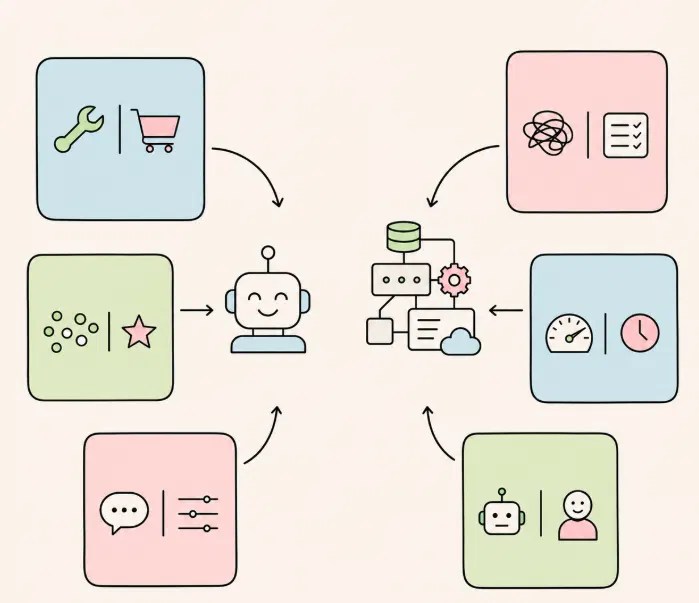
Six Choices Every AI Engineer Has to Make (and Nobody Teaches)
The article discusses six critical trade-offs that AI engineers face once their models are in production. It emphasizes that these decisions are rarely covered in academic courses, yet they significantly impact the effectiveness and cost of AI systems. By exploring these choices, the article aims to provide insights and frameworks to help engineers navigate the complexities of real-world AI deployment.
- ▪AI engineers must make decisions about automation versus human oversight after their models go live.
- ▪Trade-offs include build vs. buy, model complexity vs. maintainability, and data quantity vs. quality.
- ▪Understanding these trade-offs can help teams avoid exceeding budgets and improve system performance.
Towards Data Science files mainly under ai. We currently carry 273 of its stories.
Story provenance
Source · retrieval · rights · ranking — open for full record
inspect →
Story provenance
Attribution is not the same as permission. This drawer separates discovery metadata, excerpts, WeSearch-generated summaries, reuse status, and whether the publisher receives the visit. Nothing here claims a legal grant the publisher has not made.
Record
| Original publisher | Towards Data Science |
| Canonical URL | https://towardsdatascience.com/six-choices-every-ai-engineer-has-to-make-and-nobody-teaches/ |
| Publication time | Mon, 18 May 2026 16:30:00 +0000 |
| Retrieval time | 2026-05-18T16:34:56.666Z |
| Last seen | 2026-05-18T16:34:56.666Z |
| Headline source | Publisher (no WeSearch rewrite) |
| Excerpt source | publisher body |
| Excerpt method | First ~120 words (~800 chars) of extracted publisher body, fair-use limited. |
| Summary | WeSearch · cerebras-chat (WeSearch summarizer) |
| Summary source text | contentText |
| Citation coverage | Summary is a WeSearch-generated derivative; primary citation is the original publisher URL. |
| Cluster | 47xY0bnP0xii |
| Cluster logic | Grouped by semantic title/content similarity across sources within a rolling window. Same-publisher template collisions are excluded from coverage comparison. |
| Ranking reason | Story pages are not engagement-ranked. Hub feeds use recency, with optional source-diversified chronological ordering (cap consecutive stories per source). No personalized ranking. |
| Publisher visit | Yes — open original |
| Substitutes article? | No — link-out required for full text |
Rights status (four layers)
WeSearch handling by dimension
| Indexing | May the item be indexed (stored, ranked, made findable)? | Allowed |
| Snippet | May a short excerpt of the publisher's text be shown? | Allowed |
| AI summary | May WeSearch generate its own short summary of the article? | Limited |
| Retrieval / RAG | May the content be exposed for third-party retrieval-augmented generation? | Not asserted |
| Model training | May the content be used to train AI models? | Not asserted |
| Commercial reuse | May the content be reused commercially? | Not permitted |
Basis: Derived from the published RSS/Atom feed. Contact: [email protected]. Reviewed: 2026-07-24.
Opening excerpt (first ~120 words) tap to expand
Artificial Intelligence Six Choices Every AI Engineer Has to Make (and Nobody Teaches) The production trade-offs that only appear once your model is live. Sara Nobrega May 18, 2026 10 min read Share Image generated with DALL-E. University courses teach you how to make a model accurate. They rarely teach you the decisions that come right after. How do you know when to fully automate something versus keeping a human in the loop? When does prompting stop being enough and fine-tuning become worth the cost? What does it actually mean to pick real-time inference over batch when the bill arrives? These questions don’t show up in coursework. They show up your first week in production! This article walks through 6 trade-offs that show up in production AI work.
…
Excerpt limited to ~120 words for fair-use compliance. The full article is at Towards Data Science.