Skill Distillation
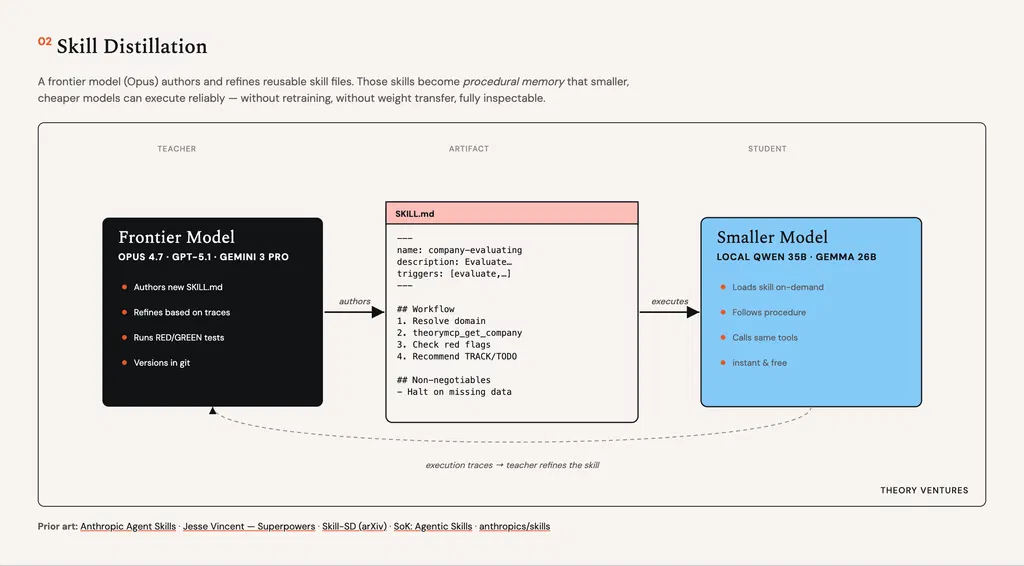
Skill distillation is a method where advanced AI models teach smaller models how to perform tasks. This process involves a structured approach with layers that include a knowledge base, skill files, and an iterative agent loop. The smaller models execute the learned procedures without needing to understand the underlying evaluations, making the system efficient and adaptable.
- ▪Skill distillation involves a frontier model teaching smaller models through markdown files.
- ▪The system includes a local knowledge base, atomic skill files, and an iterative agent loop.
- ▪This approach differs from classical knowledge distillation by focusing on procedural knowledge rather than just compressing model outputs.
Hacker News (Newest) files mainly under programming. We currently carry 5,305 of its stories.
Story provenance
Source · retrieval · rights · ranking — open for full record
inspect →
Story provenance
Attribution is not the same as permission. This drawer separates discovery metadata, excerpts, WeSearch-generated summaries, reuse status, and whether the publisher receives the visit. Nothing here claims a legal grant the publisher has not made.
Record
| Original publisher | Tomasz Tunguz |
| Canonical URL | https://tomtunguz.com/the-pi-agent-skill-distillation/ |
| Publication time | Sat, 30 May 2026 14:48:31 +0000 |
| Retrieval time | 2026-05-30T14:59:38.696Z |
| Last seen | 2026-05-30T14:59:38.696Z |
| Headline source | Publisher (no WeSearch rewrite) |
| Excerpt source | publisher body |
| Excerpt method | First ~120 words (~800 chars) of extracted publisher body, fair-use limited. |
| Summary | WeSearch · cerebras-chat (WeSearch summarizer) |
| Summary source text | contentText |
| Citation coverage | Summary is a WeSearch-generated derivative; primary citation is the original publisher URL. |
| Cluster | None |
| Cluster logic | Not yet clustered, or no peer story found in the clustering window. |
| Ranking reason | Story pages are not engagement-ranked. Hub feeds use recency, with optional source-diversified chronological ordering (cap consecutive stories per source). No personalized ranking. |
| Publisher visit | Yes — open original |
| Substitutes article? | No — link-out required for full text |
Rights status (four layers)
WeSearch handling by dimension
| Indexing | May the item be indexed (stored, ranked, made findable)? | Allowed |
| Snippet | May a short excerpt of the publisher's text be shown? | Allowed |
| AI summary | May WeSearch generate its own short summary of the article? | Limited |
| Retrieval / RAG | May the content be exposed for third-party retrieval-augmented generation? | Not asserted |
| Model training | May the content be used to train AI models? | Not asserted |
| Commercial reuse | May the content be reused commercially? | Not permitted |
Basis: Derived from the published RSS/Atom feed. Contact: [email protected]. Reviewed: 2026-07-24.
Opening excerpt (first ~120 words) tap to expand
Skill Distillation May 29, 2026 AI Agents Productivity I’ve been using state-of-the-art models to teach small models running on my computer how I work. My personal agent, based on Pi, runs my inbox, my deal pipeline, my blog publishing, my calendar, & my research. It looks less like a chatbot & more like a small operating system. The first layer is QMD, a local markdown knowledge base of about eighty workflow files in ~/memories. Before answering any procedural question, the agent searches QMD for the right playbook. The second layer is Skills, atomic SKILL.md files that describe one job each. The skills are written by a frontier model. So are the evaluations that grade them. The same system writes, tests, and rewrites each skill until accuracy converges.
…
Excerpt limited to ~120 words for fair-use compliance. The full article is at Tomasz Tunguz.
Discussion
0 commentsMore from Tomasz Tunguz