
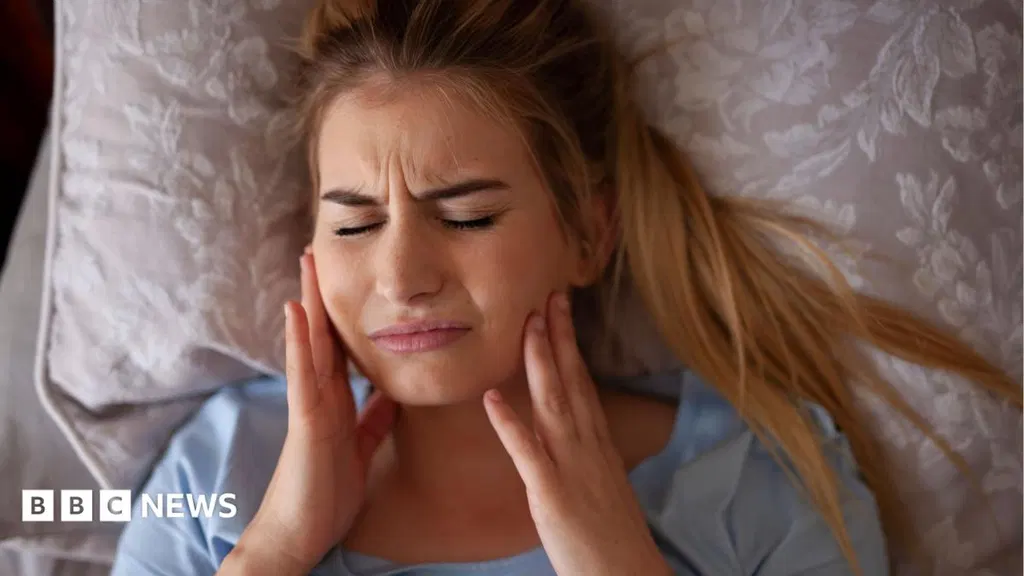
Some dentists say more young people are grinding their teeth - are you one of them?
Some studies suggest nearly one in four people experience the condition, although many may be unaware until symptoms appear.According to the British Dental Association there is some anecdotal evidence that bruxism is becoming more common, but no specific figures. However, some dentists have told the BBC they are worried about the increasing number of young people they're seeing with dental problems caused by incessant gnashing."It is definitely on the rise," Dr Aditi Desai, president of the British Society of Dental Sleep Medicine (BSDSM), says. And can it actually be a good thing in some cases?Bruxism is an umbrella term which groups together four different jaw movements - clenching, grinding, bracing and thrusting.Some people grind at night, others through the day.
- ▪Some studies suggest nearly one in four people experience the condition, although many may be unaware until symptoms appear.According to the British Dental Association there is some anecdotal evidence that bruxism is becoming more common, b
- ▪However, some dentists have told the BBC they are worried about the increasing number of young people they're seeing with dental problems caused by incessant gnashing."It is definitely on the rise," Dr Aditi Desai, president of the British
- ▪And can it actually be a good thing in some cases?Bruxism is an umbrella term which groups together four different jaw movements - clenching, grinding, bracing and thrusting.Some people grind at night, others through the day.
BBC News — UK publishes from United Kingdom and files mainly under news. We currently carry 921 of its stories.
Story provenance
Source · retrieval · rights · ranking — open for full record
inspect →
Story provenance
Attribution is not the same as permission. This drawer separates discovery metadata, excerpts, WeSearch-generated summaries, reuse status, and whether the publisher receives the visit. Nothing here claims a legal grant the publisher has not made.
Record
| Original publisher | BBC News — UK |
| Canonical URL | https://www.bbc.co.uk/news/articles/ckgwe8dk6z6o?at_medium=RSS&at_campaign=rss |
| Publication time | Sat, 12 Sep 2026 23:43:52 GMT |
| Retrieval time | 2026-09-13T02:12:05.887Z |
| Last seen | 2026-09-13T02:12:17.221Z |
| Headline source | Publisher (no WeSearch rewrite) |
| Excerpt source | publisher body |
| Excerpt method | First ~120 words (~800 chars) of extracted publisher body, fair-use limited. |
| Summary | WeSearch · cerebras-chat (WeSearch summarizer) |
| Summary source text | contentText |
| Citation coverage | Summary is a WeSearch-generated derivative; primary citation is the original publisher URL. |
| Cluster | 629pr_AsA0W4 · 1 stories |
| Cluster logic | Grouped by semantic title/content similarity across sources within a rolling window. Same-publisher template collisions are excluded from coverage comparison. |
| Ranking reason | Story pages are not engagement-ranked. Hub feeds use recency, with optional source-diversified chronological ordering (cap consecutive stories per source). No personalized ranking. |
| Publisher visit | Yes — open original |
| Substitutes article? | No — link-out required for full text |
Rights status (four layers)
WeSearch handling by dimension
| Indexing | May the item be indexed (stored, ranked, made findable)? | Allowed |
| Snippet | May a short excerpt of the publisher's text be shown? | Allowed |
| AI summary | May WeSearch generate its own short summary of the article? | Limited |
| Retrieval / RAG | May the content be exposed for third-party retrieval-augmented generation? | Not asserted |
| Model training | May the content be used to train AI models? | Not asserted |
| Commercial reuse | May the content be reused commercially? | Not permitted |
Basis: Derived from the published RSS/Atom feed. Contact: [email protected]. Reviewed: 2026-07-24.
Opening excerpt (first ~120 words) tap to expand
Some dentists say more young people are grinding their teeth - are you one of them?Image source, Getty ImagesImage caption, Nearly one in four people are thought to have bruxism, although most are unaware they grind their teethByRuth CleggHealth and wellbeing reporterPublished2 hours agoElla can't remember when she first started grinding her teeth at night, but she can vividly recall the excruciating jaw ache, the headaches, and being told her molars were disappearing."I was in so much pain," Ella says.
…
Excerpt limited to ~120 words for fair-use compliance. The full article is at BBC News — UK.
Discussion
0 commentsMore from BBC News — UK


