That’s No Moon… That’s an Exoplanet!
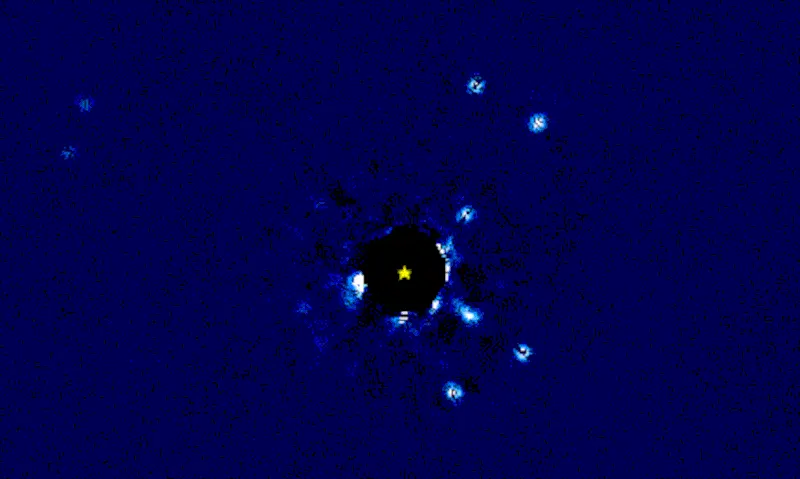
Astronomer Jason Wang has created videos that visualize the orbits of large exoplanets using images collected over many years. The project utilizes motion interpolation to reconstruct planetary positions between sparse data points, relying on the predictable nature of Kepler's laws. This work demonstrates the feasibility of directly observing exoplanets and has contributed to recent scientific publications.
- ▪Jason Wang used images taken over periods of up to 17 years to visualize the orbits of several large exoplanets.
- ▪The technique of motion interpolation is used to reconstruct planetary positions between the limited number of available images.
- ▪Some of the visualizations are based on 10 images taken over 12 years at the Keck Observatory.
- ▪The slow orbital periods of these planets allow for predictable reconstruction using Kepler's laws.
- ▪The visualizations have been used to support scientific papers on exoplanet research.
Hackaday files mainly under tech. We currently carry 516 of its stories.
Story provenance
Source · retrieval · rights · ranking — open for full record
inspect →
Story provenance
Attribution is not the same as permission. This drawer separates discovery metadata, excerpts, WeSearch-generated summaries, reuse status, and whether the publisher receives the visit. Nothing here claims a legal grant the publisher has not made.
Record
| Original publisher | Hackaday |
| Canonical URL | https://hackaday.com/2026/10/03/thats-no-moon-thats-an-exoplanet/ |
| Publication time | Sat, 03 Oct 2026 08:00:24 +0000 |
| Retrieval time | 2026-10-03T08:03:12.591Z |
| Last seen | 2026-10-03T08:03:12.591Z |
| Headline source | Publisher (no WeSearch rewrite) |
| Excerpt source | publisher body |
| Excerpt method | First ~120 words (~800 chars) of extracted publisher body, fair-use limited. |
| Summary | WeSearch · cerebras-chat (WeSearch summarizer) |
| Summary source text | contentText |
| Citation coverage | Summary is a WeSearch-generated derivative; primary citation is the original publisher URL. |
| Cluster | None |
| Cluster logic | Not yet clustered, or no peer story found in the clustering window. |
| Ranking reason | Story pages are not engagement-ranked. Hub feeds use recency, with optional source-diversified chronological ordering (cap consecutive stories per source). No personalized ranking. |
| Publisher visit | Yes — open original |
| Substitutes article? | No — link-out required for full text |
Rights status (four layers)
WeSearch handling by dimension
| Indexing | May the item be indexed (stored, ranked, made findable)? | Allowed |
| Snippet | May a short excerpt of the publisher's text be shown? | Allowed |
| AI summary | May WeSearch generate its own short summary of the article? | Limited |
| Retrieval / RAG | May the content be exposed for third-party retrieval-augmented generation? | Not asserted |
| Model training | May the content be used to train AI models? | Not asserted |
| Commercial reuse | May the content be reused commercially? | Not permitted |
Basis: Derived from the published RSS/Atom feed. Contact: [email protected]. Reviewed: 2026-07-24.
Opening excerpt (first ~120 words) tap to expand
That’s No Moon… That’s An Exoplanet! No comments by: Al Williams October 3, 2026 Title: Copy Short Link: Copy It wasn’t that long ago that a science teacher would have told students that there was no evidence of planets around other star systems. Even more recently, they might have said that while we’ve seen evidence of extra-solar planets, we would never be able to see them directly. But that’s all changed. [Jason Wang] has several videos that use images taken over years to visualize the orbit of several large exoplanets. Of course, some extrapolation is involved. According to [Jason]: We unfortunately do not have the luxury of watching these planets every night and record them.
…
Excerpt limited to ~120 words for fair-use compliance. The full article is at Hackaday.
Discussion
0 commentsMore from Hackaday