The Dollar Was—and Remains—an Accident
A new book titled 'The Almighty Dollar: 500 Years of the World’s Most Powerful Money' by Brendan Greeley explores the origins and evolution of the dollar. Contrary to popular belief, the United States did not invent the dollar, which has a history that dates back to the 16th century. Greeley's research reveals that the dollar was an accidental creation, stemming from historical events in Bohemia and the mining of silver coins.
- ▪The dollar's origins trace back to the 16th century in Bohemia.
- ▪Brendan Greeley, the author, spent years researching the history of the dollar.
- ▪The dollar was not invented by the United States, but is a product of historical circumstances.
Foreign Policy files mainly under world. We currently carry 82 of its stories.
Story provenance
Source · retrieval · rights · ranking — open for full record
inspect →
Story provenance
Attribution is not the same as permission. This drawer separates discovery metadata, excerpts, WeSearch-generated summaries, reuse status, and whether the publisher receives the visit. Nothing here claims a legal grant the publisher has not made.
Record
| Original publisher | Foreign Policy |
| Canonical URL | https://foreignpolicy.com/2026/05/29/us-dollar-history-money-currency-monetary-policy/ |
| Publication time | Fri, 29 May 2026 18:30:44 +0000 |
| Retrieval time | 2026-05-29T18:35:02.465Z |
| Last seen | 2026-05-29T18:35:02.465Z |
| Headline source | Publisher (no WeSearch rewrite) |
| Excerpt source | publisher body |
| Excerpt method | First ~120 words (~800 chars) of extracted publisher body, fair-use limited. |
| Summary | WeSearch · cerebras-chat (WeSearch summarizer) |
| Summary source text | contentText |
| Citation coverage | Summary is a WeSearch-generated derivative; primary citation is the original publisher URL. |
| Cluster | nKDGhrdOGg4N |
| Cluster logic | Grouped by semantic title/content similarity across sources within a rolling window. Same-publisher template collisions are excluded from coverage comparison. |
| Ranking reason | Story pages are not engagement-ranked. Hub feeds use recency, with optional source-diversified chronological ordering (cap consecutive stories per source). No personalized ranking. |
| Publisher visit | Yes — open original |
| Substitutes article? | No — link-out required for full text |
Rights status (four layers)
WeSearch handling by dimension
| Indexing | May the item be indexed (stored, ranked, made findable)? | Allowed |
| Snippet | May a short excerpt of the publisher's text be shown? | Allowed |
| AI summary | May WeSearch generate its own short summary of the article? | Limited |
| Retrieval / RAG | May the content be exposed for third-party retrieval-augmented generation? | Not asserted |
| Model training | May the content be used to train AI models? | Not asserted |
| Commercial reuse | May the content be reused commercially? | Not permitted |
Basis: Derived from the published RSS/Atom feed. Contact: [email protected]. Reviewed: 2026-07-24.
Opening excerpt (first ~120 words) tap to expand
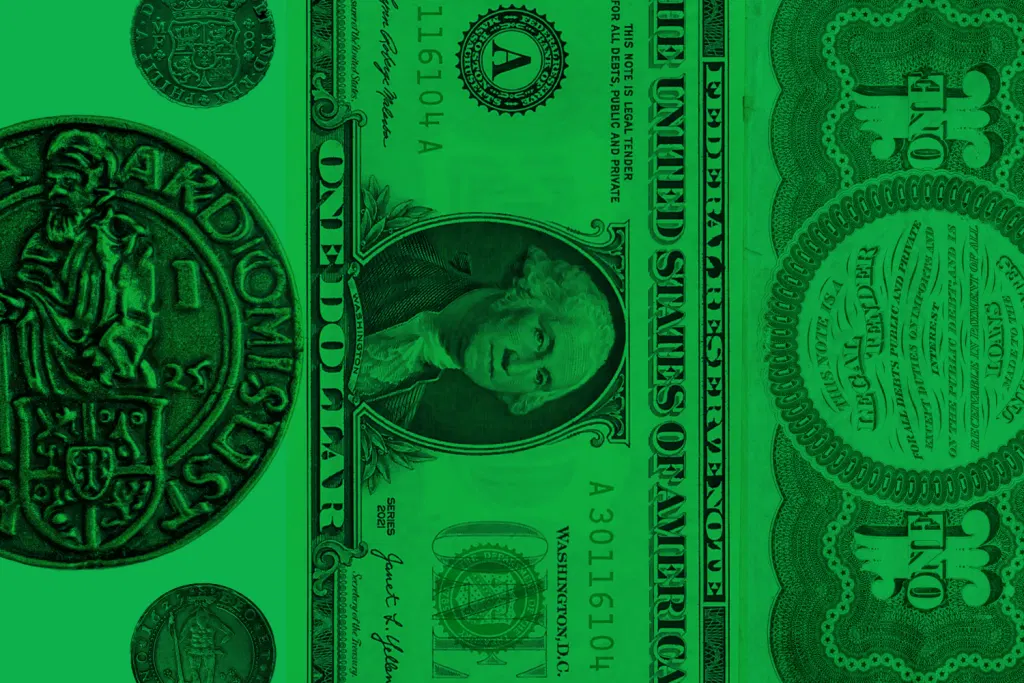
Review The Dollar Was—and Remains—an Accident As a new book shows, the dollar isn’t really the United States’ currency, but a 500-year-old relic. By Chloe Hadavas, a senior editor at Foreign Policy. A monochrome image in shades of bright green. On the left, a large, detailed old coin shows an embossed figure in profile alongside texturing and historical lettering. In the center, the portrait section of a modern U.S. one-dollar bill is visible, showing a man's face looking forward within an oval frame, flanked by serial numbers and the text "FEDERAL RESERVE NOTE." On the right side, intricate, swirling patterns and geometric linework characteristic of paper currency.
…
Excerpt limited to ~120 words for fair-use compliance. The full article is at Foreign Policy.
Discussion
0 commentsMore from Foreign Policy