The evolution of AI-assisted software engineering paradigms
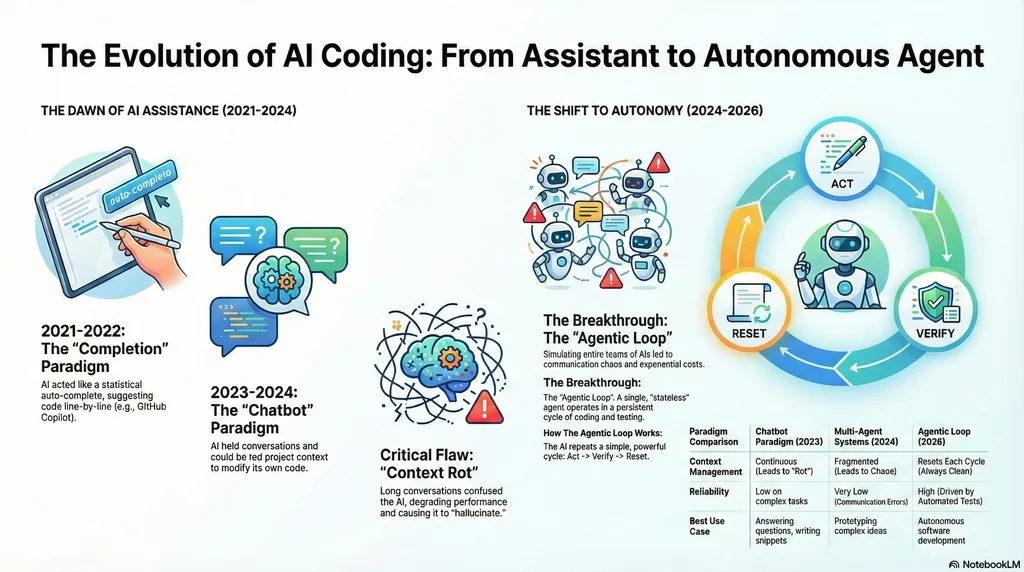
The software development industry is experiencing a significant transformation with the evolution of AI-assisted software engineering paradigms. From early coding assistants to the introduction of the Agentic Loop, these advancements have redefined how developers write code. This article explores the progression from the Completion paradigm to the revolutionary Ralph Loop, highlighting the strengths and limitations of each phase.
- ▪The Completion paradigm, introduced by OpenAI Codex and GitHub Copilot, focused on statistical code completion without long-term reasoning.
- ▪The ChatBot paradigm allowed for technical conversations, enabling developers to request explanations and refactoring, but faced challenges with context degradation.
- ▪Multi-Agent Systems aimed to tackle software complexity but resulted in cost explosions and information loss due to the 'telephone game' effect.
- ▪The Ralph Loop represents a significant shift in AI-assisted software engineering, offering a more effective approach to coding.
Hacker News (Newest) files mainly under programming. We currently carry 5,306 of its stories.
Story provenance
Source · retrieval · rights · ranking — open for full record
inspect →
Attribution is not the same as permission. This drawer separates discovery metadata, excerpts, WeSearch-generated summaries, reuse status, and whether the publisher receives the visit. Nothing here claims a legal grant the publisher has not made.
Record
| Original publisher | Pasquale Pillitteri |
| Canonical URL | https://pasqualepillitteri.it/en/news/182/evolution-ai-software-engineering-paradigms-agentic-loop |
| Publication time | Mon, 25 May 2026 23:18:26 +0000 |
| Retrieval time | 2026-05-25T23:37:40.769Z |
| Last seen | 2026-05-25T23:37:40.769Z |
| Headline source | Publisher (no WeSearch rewrite) |
| Excerpt source | publisher body |
| Excerpt method | First ~120 words (~800 chars) of extracted publisher body, fair-use limited. |
| Summary | WeSearch · cerebras-chat (WeSearch summarizer) |
| Summary source text | contentText |
| Citation coverage | Summary is a WeSearch-generated derivative; primary citation is the original publisher URL. |
| Cluster | t1dnVwIjH-AE |
| Cluster logic | Grouped by semantic title/content similarity across sources within a rolling window. Same-publisher template collisions are excluded from coverage comparison. |
| Ranking reason | Story pages are not engagement-ranked. Hub feeds use recency, with optional source-diversified chronological ordering (cap consecutive stories per source). No personalized ranking. |
| Publisher visit | Yes — open original |
| Substitutes article? | No — link-out required for full text |
Rights status (four layers)
WeSearch handling by dimension
| Indexing | May the item be indexed (stored, ranked, made findable)? | Allowed |
| Snippet | May a short excerpt of the publisher's text be shown? | Allowed |
| AI summary | May WeSearch generate its own short summary of the article? | Limited |
| Retrieval / RAG | May the content be exposed for third-party retrieval-augmented generation? | Not asserted |
| Model training | May the content be used to train AI models? | Not asserted |
| Commercial reuse | May the content be reused commercially? | Not permitted |
Basis: Derived from the published RSS/Atom feed. Contact: [email protected]. Reviewed: 2026-07-24.
Opening excerpt (first ~120 words) tap to expand
The software development industry is undergoing an unprecedented metamorphosis. From the simple statistical completion of early coding assistants, through conversational chatbots and the failure of multi-agent systems, we have arrived at the era of the Agentic Loop. In this comprehensive guide, we analyze the entire evolution, from the Completion paradigm to the revolutionary Ralph Loop that is redefining how we write code. The evolution of paradigms: from statistical completion to the Agentic Loop The Dawn of AI Assistance: The Completion Paradigm (2021-2022) The modern history of coding assistants begins with the introduction of OpenAI Codex and its integration into GitHub Copilot. In this embryonic phase, the dominant paradigm was Completion.
…
Excerpt limited to ~120 words for fair-use compliance. The full article is at Pasquale Pillitteri.
Discussion
0 commentsMore from Pasquale Pillitteri