The Future of Consumer AI
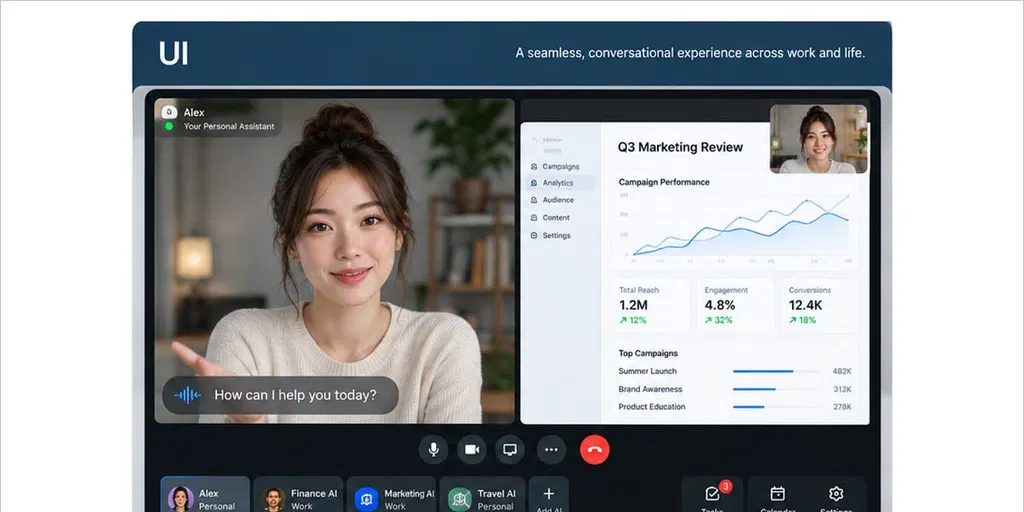
The article predicts that future consumer AI will prioritize deep personalization by maintaining interactive memory stores that track user relationships and context. Model providers are expected to introduce new pricing tiers based on the volume of stored memory, aligning with enterprise software valuation models. Additional anticipated developments include AI avatars, shared collaborative canvases, and hardware integrations like smart set-top boxes and phone cases.
- ▪Consumer AI will evolve to use interactive memory stores that users can view and edit, rather than relying solely on backend RAG systems.
- ▪AI providers will likely add a pricing axis based on memory usage, making services more costly as they accumulate more personal data.
- ▪The future of consumer AI includes features such as personalized avatars and shared canvases for collaborative work.
- ▪Hardware innovations like set-top boxes and specialized phone cases are expected to expand AI's ability to gather contextual data.
Hacker News (AI / LLM) files mainly under ai. We currently carry 5,262 of its stories.
Story provenance
Source · retrieval · rights · ranking — open for full record
inspect →
Story provenance
Attribution is not the same as permission. This drawer separates discovery metadata, excerpts, WeSearch-generated summaries, reuse status, and whether the publisher receives the visit. Nothing here claims a legal grant the publisher has not made.
Record
| Original publisher | Hacker News (AI / LLM) |
| Canonical URL | https://zero2data.substack.com/p/the-future-of-consumer-ai |
| Publication time | Thu, 17 Sep 2026 02:39:16 +0000 |
| Retrieval time | 2026-09-17T02:43:42.680Z |
| Last seen | 2026-09-17T02:43:42.680Z |
| Headline source | Publisher (no WeSearch rewrite) |
| Excerpt source | publisher body |
| Excerpt method | First ~120 words (~800 chars) of extracted publisher body, fair-use limited. |
| Summary | WeSearch · cerebras-chat (WeSearch summarizer) |
| Summary source text | contentText |
| Citation coverage | Summary is a WeSearch-generated derivative; primary citation is the original publisher URL. |
| Cluster | None |
| Cluster logic | Not yet clustered, or no peer story found in the clustering window. |
| Ranking reason | Story pages are not engagement-ranked. Hub feeds use recency, with optional source-diversified chronological ordering (cap consecutive stories per source). No personalized ranking. |
| Publisher visit | Yes — open original |
| Substitutes article? | No — link-out required for full text |
Rights status (four layers)
WeSearch handling by dimension
| Indexing | May the item be indexed (stored, ranked, made findable)? | Allowed |
| Snippet | May a short excerpt of the publisher's text be shown? | Allowed |
| AI summary | May WeSearch generate its own short summary of the article? | Limited |
| Retrieval / RAG | May the content be exposed for third-party retrieval-augmented generation? | Not asserted |
| Model training | May the content be used to train AI models? | Not asserted |
| Commercial reuse | May the content be reused commercially? | Not permitted |
Basis: Derived from the published RSS/Atom feed. Contact: [email protected]. Reviewed: 2026-07-24.
Opening excerpt (first ~120 words) tap to expand
The Future of Consumer AIConsumer AI will be more visual and personal.WillSep 17, 2026ShareThe AI that is the most useful for me is not going to be the AI that is the most useful for you. We live different lives thus we have different context in which the AI should operate. My dentist may be your sister-in-law. AI that knows that person’s relationship to me provides more value than one that does not.AI that builds, remembers, and references that personal context is the future. That future is not going to be markdown files--or RAG--behind the scenes. It will be an interactive memory store (CRM) that we can view and edit together.Model providers will recognize this and add another axis on which to price. They currently charge subscription fees and on token consumption.
…
Excerpt limited to ~120 words for fair-use compliance. The full article is at Hacker News (AI / LLM).
Discussion
0 commentsMore from Hacker News (AI / LLM)