
The Himalayas are melting faster - and India's economy is 'at risk'
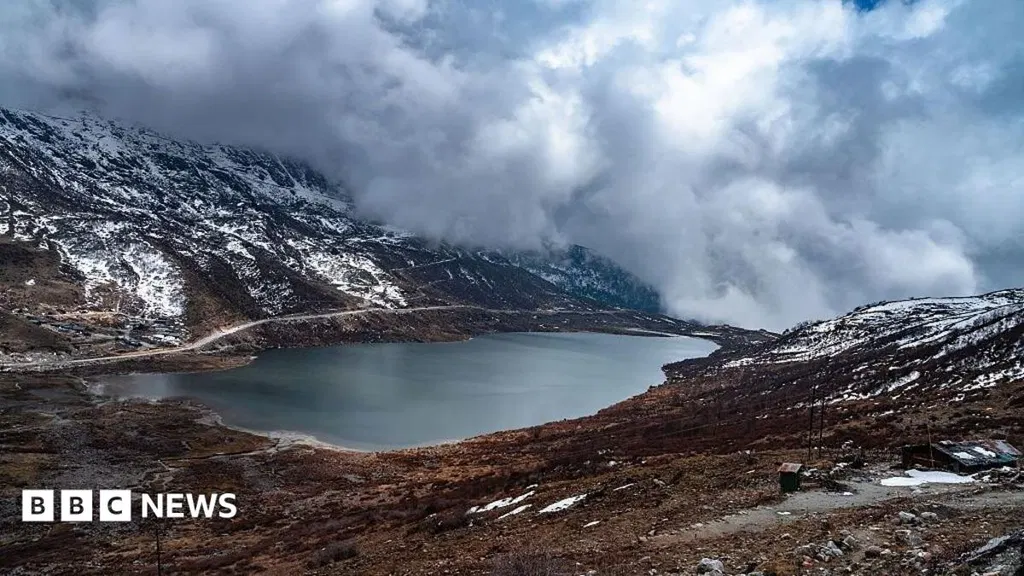
Some 18% of Indian land is Himalayan, yet the region accounts for about 35% of disasters, according to the report.The government told parliament in July that 56 glacial lakes had been classified as "very high risk", external following a 2025 scientific assessment of 189 high-risk lakes in the Indian Himalayan region. The Central Water Commission is monitoring 2,485 glacial lakes larger than 10 hectares across India's Himalayan river basins, the government said.The Himalayas have already seen devastating examples of what can happen when glacial lakes burst their natural dams. In 2023, a glacial lake outburst flood in Sikkim killed at least 70 people and caused widespread damage to roads, bridges and hydropower projects.
- ▪Some 18% of Indian land is Himalayan, yet the region accounts for about 35% of disasters, according to the report.The government told parliament in July that 56 glacial lakes had been classified as "very high risk", external following a 202
- ▪The Central Water Commission is monitoring 2,485 glacial lakes larger than 10 hectares across India's Himalayan river basins, the government said.The Himalayas have already seen devastating examples of what can happen when glacial lakes bur
- ▪In 2023, a glacial lake outburst flood in Sikkim killed at least 70 people and caused widespread damage to roads, bridges and hydropower projects.
BBC News — Science publishes from United Kingdom and files mainly under science. We currently carry 189 of its stories.
Story provenance
Source · retrieval · rights · ranking — open for full record
inspect →
Story provenance
Attribution is not the same as permission. This drawer separates discovery metadata, excerpts, WeSearch-generated summaries, reuse status, and whether the publisher receives the visit. Nothing here claims a legal grant the publisher has not made.
Record
| Original publisher | BBC News — Science |
| Canonical URL | https://www.bbc.co.uk/news/articles/crm9ezvwjpno?at_medium=RSS&at_campaign=rss |
| Publication time | Sun, 13 Sep 2026 22:07:22 GMT |
| Retrieval time | 2026-09-13T22:11:50.836Z |
| Last seen | 2026-09-13T22:11:50.836Z |
| Headline source | Publisher (no WeSearch rewrite) |
| Excerpt source | publisher body |
| Excerpt method | First ~120 words (~800 chars) of extracted publisher body, fair-use limited. |
| Summary | WeSearch · cerebras-chat (WeSearch summarizer) |
| Summary source text | contentText |
| Citation coverage | Summary is a WeSearch-generated derivative; primary citation is the original publisher URL. |
| Cluster | byAx9TAw68ai · 1 stories |
| Cluster logic | Grouped by semantic title/content similarity across sources within a rolling window. Same-publisher template collisions are excluded from coverage comparison. |
| Ranking reason | Story pages are not engagement-ranked. Hub feeds use recency, with optional source-diversified chronological ordering (cap consecutive stories per source). No personalized ranking. |
| Publisher visit | Yes — open original |
| Substitutes article? | No — link-out required for full text |
Rights status (four layers)
WeSearch handling by dimension
| Indexing | May the item be indexed (stored, ranked, made findable)? | Allowed |
| Snippet | May a short excerpt of the publisher's text be shown? | Allowed |
| AI summary | May WeSearch generate its own short summary of the article? | Limited |
| Retrieval / RAG | May the content be exposed for third-party retrieval-augmented generation? | Not asserted |
| Model training | May the content be used to train AI models? | Not asserted |
| Commercial reuse | May the content be reused commercially? | Not permitted |
Basis: Derived from the published RSS/Atom feed. Contact: [email protected]. Reviewed: 2026-07-24.
Opening excerpt (first ~120 words) tap to expand
The Himalayas are melting faster - and India's economy is 'at risk'Image source, Nur Photo via Getty ImagesImage caption, India's government says 56 glacial lakes had been classified as "very high risk"BySoutik BiswasIndia correspondentPublished1 minute agoThe Himalayas are approaching a dangerous threshold as glaciers melt faster, glacial lakes grow more unstable and the mountains face a widening gap in monitoring, according to new research.The findings come in the aftermath of devastating floods in Nepal and Tibet, which killed more than 1,300 people and caused widespread destruction, highlighting the growing risks from a rapidly changing Himalayan environment.Himalayan glaciers are now losing mass 65% faster than they were a decade ago, the report by global consultancy Systemiq,…
Excerpt limited to ~120 words for fair-use compliance. The full article is at BBC News — Science.
Discussion
0 commentsMore from BBC News — Science


