The rise of the fruit that tastes like custard
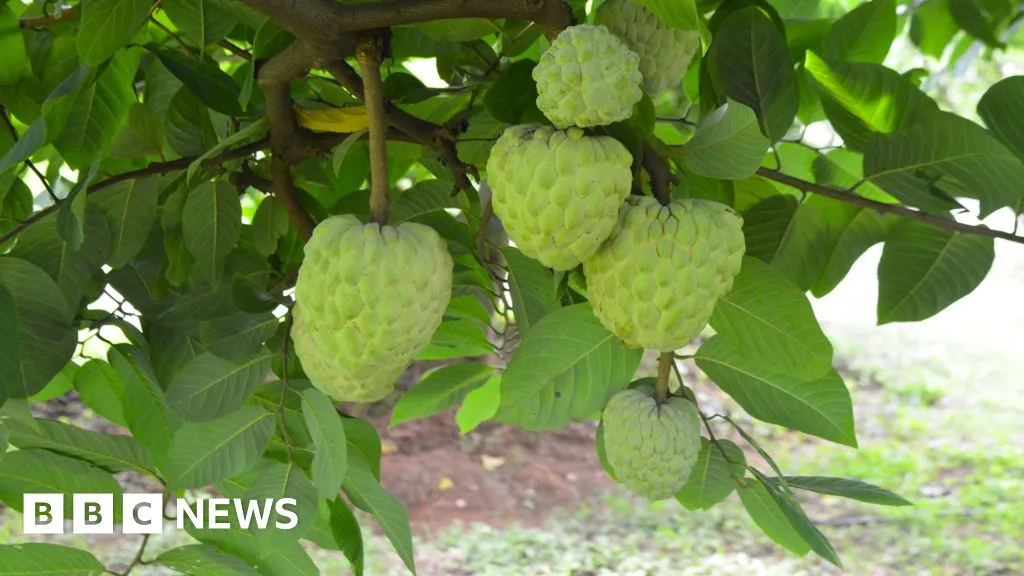
The custard apple, a fruit that resembles an avocado and has a creamy texture, is gaining popularity among farmers in India due to its resilience in drought conditions. Farmers like Ashoka Shivareddy and Navnath Malhari Kaspate are experimenting with hybrid varieties to improve yield and shelf life. The demand for custard apples is increasing both domestically and internationally, leading to new export opportunities.
- ▪Custard apple trees can survive months without watering, making them suitable for drought-prone areas.
- ▪Hybrid varieties like Arka Sahan have been developed to improve pulp content and shelf life, doubling usable harvests for farmers.
- ▪Maharashtra is the leading producer of custard apples in India, accounting for nearly a third of the national output.
BBC News — Tech publishes from United Kingdom and files mainly under tech. We currently carry 48 of its stories.
Story provenance
Source · retrieval · rights · ranking — open for full record
inspect →
Story provenance
Attribution is not the same as permission. This drawer separates discovery metadata, excerpts, WeSearch-generated summaries, reuse status, and whether the publisher receives the visit. Nothing here claims a legal grant the publisher has not made.
Record
| Original publisher | BBC News — Tech |
| Canonical URL | https://www.bbc.com/news/articles/ce8pmrp0m47o?at_medium=RSS&at_campaign=rss |
| Publication time | Mon, 25 May 2026 23:27:04 GMT |
| Retrieval time | 2026-05-25T23:32:40.625Z |
| Last seen | 2026-05-25T23:32:40.625Z |
| Headline source | Publisher (no WeSearch rewrite) |
| Excerpt source | publisher body |
| Excerpt method | First ~120 words (~800 chars) of extracted publisher body, fair-use limited. |
| Summary | WeSearch · cerebras-chat (WeSearch summarizer) |
| Summary source text | contentText |
| Citation coverage | Summary is a WeSearch-generated derivative; primary citation is the original publisher URL. |
| Cluster | D6EK7bIZt4MT |
| Cluster logic | Grouped by semantic title/content similarity across sources within a rolling window. Same-publisher template collisions are excluded from coverage comparison. |
| Ranking reason | Story pages are not engagement-ranked. Hub feeds use recency, with optional source-diversified chronological ordering (cap consecutive stories per source). No personalized ranking. |
| Publisher visit | Yes — open original |
| Substitutes article? | No — link-out required for full text |
Rights status (four layers)
WeSearch handling by dimension
| Indexing | May the item be indexed (stored, ranked, made findable)? | Allowed |
| Snippet | May a short excerpt of the publisher's text be shown? | Allowed |
| AI summary | May WeSearch generate its own short summary of the article? | Limited |
| Retrieval / RAG | May the content be exposed for third-party retrieval-augmented generation? | Not asserted |
| Model training | May the content be used to train AI models? | Not asserted |
| Commercial reuse | May the content be reused commercially? | Not permitted |
Basis: Derived from the published RSS/Atom feed. Contact: [email protected]. Reviewed: 2026-07-24.
Opening excerpt (first ~120 words) tap to expand
The rise of the fruit that tastes like custardJust nowShareSaveAdd as preferred on GooglePriti GuptaTechnology Reporter, MumbaiIIHR BangaloreCustard fruit trees can survive months without wateringAshoka Shivareddy comes from a family of farmers, but it was hard to make a living in their drought-prone district of Kolar in southern India."The area receives rainfall of only 60 to 70 centimetres, and farmers dig borewells of up to 1,300 feet - most of their money goes into chasing water," he says.Amid mounting losses the family gave up farming and in 2005 moved to the city - to Bengaluru - and started a vegetable shop.Shivareddy became an AI software engineer, but he never lost the farming bug.In 2018 he decided to revive the family farm, but with a more scientific approach.
…
Excerpt limited to ~120 words for fair-use compliance. The full article is at BBC News — Tech.
Discussion
0 commentsMore from BBC News — Tech