The Transformation of Documents: Repositories Are the New Unit of Knowledge Work
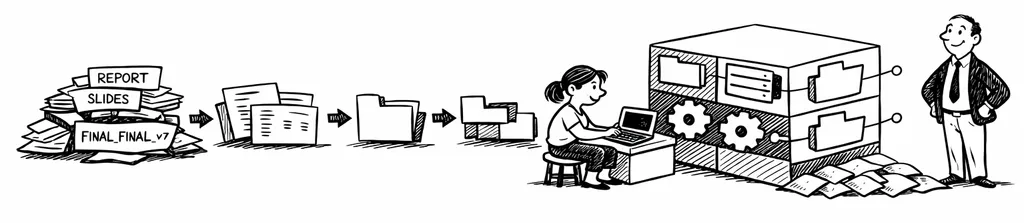
Traditional documents like reports and spreadsheets are limited by human cognitive constraints and are no longer sufficient for AI-driven workflows. Source code repositories, with their support for version control, decomposition, and stable references, are becoming the central medium for collaboration between humans and AI agents. Documents still exist but are increasingly treated as output artifacts generated from repository-stored source, similar to compiled binaries in software development.
- ▪AI agents require stable references, change tracking, and decomposability, which traditional documents lack but repositories provide.
- ▪Platforms like GitHub offer the infrastructure for repositories to serve as shared workspaces between humans and AI agents.
- ▪In the AVA project, human-written policies are converted by AI agents into executable invariant packs, with all collaboration and artifacts managed within a repository.
- ▪Repositories function as the source of truth, while documents become rendered outputs rather than primary work units.
- ▪The repository-centric model is expected to generalize beyond software development to all complex knowledge work processes involving intent, elaboration, and validation.
Hacker News (Newest) files mainly under programming. We currently carry 5,306 of its stories.
Story provenance
Source · retrieval · rights · ranking — open for full record
inspect →
Story provenance
Attribution is not the same as permission. This drawer separates discovery metadata, excerpts, WeSearch-generated summaries, reuse status, and whether the publisher receives the visit. Nothing here claims a legal grant the publisher has not made.
Record
| Original publisher | SIGPLAN Blog |
| Canonical URL | https://blog.sigplan.org/2026/05/15/the-transformation-of-documents-repositories-are-the-new-unit-of-knowledge-work/ |
| Publication time | Sat, 16 May 2026 14:57:03 +0000 |
| Retrieval time | 2026-05-16T15:10:19.235Z |
| Last seen | 2026-05-16T15:10:19.235Z |
| Headline source | Publisher (no WeSearch rewrite) |
| Excerpt source | publisher body |
| Excerpt method | First ~120 words (~800 chars) of extracted publisher body, fair-use limited. |
| Summary | WeSearch · cerebras-chat (WeSearch summarizer) |
| Summary source text | contentText |
| Citation coverage | Summary is a WeSearch-generated derivative; primary citation is the original publisher URL. |
| Cluster | uRbLnGBAdzYR |
| Cluster logic | Grouped by semantic title/content similarity across sources within a rolling window. Same-publisher template collisions are excluded from coverage comparison. |
| Ranking reason | Story pages are not engagement-ranked. Hub feeds use recency, with optional source-diversified chronological ordering (cap consecutive stories per source). No personalized ranking. |
| Publisher visit | Yes — open original |
| Substitutes article? | No — link-out required for full text |
Rights status (four layers)
WeSearch handling by dimension
| Indexing | May the item be indexed (stored, ranked, made findable)? | Allowed |
| Snippet | May a short excerpt of the publisher's text be shown? | Allowed |
| AI summary | May WeSearch generate its own short summary of the article? | Limited |
| Retrieval / RAG | May the content be exposed for third-party retrieval-augmented generation? | Not asserted |
| Model training | May the content be used to train AI models? | Not asserted |
| Commercial reuse | May the content be reused commercially? | Not permitted |
Basis: Derived from the published RSS/Atom feed. Contact: [email protected]. Reviewed: 2026-07-24.
Opening excerpt (first ~120 words) tap to expand
The Transformation of Documents: Repositories Are the New Unit of Knowledge Work by Peli de Hallex, Don Syme, Ben Zorn on May 15, 2026 | Tags: agents, AI, productivity software, software development, software engineering Summary: Traditional documents — reports, slide decks, spreadsheets — are artifacts shaped by human biology: linear, single-file, snapshot-oriented. AI agents need something different: stable references, change tracking, decomposability, etc. Source repositories provide all of these natively. This post argues that the repository is emerging as a primary interaction medium between humans and agents — a workspace where humans declare intent, agents elaborate it into artifacts, and both iterate toward quality.
…
Excerpt limited to ~120 words for fair-use compliance. The full article is at SIGPLAN Blog.
Discussion
0 commentsMore from SIGPLAN Blog