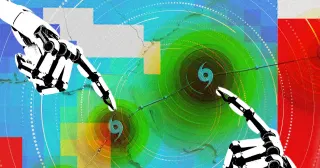
The US Can Put People on the Moon. Why Can’t It Get Iranians Online?

The ongoing conflict between the US and Iran has led to significant challenges for the Iranian populace, particularly due to a nationwide internet blackout. Jason Rezaian, a former Washington Post bureau chief in Tehran, emphasizes the importance of internet access for the Iranian people amid the chaos. The situation remains precarious, with a fragile ceasefire in place and concerns about the potential for the conflict to escalate further.
- ▪The US and Israel have attacked Iran, resulting in widespread chaos and economic damage.
- ▪A nationwide internet blackout imposed by the Iranian regime has hindered communication and information flow.
- ▪Jason Rezaian, who was imprisoned in Iran, advocates for better internet access to help the Iranian people during this crisis.
WIRED files mainly under tech. We currently carry 667 of its stories.
Story provenance
Source · retrieval · rights · ranking — open for full record
inspect →
Story provenance
Attribution is not the same as permission. This drawer separates discovery metadata, excerpts, WeSearch-generated summaries, reuse status, and whether the publisher receives the visit. Nothing here claims a legal grant the publisher has not made.
Record
| Original publisher | WIRED |
| Canonical URL | https://www.wired.com/story/the-big-interview-podcast-jason-rezaian/ |
| Publication time | Tue, 26 May 2026 14:41:54 +0000 |
| Retrieval time | 2026-05-26T14:47:49.970Z |
| Last seen | 2026-05-26T14:47:49.970Z |
| Headline source | Publisher (no WeSearch rewrite) |
| Excerpt source | publisher body |
| Excerpt method | First ~120 words (~800 chars) of extracted publisher body, fair-use limited. |
| Summary | WeSearch · cerebras-chat (WeSearch summarizer) |
| Summary source text | contentText |
| Citation coverage | Summary is a WeSearch-generated derivative; primary citation is the original publisher URL. |
| Cluster | U90llDJqpFt8 |
| Cluster logic | Grouped by semantic title/content similarity across sources within a rolling window. Same-publisher template collisions are excluded from coverage comparison. |
| Ranking reason | Story pages are not engagement-ranked. Hub feeds use recency, with optional source-diversified chronological ordering (cap consecutive stories per source). No personalized ranking. |
| Publisher visit | Yes — open original |
| Substitutes article? | No — link-out required for full text |
Rights status (four layers)
WeSearch handling by dimension
| Indexing | May the item be indexed (stored, ranked, made findable)? | Allowed |
| Snippet | May a short excerpt of the publisher's text be shown? | Allowed |
| AI summary | May WeSearch generate its own short summary of the article? | Limited |
| Retrieval / RAG | May the content be exposed for third-party retrieval-augmented generation? | Not asserted |
| Model training | May the content be used to train AI models? | Not asserted |
| Commercial reuse | May the content be reused commercially? | Not permitted |
Basis: Derived from the published RSS/Atom feed. Contact: [email protected]. Reviewed: 2026-07-24.
Opening excerpt (first ~120 words) tap to expand
Katie DrummondThe Big StoryMay 26, 2026 10:41 AMThe US Can Put People on the Moon. Why Can’t It Get Iranians Online?Jason Rezaian spent years reporting from Iran before being imprisoned by the regime. He says internet access is key to transforming the country—if only the US government would do something about it.Photo-Illustration: WIRED Staff; Getty ImagesCommentLoaderSave StorySave this storyCommentLoaderSave StorySave this storyIt’s been three months since the United States and Israel attacked Iran, kicking off a seemingly open-ended war that’s been characterized by chaos, widespread confusion, and global economic damage that’s expected to persist for months—if not years.Those suffering most from the war’s impact, the Iranian people, are arguably who we’ve heard from the least.
…
Excerpt limited to ~120 words for fair-use compliance. The full article is at WIRED.
Discussion
0 commentsMore from WIRED