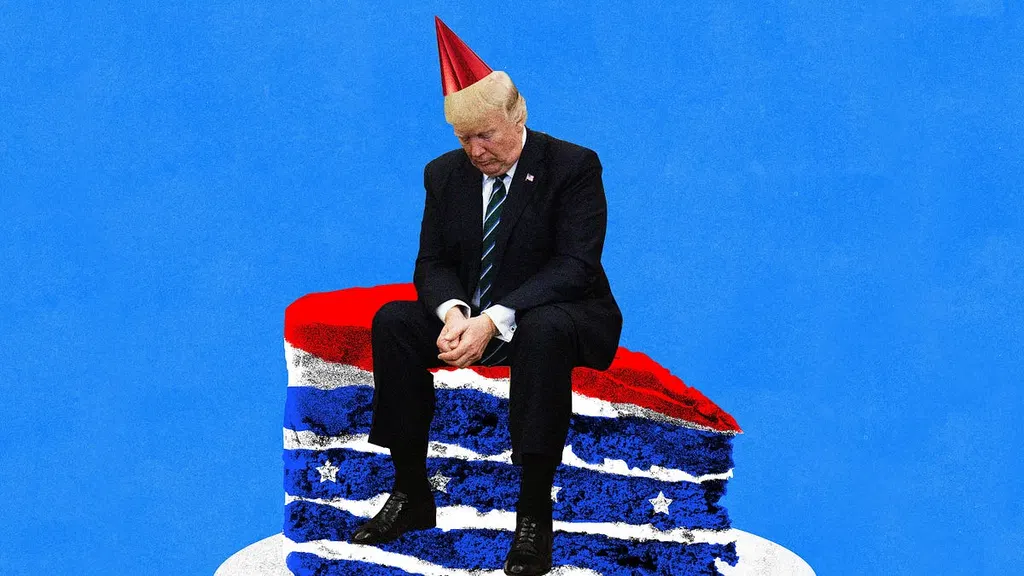
Trump’s Semiquincentennial Faceplant
The article discusses the potential reopening of the Strait of Hormuz and the implications of a deal between the U.S. and Iran. It highlights concerns about the economic support the U.S. may provide to Iran while questioning the effectiveness of future negotiations regarding Iran's nuclear program. Additionally, the piece critiques Donald Trump's attempts to dominate the upcoming 250th anniversary of American independence, suggesting that his efforts to personalize the celebration are failing.
- ▪The U.S. and Iran are reportedly nearing a deal to reopen the Strait of Hormuz.
- ▪The deal may lead to sanctions relief for Iran, raising concerns about economic support for the country.
- ▪Trump's attempts to dominate the 250th anniversary celebration of American independence are facing public disapproval.
The Bulwark files mainly under politics. We currently carry 342 of its stories.
Story provenance
Source · retrieval · rights · ranking — open for full record
inspect →
Story provenance
Attribution is not the same as permission. This drawer separates discovery metadata, excerpts, WeSearch-generated summaries, reuse status, and whether the publisher receives the visit. Nothing here claims a legal grant the publisher has not made.
Record
| Original publisher | The Bulwark |
| Canonical URL | https://www.thebulwark.com/p/trumps-semiquincentennial-faceplant-250-anniversary-concert-celebration-ufc-face-bill-passport-rededicate-jubilee-congress-arch |
| Publication time | Fri, 29 May 2026 13:29:38 GMT |
| Retrieval time | 2026-05-29T13:35:00.580Z |
| Last seen | 2026-05-29T13:35:00.580Z |
| Headline source | Publisher (no WeSearch rewrite) |
| Excerpt source | publisher body |
| Excerpt method | First ~120 words (~800 chars) of extracted publisher body, fair-use limited. |
| Summary | WeSearch · cerebras-chat (WeSearch summarizer) |
| Summary source text | contentText |
| Citation coverage | Summary is a WeSearch-generated derivative; primary citation is the original publisher URL. |
| Cluster | LEhdA87PQljU |
| Cluster logic | Grouped by semantic title/content similarity across sources within a rolling window. Same-publisher template collisions are excluded from coverage comparison. |
| Ranking reason | Story pages are not engagement-ranked. Hub feeds use recency, with optional source-diversified chronological ordering (cap consecutive stories per source). No personalized ranking. |
| Publisher visit | Yes — open original |
| Substitutes article? | No — link-out required for full text |
Rights status (four layers)
WeSearch handling by dimension
| Indexing | May the item be indexed (stored, ranked, made findable)? | Allowed |
| Snippet | May a short excerpt of the publisher's text be shown? | Allowed |
| AI summary | May WeSearch generate its own short summary of the article? | Limited |
| Retrieval / RAG | May the content be exposed for third-party retrieval-augmented generation? | Not asserted |
| Model training | May the content be used to train AI models? | Not asserted |
| Commercial reuse | May the content be reused commercially? | Not permitted |
Basis: Derived from the published RSS/Atom feed. Contact: [email protected]. Reviewed: 2026-07-24.
Opening excerpt (first ~120 words) tap to expand
Morning ShotsTrump’s Semiquincentennial FaceplantHis attempt to usurp America’s moment—and meaning—is failing.William Kristol, Andrew Egger, and Jim SwiftMay 29, 20263ShareOur long national nightmare may be coming to an end: The White House and Iran are reportedly closing in on a deal to reopen the Strait of Hormuz, with Iran seemingly willing to forgo tolls or controls on the waterway in exchange for various U.S. concessions like sanctions relief and the unfreezing of assets.If the deal materializes as promised, it’s likely a better outcome for the United States than the extraordinarily bleak one many expected, in which Iran felt empowered to throw its weight around in the strait in perpetuity—although, as always, the devil will be in the details.Even here, the deal represents at best a…
Excerpt limited to ~120 words for fair-use compliance. The full article is at The Bulwark.
Discussion
0 commentsMore from The Bulwark