Trust, but benchmark: How we let an AI agent optimize Elasticsearch
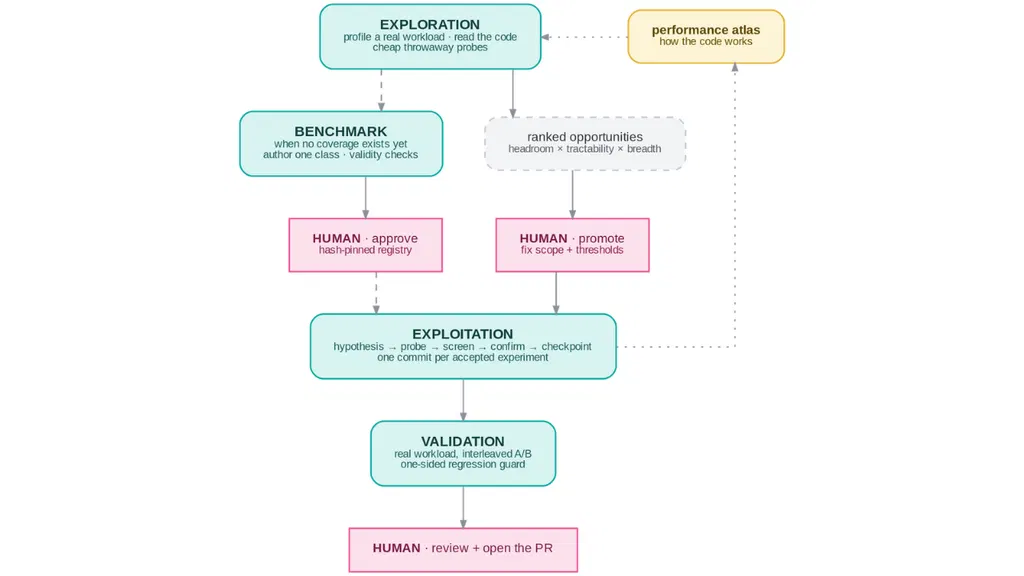
Dive into our sample notebooks in the Elasticsearch Labs repo, start a free cloud trial, or try Elastic on your local machine now.Elasticsearch executes a diverse set of workloads, including sustained heavy index building and real-time search and analytics. Delivering excellent performance across the board requires going broad in coverage while simultaneously diving deep enough into the codebase to understand optimization opportunities for each workload. Unlike many software engineering challenges, optimizing code offers a cheap and objective verifier.
- ▪Dive into our sample notebooks in the Elasticsearch Labs repo, start a free cloud trial, or try Elastic on your local machine now.Elasticsearch executes a diverse set of workloads, including sustained heavy index building and real-time sear
- ▪Delivering excellent performance across the board requires going broad in coverage while simultaneously diving deep enough into the codebase to understand optimization opportunities for each workload.
- ▪Unlike many software engineering challenges, optimizing code offers a cheap and objective verifier.
Hacker News (AI / LLM) files mainly under ai. We currently carry 5,327 of its stories.
Story provenance
Source · retrieval · rights · ranking — open for full record
inspect →
Story provenance
Attribution is not the same as permission. This drawer separates discovery metadata, excerpts, WeSearch-generated summaries, reuse status, and whether the publisher receives the visit. Nothing here claims a legal grant the publisher has not made.
Record
| Original publisher | Elastic |
| Canonical URL | https://www.elastic.co/search-labs/blog/ai-code-optimization-elasticsearch-agent-harness |
| Publication time | Thu, 17 Sep 2026 13:52:33 +0000 |
| Retrieval time | 2026-09-17T13:58:44.248Z |
| Last seen | 2026-09-17T13:58:44.248Z |
| Headline source | Publisher (no WeSearch rewrite) |
| Excerpt source | publisher body |
| Excerpt method | First ~120 words (~800 chars) of extracted publisher body, fair-use limited. |
| Summary | WeSearch · cerebras-chat (WeSearch summarizer) |
| Summary source text | contentText |
| Citation coverage | Summary is a WeSearch-generated derivative; primary citation is the original publisher URL. |
| Cluster | q14VcYI-T8to · 1 stories |
| Cluster logic | Grouped by semantic title/content similarity across sources within a rolling window. Same-publisher template collisions are excluded from coverage comparison. |
| Ranking reason | Story pages are not engagement-ranked. Hub feeds use recency, with optional source-diversified chronological ordering (cap consecutive stories per source). No personalized ranking. |
| Publisher visit | Yes — open original |
| Substitutes article? | No — link-out required for full text |
Rights status (four layers)
WeSearch handling by dimension
| Indexing | May the item be indexed (stored, ranked, made findable)? | Allowed |
| Snippet | May a short excerpt of the publisher's text be shown? | Allowed |
| AI summary | May WeSearch generate its own short summary of the article? | Limited |
| Retrieval / RAG | May the content be exposed for third-party retrieval-augmented generation? | Not asserted |
| Model training | May the content be used to train AI models? | Not asserted |
| Commercial reuse | May the content be reused commercially? | Not permitted |
Basis: Derived from the published RSS/Atom feed. Contact: [email protected]. Reviewed: 2026-07-24.
Opening excerpt (first ~120 words) tap to expand
Elasticsearch LabsSecurity LabsObservability LabsBlogTutorialsExamples01Apps02Notebooks03GlossaryIntegrationsGithubElasticsearch LabsBlogTrust, but benchmark: How we let an AI agent optimize ElasticsearchWe share how we built a harness that automatically identifies and implements optimizations in the Elasticsearch codebase.September 11, 2026Thomas VeaseyChris HegartyInside ElasticAgentic AIJump toThe AI code optimization pipeline architectureWhy performance optimization suits autonomous agentsSignals are what the agent gets to seeFrom 20-second probes to hours of validationHanding off from exploration to exploitationValidating a new benchmark before it can gate anythingThe validation ladderHow do you know a performance improvement is real?Forks are the statistical unitPair candidate and…
Excerpt limited to ~120 words for fair-use compliance. The full article is at Elastic.
Discussion
0 commentsMore from Elastic