Turning Glass Into a Touch-Sensitive Button
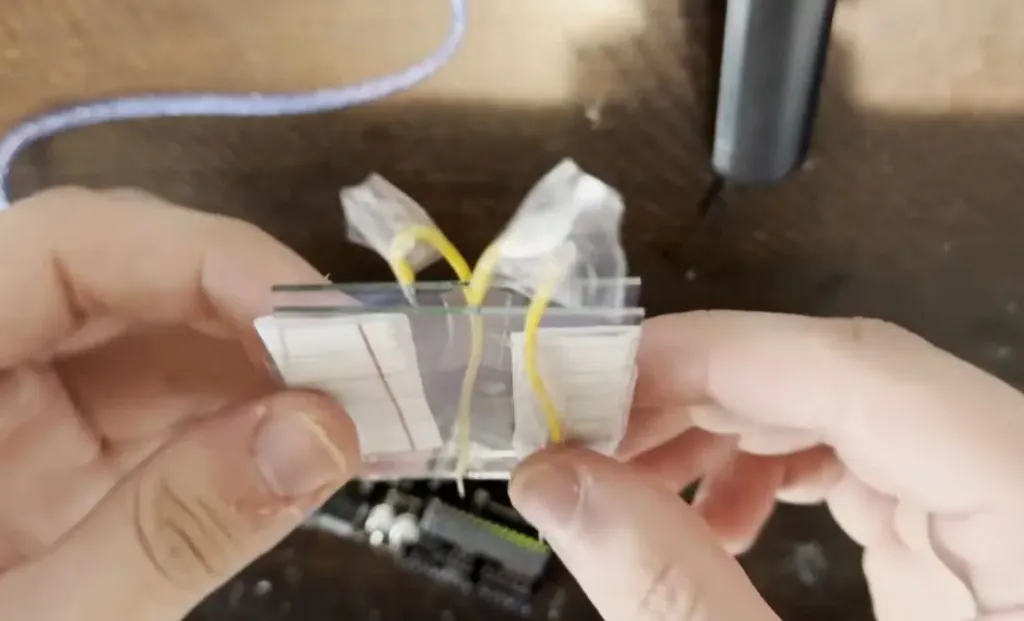
Glass can be made touch-sensitive by applying an indium tin oxide (ITO) coating that provides transparency and electrical conductivity. By placing two ITO-coated glass pieces face‑to‑face with a paper spacer, the glass flexes to allow the conductive layers to contact, creating a pressure‑sensitive button similar to resistive touch screens. The approach enables hobbyists to build multi‑position touch interfaces using simple materials and firmware.
- ▪ITO coating gives glass both optical transparency and a conductivity of about 20 Ω.
- ▪Two pieces of ITO‑coated glass are aligned with their conductive sides facing each other and separated by a paper spacer.
- ▪When the glass flexes, the ITO layers touch, completing a circuit and acting as a pressure‑sensitive switch.
- ▪The method mirrors resistive touch‑screen technology and can be adapted for multi‑position touch screens in hobby projects.
Hackaday files mainly under tech. We currently carry 229 of its stories.
Story provenance
Source · retrieval · rights · ranking — open for full record
inspect →
Story provenance
Attribution is not the same as permission. This drawer separates discovery metadata, excerpts, WeSearch-generated summaries, reuse status, and whether the publisher receives the visit. Nothing here claims a legal grant the publisher has not made.
Record
| Original publisher | Hackaday |
| Canonical URL | https://hackaday.com/2026/07/31/turning-glass-into-a-touch-sensitive-button/ |
| Publication time | Sat, 01 Aug 2026 02:00:14 +0000 |
| Retrieval time | 2026-08-01T02:03:02.707Z |
| Last seen | 2026-08-01T02:03:02.707Z |
| Headline source | Publisher (no WeSearch rewrite) |
| Excerpt source | publisher body |
| Excerpt method | First ~120 words (~800 chars) of extracted publisher body, fair-use limited. |
| Summary | WeSearch · cerebras-chat (WeSearch summarizer) |
| Summary source text | contentText |
| Citation coverage | Summary is a WeSearch-generated derivative; primary citation is the original publisher URL. |
| Cluster | ZT2A-hd-57ma · 1 stories |
| Cluster logic | Grouped by semantic title/content similarity across sources within a rolling window. Same-publisher template collisions are excluded from coverage comparison. |
| Ranking reason | Story pages are not engagement-ranked. Hub feeds use recency, with optional source-diversified chronological ordering (cap consecutive stories per source). No personalized ranking. |
| Publisher visit | Yes — open original |
| Substitutes article? | No — link-out required for full text |
Rights status (four layers)
WeSearch handling by dimension
| Indexing | May the item be indexed (stored, ranked, made findable)? | Allowed |
| Snippet | May a short excerpt of the publisher's text be shown? | Allowed |
| AI summary | May WeSearch generate its own short summary of the article? | Limited |
| Retrieval / RAG | May the content be exposed for third-party retrieval-augmented generation? | Not asserted |
| Model training | May the content be used to train AI models? | Not asserted |
| Commercial reuse | May the content be reused commercially? | Not permitted |
Basis: Derived from the published RSS/Atom feed. Contact: [email protected]. Reviewed: 2026-07-24.
Opening excerpt (first ~120 words) tap to expand
Turning Glass Into A Touch-Sensitive Button No comments by: Maya Posch July 31, 2026 Title: Copy Short Link: Copy Although generally glass isn’t associated with touch-sensitive surfaces, the addition of an ITO (indium tin oxygen) coating adds the exciting property of not only being transparent to the visible light part of the electromagnetic spectrum, but also of being electrically conductive. The logical result is that fine folk like [Sokol] simply had to use their newly acquired ITO-coated glass to make a button out of. Here the easy option is of course to just use it as a capacitive sensor where the conductive ITO layer is used for the capacitive charge and the glass provides the insulator, but here we see it demonstrated how to create a pressure-sensitive implementation instead.
…
Excerpt limited to ~120 words for fair-use compliance. The full article is at Hackaday.
Discussion
0 commentsMore from Hackaday