WeSearch
Understanding the Dynamics of the AI Ecosystem with Pace Layers
Understanding the Dynamics of the AI Ecosystem with Pace Layers

Drew Breunig· ·5 min read · 0 reactions · 0 comments · 46 views
More from Drew Breunig ai Compare coverage Trending Talk Blindspots Daily Sources Live wire
TL;DR · WeSearch summary

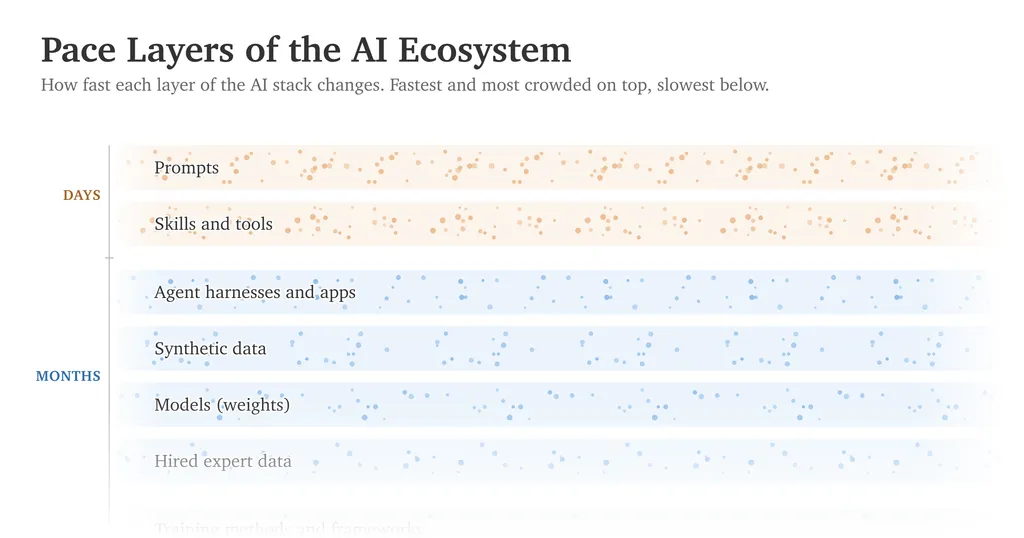
Jul 3, 2026 AI CULTURE SPEED FRAMEWORKS Understanding the Dynamics of the AI Ecosystem with Pace Layers When a sector goes too fast, it loses support Without a doubt, the pace of the AI ecosystem is dizzying. Scaffolding it, finding themes, and understanding the shape of it is nearly impossible. Recently, Mike Migurski introduced me to Stewart Brand’s Pace Layers, a framework for organizing fields and categories by how fast they change.

Key facts
About this source

Hacker News (AI / LLM) files mainly under ai. We currently carry 4,376 of its stories.

Original article
Drew Breunig · Drew Breunig
Read full at Drew Breunig →

Story provenance

Source · retrieval · rights · ranking — open for full record
inspect →

Attribution is not the same as permission. This drawer separates discovery metadata, excerpts, WeSearch-generated summaries, reuse status, and whether the publisher receives the visit. Nothing here claims a legal grant the publisher has not made.

Record

Original publisherDrew Breunig
Canonical URLhttps://www.dbreunig.com/2026/07/03/ai-ecosytem-pace-layers.html
Publication timeSat, 04 Jul 2026 16:07:50 +0000
Retrieval time2026-07-04T19:00:17.915Z
Last seen2026-07-04T19:00:17.915Z
Headline sourcePublisher (no WeSearch rewrite)
Excerpt sourcepublisher body
Excerpt methodFirst ~120 words (~800 chars) of extracted publisher body, fair-use limited.
SummaryWeSearch · cerebras-chat (WeSearch summarizer)
Summary source textcontentText
Citation coverageSummary is a WeSearch-generated derivative; primary citation is the original publisher URL.
Cluster3IvfbrTDZINS
Cluster logicGrouped by semantic title/content similarity across sources within a rolling window. Same-publisher template collisions are excluded from coverage comparison.
Ranking reasonStory pages are not engagement-ranked. Hub feeds use recency, with optional source-diversified chronological ordering (cap consecutive stories per source). No personalized ranking.
Publisher visitYes — open original
Substitutes article?No — link-out required for full text

Rights status (four layers)

Publisher-declared
No publisher-confirmed rights record for this source yet.
Machine-readable
No source-specific machine-readable restriction detected beyond the public feed.
WeSearch interpretation
WeSearch declared handling (basis: Derived from the published RSS/Atom feed). This is WeSearch policy, not a legal grant on the publisher's behalf.
Unknown
Retrieval and training permissions are not asserted unless the publisher confirms them.

WeSearch handling by dimension

Indexing May the item be indexed (stored, ranked, made findable)? Allowed
Snippet May a short excerpt of the publisher's text be shown? Allowed
AI summary May WeSearch generate its own short summary of the article? Limited
Retrieval / RAG May the content be exposed for third-party retrieval-augmented generation? Not asserted
Model training May the content be used to train AI models? Not asserted
Commercial reuse May the content be reused commercially? Not permitted

Basis: Derived from the published RSS/Atom feed. Contact: [email protected]. Reviewed: 2026-07-24.

Opening excerpt (first ~120 words) tap to expand

Jul 3, 2026 AI CULTURE SPEED FRAMEWORKS Understanding the Dynamics of the AI Ecosystem with Pace Layers When a sector goes too fast, it loses support Without a doubt, the pace of the AI ecosystem is dizzying. Just processing it all is difficult enough. Scaffolding it, finding themes, and understanding the shape of it is nearly impossible. Recently, Mike Migurski introduced me to Stewart Brand’s Pace Layers, a framework for organizing fields and categories by how fast they change. Brand writes: Consider the differently paced components to be layers. Each layer is functionally different from the others and operates somewhat independently, but each layer influences and responds to the layers closest to it in a way that makes the whole system resilient.

Excerpt limited to ~120 words for fair-use compliance. The full article is at Drew Breunig.

Anonymous · no account needed
Share 𝕏 Facebook Reddit LinkedIn Threads WhatsApp Bluesky Mastodon Email

Discussion

0 comments

More from Drew Breunig