US not 'turning back' on Asia allies, but expects them to boost defence - Hegseth
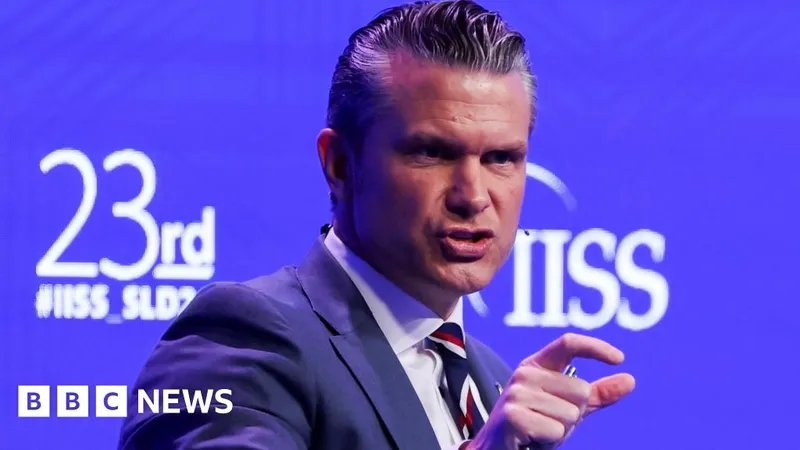
US Defense Secretary Pete Hegseth reassured Asia-Pacific allies of the US commitment to the region while emphasizing the need for increased defense spending among these nations. He addressed concerns about the US's ability to fulfill arms deals, particularly after suspending a Taiwan weapons package. Hegseth advocated for a balance of power in the region, acknowledging the threat posed by China's military buildup while avoiding unnecessary confrontation.
- ▪Hegseth stated that the US is not turning its back on Asia while fulfilling global obligations.
- ▪He called on Asian allies to increase their defense spending to 3.5% of GDP.
- ▪Hegseth emphasized the importance of backing up rules with military power rather than relying solely on diplomatic rhetoric.
BBC News — World publishes from United Kingdom and files mainly under world. We currently carry 593 of its stories.
Story provenance
Source · retrieval · rights · ranking — open for full record
inspect →
Story provenance
Attribution is not the same as permission. This drawer separates discovery metadata, excerpts, WeSearch-generated summaries, reuse status, and whether the publisher receives the visit. Nothing here claims a legal grant the publisher has not made.
Record
| Original publisher | BBC News |
| Canonical URL | https://www.bbc.com/news/articles/c5ye34k7yejo?at_medium=RSS&at_campaign=rss |
| Publication time | Sat, 30 May 2026 13:34:57 GMT |
| Retrieval time | 2026-05-30T06:07:06.401Z |
| Last seen | 2026-05-30T13:58:41.218Z |
| Headline source | Publisher (no WeSearch rewrite) |
| Excerpt source | publisher body |
| Excerpt method | First ~120 words (~800 chars) of extracted publisher body, fair-use limited. |
| Summary | WeSearch · cerebras-chat (WeSearch summarizer) |
| Summary source text | contentText |
| Citation coverage | Summary is a WeSearch-generated derivative; primary citation is the original publisher URL. |
| Cluster | 23v75oseTL0h |
| Cluster logic | Grouped by semantic title/content similarity across sources within a rolling window. Same-publisher template collisions are excluded from coverage comparison. |
| Ranking reason | Story pages are not engagement-ranked. Hub feeds use recency, with optional source-diversified chronological ordering (cap consecutive stories per source). No personalized ranking. |
| Publisher visit | Yes — open original |
| Substitutes article? | No — link-out required for full text |
Rights status (four layers)
WeSearch handling by dimension
| Indexing | May the item be indexed (stored, ranked, made findable)? | Allowed |
| Snippet | May a short excerpt of the publisher's text be shown? | Allowed |
| AI summary | May WeSearch generate its own short summary of the article? | Limited |
| Retrieval / RAG | May the content be exposed for third-party retrieval-augmented generation? | Not asserted |
| Model training | May the content be used to train AI models? | Not asserted |
| Commercial reuse | May the content be reused commercially? | Not permitted |
Basis: Derived from the published RSS/Atom feed. Contact: [email protected]. Reviewed: 2026-07-24.
Opening excerpt (first ~120 words) tap to expand
US not 'turning back' on Asia allies, but expects them to boost defence - Hegseth9 minutes agoShareSaveAdd as preferred on GoogleTessa WongAsia Digital Reporter, Shangri-La Dialogue, SingaporeReutersThe US military are not "turning our backs" on Asia while fulfilling "global obligations" such as the Iran war, US Defense Secretary Pete Hegseth has told a top regional defence forum in Singapore.Hegseth sought to reassure Asia-Pacific allies about US commitment to the region, including fulfilling arms deals in the wake of a suspended Taiwan weapons package - even as he reiterated calls for Asian partners to spend more on defence.While noting the threat of China's military build-up in the region, Hegseth also said the US wanted to avoid "needless confrontation".Hegseth was speaking weeks…
Excerpt limited to ~120 words for fair-use compliance. The full article is at BBC News.
Discussion
0 commentsMore from BBC News