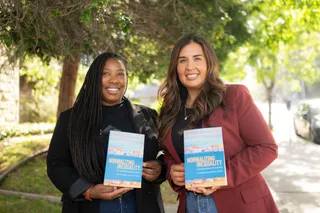
Violence against women remains high — particularly for marginalized groups
A recent UC Berkeley study highlights the persistent high rates of violence against women in California, particularly affecting marginalized groups. Black women under 65 are at the highest risk, with assault injury rates significantly higher than those of white women. The findings underscore the need for systemic solutions to address the underlying issues of structural racism and violence.
- ▪Black women under age 65 were found to be at the highest risk of violence in California.
- ▪Assault injury rates among Black women were 3.8 times those of white women across all ages.
- ▪The study analyzed 763,000 assault injuries resulting in hospitalization or death from 2005 to 2022.
Berkeley News files mainly under science. We currently carry 18 of its stories.
Story provenance
Source · retrieval · rights · ranking — open for full record
inspect →
Story provenance
Attribution is not the same as permission. This drawer separates discovery metadata, excerpts, WeSearch-generated summaries, reuse status, and whether the publisher receives the visit. Nothing here claims a legal grant the publisher has not made.
Record
| Original publisher | Berkeley News |
| Canonical URL | https://news.berkeley.edu/2026/05/19/violence-against-women-remains-high-particularly-for-marginalized-groups/ |
| Publication time | Tue, 19 May 2026 16:28:57 +0000 |
| Retrieval time | 2026-05-19T16:29:57.870Z |
| Last seen | 2026-05-19T16:29:57.870Z |
| Headline source | Publisher (no WeSearch rewrite) |
| Excerpt source | publisher body |
| Excerpt method | First ~120 words (~800 chars) of extracted publisher body, fair-use limited. |
| Summary | WeSearch · cerebras-chat (WeSearch summarizer) |
| Summary source text | contentText |
| Citation coverage | Summary is a WeSearch-generated derivative; primary citation is the original publisher URL. |
| Cluster | BCrnl4PHSB16 |
| Cluster logic | Grouped by semantic title/content similarity across sources within a rolling window. Same-publisher template collisions are excluded from coverage comparison. |
| Ranking reason | Story pages are not engagement-ranked. Hub feeds use recency, with optional source-diversified chronological ordering (cap consecutive stories per source). No personalized ranking. |
| Publisher visit | Yes — open original |
| Substitutes article? | No — link-out required for full text |
Rights status (four layers)
WeSearch handling by dimension
| Indexing | May the item be indexed (stored, ranked, made findable)? | Allowed |
| Snippet | May a short excerpt of the publisher's text be shown? | Allowed |
| AI summary | May WeSearch generate its own short summary of the article? | Limited |
| Retrieval / RAG | May the content be exposed for third-party retrieval-augmented generation? | Not asserted |
| Model training | May the content be used to train AI models? | Not asserted |
| Commercial reuse | May the content be reused commercially? | Not permitted |
Basis: Derived from the published RSS/Atom feed. Contact: [email protected]. Reviewed: 2026-07-24.
Opening excerpt (first ~120 words) tap to expand
Research Violence against women remains high — particularly for marginalized groups A UC Berkeley study of California hospital data reveals persistent racial disparities and the higher risks faced by Black, multiracial and Indigenous women. By Jason Pohl Black women under age 65 were at the highest risk of violence, according to a new UC Berkeley analysis of California hospital data. Across all ages, assault injury rates among Black women were 3.8 times those of white women. Jacob McGowin via Unsplash May 19, 2026 Rates of violence against women have remained largely unchanged in California for nearly two decades, with Black and multiracial women facing the highest risks, a sweeping new analysis by UC Berkeley public health researchers has found.
…
Excerpt limited to ~120 words for fair-use compliance. The full article is at Berkeley News.
Discussion
0 commentsMore from Berkeley News