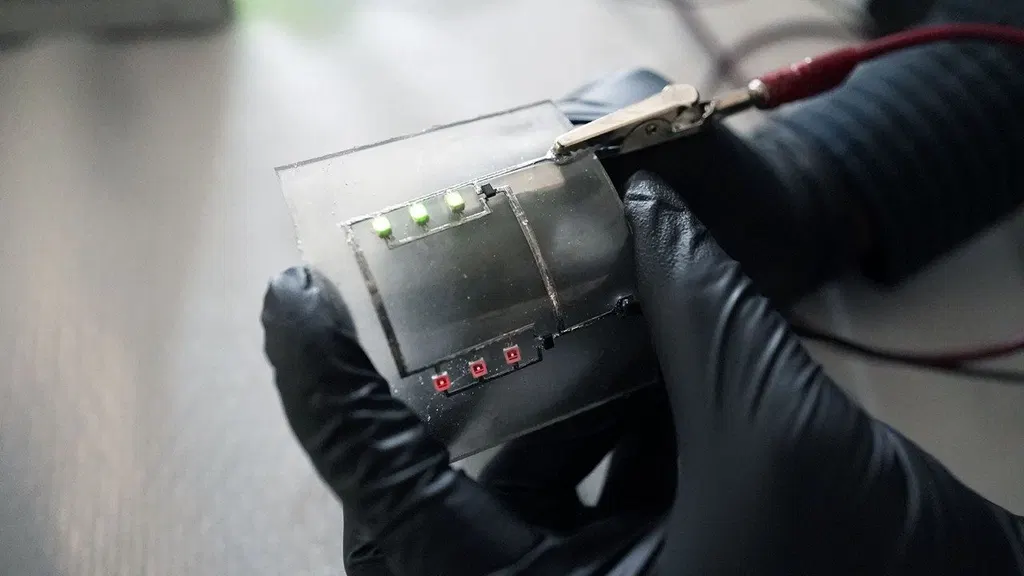
Virginia Tech lab 3D prints a liquid metal composite to guide heat, boost thermal conductivity 40x
3D Printing Virginia Tech lab 3D prints a liquid metal composite to guide heat, boost thermal conductivity 40x — the nozzle stretches gallium-indium droplets inside soft silicone, can also create self-healing traces News By Shane Downing Published 28 September 2026 Heat follows the toolpath through a flexible part. When you purchase through links on our site, we may earn an affiliate commission. He cast a slab of the mixture, pressed a line into it to light an LED, sliced that line with a razor blade to show it still conducted, and then printed the same material on a syringe-fed printer to guide heat rather than electricity.
- ▪3D Printing Virginia Tech lab 3D prints a liquid metal composite to guide heat, boost thermal conductivity 40x — the nozzle stretches gallium-indium droplets inside soft silicone, can also create self-healing traces News By Shane Downing Pu
- ▪When you purchase through links on our site, we may earn an affiliate commission.
- ▪He cast a slab of the mixture, pressed a line into it to light an LED, sliced that line with a razor blade to show it still conducted, and then printed the same material on a syringe-fed printer to guide heat rather than electricity.
Tom's Hardware files mainly under tech. We currently carry 828 of its stories.
Story provenance
Source · retrieval · rights · ranking — open for full record
inspect →
Story provenance
Attribution is not the same as permission. This drawer separates discovery metadata, excerpts, WeSearch-generated summaries, reuse status, and whether the publisher receives the visit. Nothing here claims a legal grant the publisher has not made.
Record
| Original publisher | Tom's Hardware |
| Canonical URL | https://www.tomshardware.com/3d-printing/virginia-tech-lab-3d-prints-a-liquid-metal-composite-to-guide-heat-boost-thermal-conductivity-40x-the-nozzle-stretches-gallium-indium-droplets-inside-soft-silicone-can-also-create-self-healing-traces |
| Publication time | Mon, 28 Sep 2026 14:45:00 +0000 |
| Retrieval time | 2026-09-28T15:27:23.499Z |
| Last seen | 2026-09-28T15:27:23.499Z |
| Headline source | Publisher (no WeSearch rewrite) |
| Excerpt source | publisher body |
| Excerpt method | First ~120 words (~800 chars) of extracted publisher body, fair-use limited. |
| Summary | WeSearch · cerebras-chat (WeSearch summarizer) |
| Summary source text | contentText |
| Citation coverage | Summary is a WeSearch-generated derivative; primary citation is the original publisher URL. |
| Cluster | O3E7yHAqRXIv · 1 stories |
| Cluster logic | Grouped by semantic title/content similarity across sources within a rolling window. Same-publisher template collisions are excluded from coverage comparison. |
| Ranking reason | Story pages are not engagement-ranked. Hub feeds use recency, with optional source-diversified chronological ordering (cap consecutive stories per source). No personalized ranking. |
| Publisher visit | Yes — open original |
| Substitutes article? | No — link-out required for full text |
Rights status (four layers)
WeSearch handling by dimension
| Indexing | May the item be indexed (stored, ranked, made findable)? | Allowed |
| Snippet | May a short excerpt of the publisher's text be shown? | Allowed |
| AI summary | May WeSearch generate its own short summary of the article? | Limited |
| Retrieval / RAG | May the content be exposed for third-party retrieval-augmented generation? | Not asserted |
| Model training | May the content be used to train AI models? | Not asserted |
| Commercial reuse | May the content be reused commercially? | Not permitted |
Basis: Derived from the published RSS/Atom feed. Contact: [email protected]. Reviewed: 2026-07-24.
Opening excerpt (first ~120 words) tap to expand
3D Printing Virginia Tech lab 3D prints a liquid metal composite to guide heat, boost thermal conductivity 40x — the nozzle stretches gallium-indium droplets inside soft silicone, can also create self-healing traces News By Shane Downing Published 28 September 2026 Heat follows the toolpath through a flexible part. When you purchase through links on our site, we may earn an affiliate commission. Here’s how it works. (Image credit: Alex Parrish for Virginia Tech) Copy link Facebook X Whatsapp Reddit Pinterest Flipboard Email Share this article 0 Join the conversation Follow us Add us as a preferred source on Google Newsletter Subscribe to our newsletter Virginia Tech graduate student Hugh Grennan mixed eutectic gallium-indium (EGaIn) into uncured polydimethylsiloxane (PDMS) silicone in a…
Excerpt limited to ~120 words for fair-use compliance. The full article is at Tom's Hardware.
Discussion
0 commentsMore from Tom's Hardware