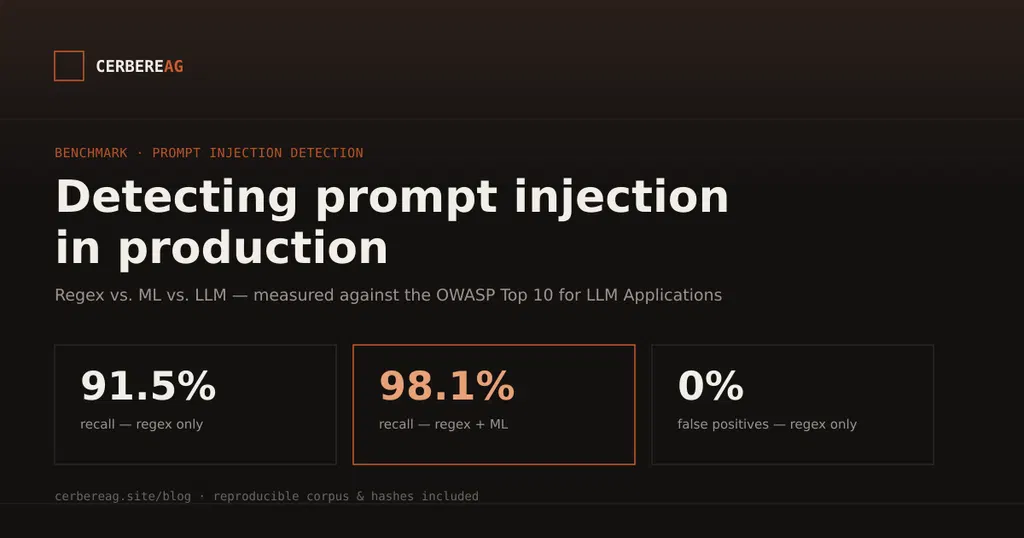
We benchmarked our prompt-injection detector against OWASP's LLM Top
Adding a ML layer pushes recall to 98.1%, at the cost of ~450ms latency and false positive rates that still need work.We're publishing this first because the deterministic layer is already solid, fast and fully reproducible. The ML false-positive work is in progress — the "Known limitations" section below is part of this post, not a footnote.MethodologyThe corpus contains 106 malicious prompts, 20 ordinary benign prompts, and 12 hard negatives — benign prompts worded to resemble attacks (e.g. Typically requests that talk about security or API keys without exposing any.
- ▪Adding a ML layer pushes recall to 98.1%, at the cost of ~450ms latency and false positive rates that still need work.We're publishing this first because the deterministic layer is already solid, fast and fully reproducible.
- ▪The ML false-positive work is in progress — the "Known limitations" section below is part of this post, not a footnote.MethodologyThe corpus contains 106 malicious prompts, 20 ordinary benign prompts, and 12 hard negatives — benign prompts
- ▪Typically requests that talk about security or API keys without exposing any.
Hacker News (AI / LLM) files mainly under ai. We currently carry 6,543 of its stories.
Story provenance
Source · retrieval · rights · ranking — open for full record
inspect →
Story provenance
Attribution is not the same as permission. This drawer separates discovery metadata, excerpts, WeSearch-generated summaries, reuse status, and whether the publisher receives the visit. Nothing here claims a legal grant the publisher has not made.
Record
| Original publisher | Cerbereag |
| Canonical URL | https://www.cerbereag.site/blog/detecting-prompt-injection-in-production |
| Publication time | Sat, 26 Sep 2026 16:51:35 +0000 |
| Retrieval time | 2026-09-26T18:30:14.432Z |
| Last seen | 2026-09-26T18:30:14.432Z |
| Headline source | Publisher (no WeSearch rewrite) |
| Excerpt source | publisher body |
| Excerpt method | First ~120 words (~800 chars) of extracted publisher body, fair-use limited. |
| Summary | WeSearch · cerebras-chat (WeSearch summarizer) |
| Summary source text | contentText |
| Citation coverage | Summary is a WeSearch-generated derivative; primary citation is the original publisher URL. |
| Cluster | gjRuqFFiC3CQ · 1 stories |
| Cluster logic | Grouped by semantic title/content similarity across sources within a rolling window. Same-publisher template collisions are excluded from coverage comparison. |
| Ranking reason | Story pages are not engagement-ranked. Hub feeds use recency, with optional source-diversified chronological ordering (cap consecutive stories per source). No personalized ranking. |
| Publisher visit | Yes — open original |
| Substitutes article? | No — link-out required for full text |
Rights status (four layers)
WeSearch handling by dimension
| Indexing | May the item be indexed (stored, ranked, made findable)? | Allowed |
| Snippet | May a short excerpt of the publisher's text be shown? | Allowed |
| AI summary | May WeSearch generate its own short summary of the article? | Limited |
| Retrieval / RAG | May the content be exposed for third-party retrieval-augmented generation? | Not asserted |
| Model training | May the content be used to train AI models? | Not asserted |
| Commercial reuse | May the content be reused commercially? | Not permitted |
Basis: Derived from the published RSS/Atom feed. Contact: [email protected]. Reviewed: 2026-07-24.
Opening excerpt (first ~120 words) tap to expand
benchmarkDetecting prompt injection in productionOur first public benchmark for AgentGuard's detection runtime: recall, false positives and latency for each layer, measured against a corpus mapped to the OWASP Top 10 for LLM Applications.September 26, 2026 · benchmark v1.0.0 · reproducible corpus and hashes below91.5%recall — regex only98.1%recall — regex + ML0%false positives — regex onlyShort version: the deterministic regex layer catches 91.5% of the attacks in our corpus with 0% false positives, under a millisecond. Adding a ML layer pushes recall to 98.1%, at the cost of ~450ms latency and false positive rates that still need work.We're publishing this first because the deterministic layer is already solid, fast and fully reproducible.
…
Excerpt limited to ~120 words for fair-use compliance. The full article is at Cerbereag.
Discussion
0 commentsMore from Cerbereag