What AI Agents Should Never Do on Their Own
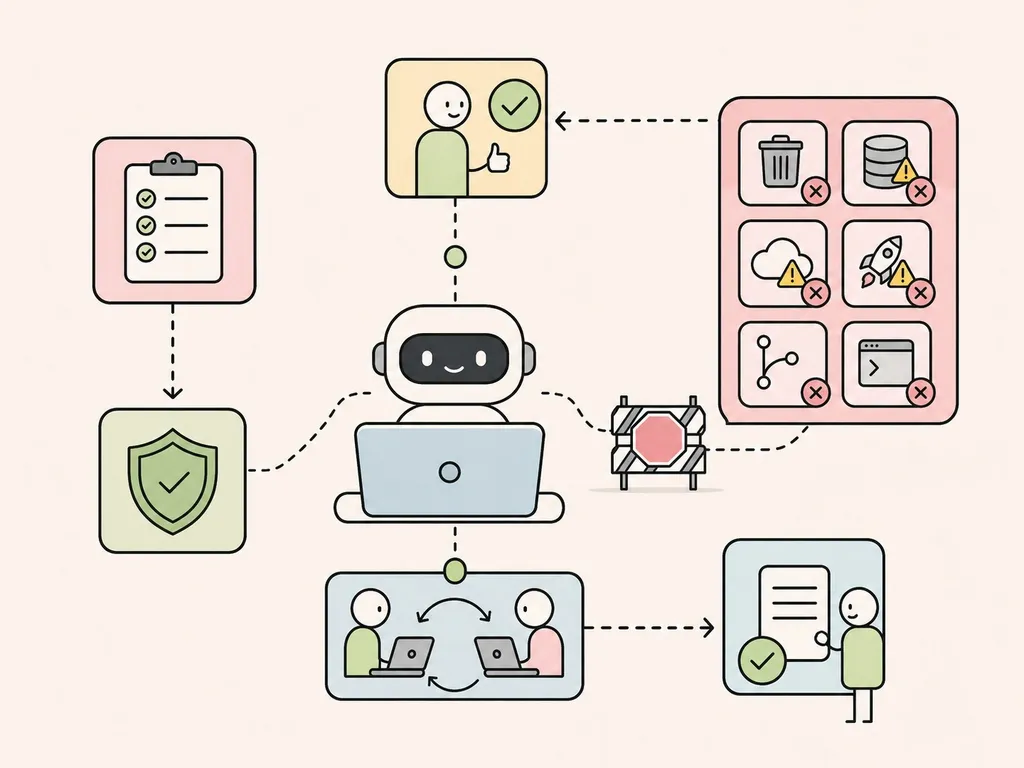
The article discusses the importance of setting boundaries for AI agents to prevent costly mistakes. It emphasizes that while agents can increase productivity, they should not operate independently on high-risk tasks. A permission matrix is suggested to determine when human oversight is necessary.
- ▪AI agents can significantly enhance productivity but require careful management.
- ▪Certain tasks, such as destructive file operations and database migrations, should always involve human review.
- ▪A permission matrix can help define the appropriate level of autonomy for AI agents based on task type.
Towards Data Science files mainly under ai. We currently carry 108 of its stories.
Story provenance
Source · retrieval · rights · ranking — open for full record
inspect →
Story provenance
Attribution is not the same as permission. This drawer separates discovery metadata, excerpts, WeSearch-generated summaries, reuse status, and whether the publisher receives the visit. Nothing here claims a legal grant the publisher has not made.
Record
| Original publisher | Towards Data Science |
| Canonical URL | https://towardsdatascience.com/what-ai-agents-should-never-do-on-their-own/ |
| Publication time | Wed, 03 Jun 2026 12:00:00 +0000 |
| Retrieval time | 2026-06-03T12:07:04.822Z |
| Last seen | 2026-06-03T12:07:04.822Z |
| Headline source | Publisher (no WeSearch rewrite) |
| Excerpt source | publisher body |
| Excerpt method | First ~120 words (~800 chars) of extracted publisher body, fair-use limited. |
| Summary | WeSearch · cerebras-chat (WeSearch summarizer) |
| Summary source text | contentText |
| Citation coverage | Summary is a WeSearch-generated derivative; primary citation is the original publisher URL. |
| Cluster | 3Zb5ZlZuOdAS |
| Cluster logic | Grouped by semantic title/content similarity across sources within a rolling window. Same-publisher template collisions are excluded from coverage comparison. |
| Ranking reason | Story pages are not engagement-ranked. Hub feeds use recency, with optional source-diversified chronological ordering (cap consecutive stories per source). No personalized ranking. |
| Publisher visit | Yes — open original |
| Substitutes article? | No — link-out required for full text |
Rights status (four layers)
WeSearch handling by dimension
| Indexing | May the item be indexed (stored, ranked, made findable)? | Allowed |
| Snippet | May a short excerpt of the publisher's text be shown? | Allowed |
| AI summary | May WeSearch generate its own short summary of the article? | Limited |
| Retrieval / RAG | May the content be exposed for third-party retrieval-augmented generation? | Not asserted |
| Model training | May the content be used to train AI models? | Not asserted |
| Commercial reuse | May the content be reused commercially? | Not permitted |
Basis: Derived from the published RSS/Atom feed. Contact: [email protected]. Reviewed: 2026-07-24.
Opening excerpt (first ~120 words) tap to expand
Agentic AI What AI Agents Should Never Do on Their Own How to set the rules that keep agents effective and out of trouble Sara Nobrega Jun 3, 2026 8 min read Share Image created with DALL-E. All the content about agents focuses on what they can do. Autonomy gets framed as the goal: give them tools, give them access, let them run. The more freedom, the better the output. That framing is mostly accurate. I use agents daily. They’ve genuinely increased my output. I’m a believer! And I’ve also lost two hours of work through an agent that was doing exactly what I asked. I was working on a feature branch cleanup.
…
Excerpt limited to ~120 words for fair-use compliance. The full article is at Towards Data Science.
Discussion
0 commentsMore from Towards Data Science