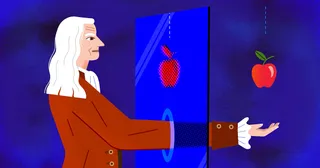
What Do Gödel’s Incompleteness Theorems Truly Mean?
Kurt Gödel's incompleteness theorems demonstrate that no formal mathematical system can be complete, meaning there will always be true statements that cannot be derived from a finite set of axioms. This realization has significant implications for the pursuit of a mathematical 'theory of everything.' As mathematicians and philosophers continue to explore these ideas, they highlight the complexities and uncertainties inherent in mathematical truths.
- ▪Gödel proved that no formal system of mathematics can ever be complete.
- ▪There will always be true mathematical statements that do not logically follow from established axioms.
- ▪The implications of Gödel's theorems challenge the traditional view of objective mathematical truth.
Quanta Magazine files mainly under science. We currently carry 20 of its stories.
Story provenance
Source · retrieval · rights · ranking — open for full record
inspect →
Story provenance
Attribution is not the same as permission. This drawer separates discovery metadata, excerpts, WeSearch-generated summaries, reuse status, and whether the publisher receives the visit. Nothing here claims a legal grant the publisher has not made.
Record
| Original publisher | Quanta Magazine |
| Canonical URL | https://www.quantamagazine.org/what-do-godels-incompleteness-theorems-truly-mean-20260518/ |
| Publication time | Mon, 18 May 2026 15:14:42 +0000 |
| Retrieval time | 2026-05-18T15:19:56.628Z |
| Last seen | 2026-05-18T15:19:56.628Z |
| Headline source | Publisher (no WeSearch rewrite) |
| Excerpt source | publisher body |
| Excerpt method | First ~120 words (~800 chars) of extracted publisher body, fair-use limited. |
| Summary | WeSearch · cerebras-chat (WeSearch summarizer) |
| Summary source text | contentText |
| Citation coverage | Summary is a WeSearch-generated derivative; primary citation is the original publisher URL. |
| Cluster | x8qdHCJz2L4F |
| Cluster logic | Grouped by semantic title/content similarity across sources within a rolling window. Same-publisher template collisions are excluded from coverage comparison. |
| Ranking reason | Story pages are not engagement-ranked. Hub feeds use recency, with optional source-diversified chronological ordering (cap consecutive stories per source). No personalized ranking. |
| Publisher visit | Yes — open original |
| Substitutes article? | No — link-out required for full text |
Rights status (four layers)
WeSearch handling by dimension
| Indexing | May the item be indexed (stored, ranked, made findable)? | Allowed |
| Snippet | May a short excerpt of the publisher's text be shown? | Allowed |
| AI summary | May WeSearch generate its own short summary of the article? | Limited |
| Retrieval / RAG | May the content be exposed for third-party retrieval-augmented generation? | Not asserted |
| Model training | May the content be used to train AI models? | Not asserted |
| Commercial reuse | May the content be reused commercially? | Not permitted |
Basis: Derived from the published RSS/Atom feed. Contact: [email protected]. Reviewed: 2026-07-24.
Opening excerpt (first ~120 words) tap to expand
Home What Do Gödel’s Incompleteness Theorems Truly Mean? Comment Save Article Read Later Share Facebook Copied! Copy link Email Pocket Reddit Ycombinator Comment Comments Save Article Read Later Read Later Qualia What Do Gödel’s Incompleteness Theorems Truly Mean? By Natalie Wolchover May 18, 2026 At 25, Kurt Gödel proved there can never be a mathematical “theory of everything.” Columnist Natalie Wolchover explores the implications. Comment Save Article Read Later .orange { color: #ff8600; } Kurt Gödel Papers, the Shelby White and Leon Levy Achives Center, Institute for Advanced Study; Samuel Velasco and Michael Kanyongolo/Quanta Magazine By Natalie Wolchover Columnist May 18, 2026 View PDF/Print Mode continuum hypothesis foundations of mathematics mathematics proofs Qualia set theory…
Excerpt limited to ~120 words for fair-use compliance. The full article is at Quanta Magazine.