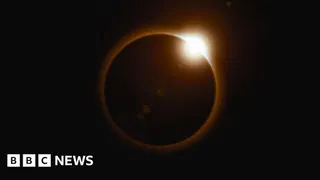
What you need to know about the solar eclipse over Yorkshire

"You are looking at the movement of the moon as it goes around the earth. It's one of these very rare events when you can see the solar system in action."Image source, Getty ImagesImage caption, The progression of a solar eclipseOther countries, such as parts of Spain and Portugal, will enjoy the spectacle of a total eclipse this year. Chris Higgins, a retired scientist and volunteer at Lime Tree Observatory and Planetarium in Grewelthorpe, North Yorkshire, added it is still "certainly worth" seeing it from the UK."It's quite significant.
- ▪"You are looking at the movement of the moon as it goes around the earth.
- ▪It's one of these very rare events when you can see the solar system in action."Image source, Getty ImagesImage caption, The progression of a solar eclipseOther countries, such as parts of Spain and Portugal, will enjoy the spectacle of a t
- ▪Chris Higgins, a retired scientist and volunteer at Lime Tree Observatory and Planetarium in Grewelthorpe, North Yorkshire, added it is still "certainly worth" seeing it from the UK."It's quite significant.
BBC News — Science publishes from United Kingdom and files mainly under science. We currently carry 150 of its stories.
Story provenance
Source · retrieval · rights · ranking — open for full record
inspect →
Story provenance
Attribution is not the same as permission. This drawer separates discovery metadata, excerpts, WeSearch-generated summaries, reuse status, and whether the publisher receives the visit. Nothing here claims a legal grant the publisher has not made.
Record
| Original publisher | BBC News — Science |
| Canonical URL | https://www.bbc.co.uk/news/articles/c980913yep8o?at_medium=RSS&at_campaign=rss |
| Publication time | Sat, 08 Aug 2026 06:12:59 GMT |
| Retrieval time | 2026-08-08T06:15:41.821Z |
| Last seen | 2026-08-08T06:15:41.821Z |
| Headline source | Publisher (no WeSearch rewrite) |
| Excerpt source | publisher body |
| Excerpt method | First ~120 words (~800 chars) of extracted publisher body, fair-use limited. |
| Summary | WeSearch · cerebras-chat (WeSearch summarizer) |
| Summary source text | contentText |
| Citation coverage | Summary is a WeSearch-generated derivative; primary citation is the original publisher URL. |
| Cluster | 8j1St-_ofdYd · 1 stories |
| Cluster logic | Grouped by semantic title/content similarity across sources within a rolling window. Same-publisher template collisions are excluded from coverage comparison. |
| Ranking reason | Story pages are not engagement-ranked. Hub feeds use recency, with optional source-diversified chronological ordering (cap consecutive stories per source). No personalized ranking. |
| Publisher visit | Yes — open original |
| Substitutes article? | No — link-out required for full text |
Rights status (four layers)
WeSearch handling by dimension
| Indexing | May the item be indexed (stored, ranked, made findable)? | Allowed |
| Snippet | May a short excerpt of the publisher's text be shown? | Allowed |
| AI summary | May WeSearch generate its own short summary of the article? | Limited |
| Retrieval / RAG | May the content be exposed for third-party retrieval-augmented generation? | Not asserted |
| Model training | May the content be used to train AI models? | Not asserted |
| Commercial reuse | May the content be reused commercially? | Not permitted |
Basis: Derived from the published RSS/Atom feed. Contact: [email protected]. Reviewed: 2026-07-24.
Opening excerpt (first ~120 words) tap to expand
What you need to know about the solar eclipse over YorkshireImage source, Getty ImagesImage caption, The last total solar eclipse over the UK happened in 1999ByFiona CallowYorkshirePublished2 minutes agoPeople across Yorkshire and the UK have a chance to witness the most dramatic solar eclipse in nearly three decades on 12 August.Up to 95% of the sun will slowly disappear behind the moon between 18:00 and 20:15 BST - the first time such coverage has been seen since 1999's total eclipse.While there will be smaller solar eclipses in the coming years, including one next August, the next total eclipse will not take place until 23 September 2090.Weather permitting, astronomers say the natural spectacle promises to be a "very, very special" event - so, here's what you need to know about how and…
Excerpt limited to ~120 words for fair-use compliance. The full article is at BBC News — Science.
Discussion
0 commentsMore from BBC News — Science